
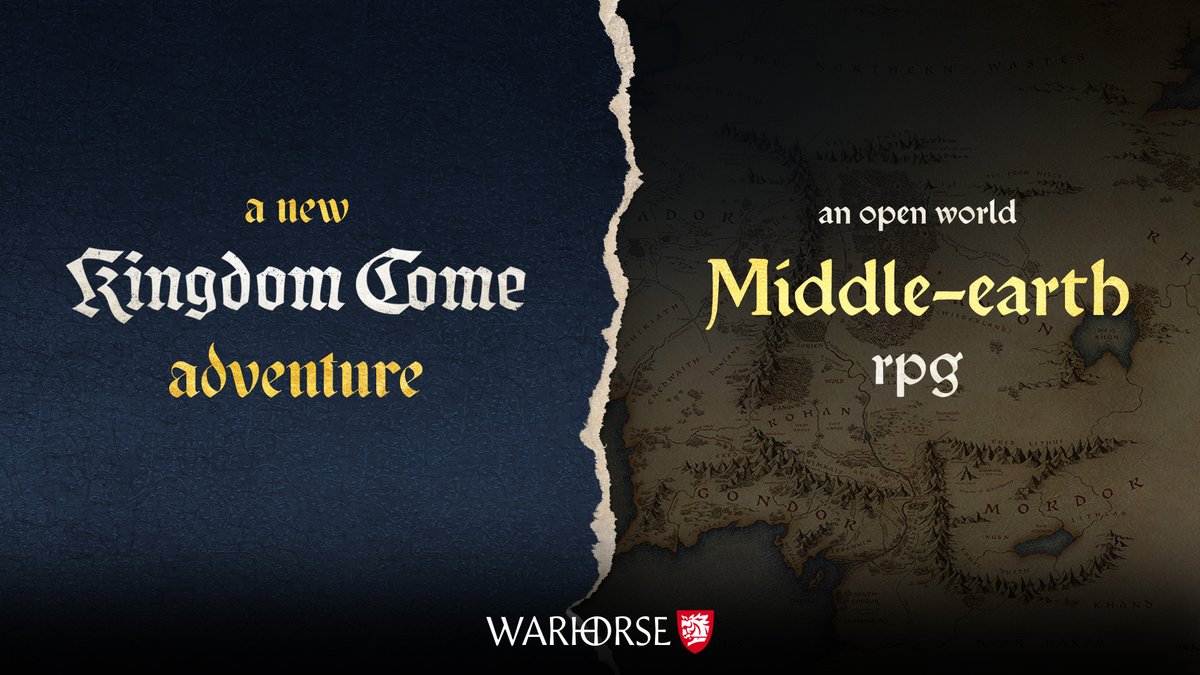
Recently, Warhorse Studios announced they are working on a new Kingdom Come game and an as-yet unannounced open-world RPG set in Middle-Earth. I’m excited about the possibilities, but this kickstarted a bunch of thoughts and emotions in me that I needed to write out. Tolkien is near and dear to my heart. I was first introduced to Middle-Earth through Peter Jackson’s movies, but I read the books soon after, and that’s when my interest in Lord of the Rings became something approaching obsession.
Jackson’s movies are relatively strong as adaptations go, but they are by no means perfect. Fellowship is by far the best, with a good but simplistic view of Middle-Earth. Still, it had unnecessary drama so as to create artificial character arcs. Future installments exacerbated these mistakes. There’s a lot that could be said about the movies, but that’s out of scope. Point is, it was well done, and it’s a massive understatement to say it defined the visual vocabulary of Middle-Earth. Even outside of Warner’s dominion, many of the new products around then were of a similar vision to Peter Jackson’s trilogy. Thankfully, for better or worse, creatives are beginning to diverge more from exact recreation.
Return to Moria shows Moria like we’ve never seen it before. It has a pretty strong adherence to canon, but isn’t afraid to interpret or add onto it, as we can see in the Elvish-inspired district in the mines. Rings of Power certainly owes plenty to Peter Jackson, but it still seeks to make its own mark, particularly in Numenor where it truly shines. The Shadow of Mordor series kept in line aesthetically with Peter Jackson (for obvious reasons considering the devs), but it was tonally at odds with what came before. Gorey and violent, it feels more like Peter Jackson’s horror movies than his fantasy hit. It plays fast and loose with the rules and lore, but it was fun, so it passed the rule of cool for many people. Tales of the Shire is Middle-Earth at its most pastoral and mundane. Even Gollum, the most infamously bad game of this decade, had truly original designs (and I don’t mean that entirely in a backhanded way! It’s the first depiction of Gandalf to remember his hat is blue!)
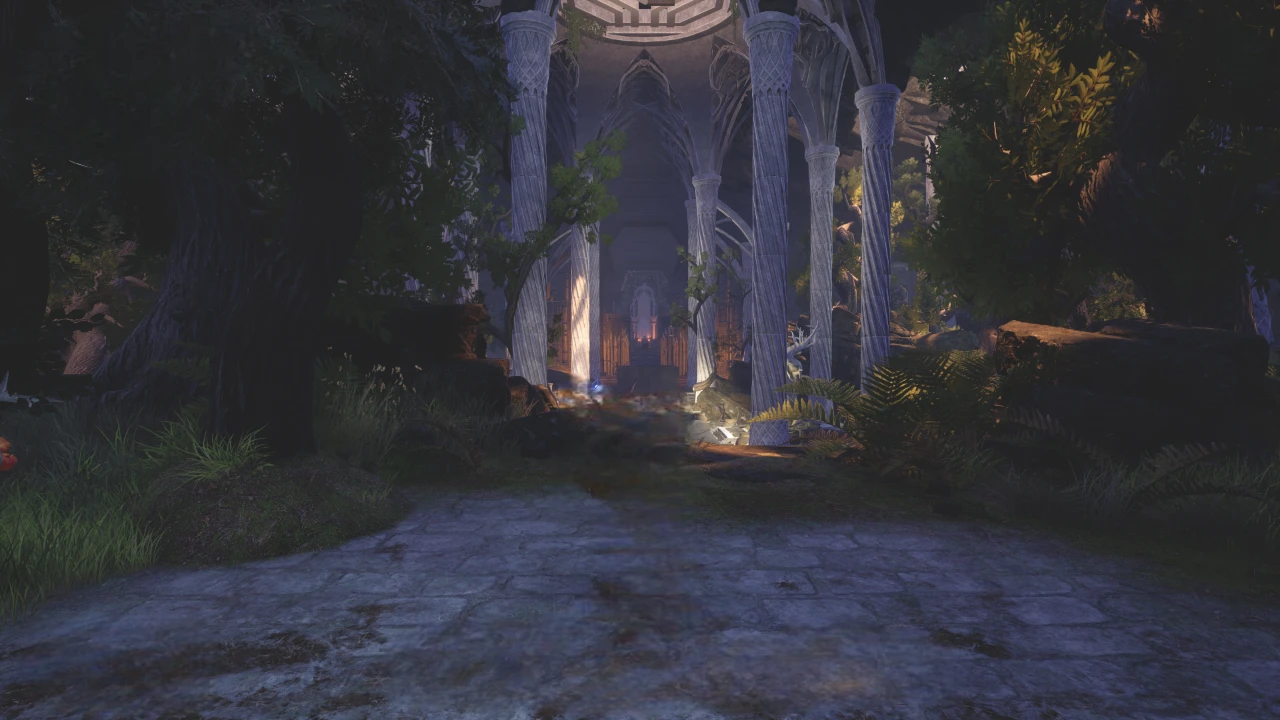
Lord of the Rings is everywhere these days. Video games, board games, trick-taking card games, shows, new movies…It’s even in Pope Leo’s first encyclical. As far as video games go, they have felt like fantasy. But do they feel like Lord of the Rings? Some have gotten close! (Lord of the Rings Online could maybe even undermine my argument, if I had played it.) But no – no one has captured the heart of Middle-Earth quite yet. Before you dismiss me as some disgruntled book purist, hear me out, because I do not think capturing Middle-Earth is impossible! But it has some difficult obstacles to surmount.
Let’s start with some definitions: what is Middle-Earth actually? I could start with defining it historically in medieval literature, as the place between the high heavens and Sheol below. (You might be surprised to realize the etymological connection to the Norse Midgard, which also acted as a border between the profane and the divine!) In light of the Silmarillion we could glean some notes with this interpretation: that it is a place of enchantment but entropy, removed from Aman and from its source of grace, fading just as the elves are. I could try to define it by capturing Middle-Earth’s tone: it is a place of high beauty and enduring hope, but simultaneously a place of austerity, humor and simplicity. I could stick to the bare scientific facts and state it is the world J.R.R. Tolkien created to house his fantastical creations, linguistic and otherwise. That is the most accurate so far, yet it tells us the least.
Middle-Earth contains multitudes: It’s such a broad world, fully drawn up in the mind of Tolkien. To paraphrase Tolkien (see On Fairy-Stories for more), fantasy is a sub-creation. On this earth, none of us can create ex nihilo. But God can, and He made us: more than that, God made us in His image. What does that mean? Primarily, that God is a maker. So if we’re made in the image of a maker, we also desire to make. Many things are sub-creations: paintings, wood workings, sculptures…but to Tolkien, the purest form of sub-creation is using the image-making faculty of our minds: our imagination. To use words to rouse another to produce an image in their own minds is the highest form of sub-creation, for in it the only rule that can’t be broken is one of non-contradiction. If your sub-created world is inconsistent, your illusion will fail to work on others. That is fantasy: the enchantment of others’ minds. And Middle-Earth is Tolkien’s fantasy.
“If [fairy stories] awakened desire, satisfying it while often whetting it unbearably, they succeeded.”
-On Fairy Stories
Tolkien spent almost his entire lifetime refining and rejiggering the world of Middle-Earth. Most of it would never matter to the reader of the tale if it weren’t called into question, but that attention to detail can be felt even when it can’t be seen. Knowing Tolkien had to rework entire narrative sections of Lord of the Rings so that the Lunar cycle would line up between storylines would not matter to many. But that consistency adds to the reality of this world. The more drawn up it is, the more real it feels.
That scope is the first obstacle preventing many from capturing its spirit: it encompasses such a wide breadth that it is difficult to capture – either you focus on one aspect you consider key and lose the rest, or you try to handle it all and risk tonally confusing the audience. If your game’s setting is in one locale, you can get away with just focusing on a few tones. But in an open-world RPG, that second path is what ought to be attempted, though it requires a masterful guiding hand to truly work. So most go for the first approach. Peter Jackson wanted high fantasy, but he also wanted a return on his box office. The end result is the movies contain more action and less slow-paced whimsy. He got the closest to showing Middle-Earth (with a huge assist from Howard Shore), and we certainly got a few authentic glimpses, but it is not a perfect translation. In fact, it could never be perfectly translated.
Why? Partly because it is in the nature of adaptations to change. In order to adapt something, it has to be translated from one medium to another. When literature is translated to any type of pictorial expression, you have to interpret how you think your subject looks. Tolkien continues the argument by saying adaptations are a lesser form of subcreation, because by necessity they limit the imagination to one single representation.
However good in themselves, illustrations do little good to fairy-stories. The radical distinction between all art (including drama) that offers a visible presentation and true literature is that it imposes one visible form. Literature works from mind to mind and is thus more progenitive. It is at once more universal and more poignantly particular. If it speaks of bread or wine or stone or tree, it appeals to the whole of these things, to their ideas; yet each hearer will give to them a peculiar personal embodiment in his imagination. Should the story say “he ate bread,” the dramatic producer or painter can only show ”a piece of bread” according to his taste or fancy, but the hearer of the story will think of bread in general and picture it in some form of his own. If a story says “he climbed a hill and saw a river in the valley below,” the illustrator may catch, or nearly catch, his own vision of such a scene; but every hearer of the words will have his own picture, and it will be made out of all the hills and rivers and dales he has ever seen, but especially out of The Hill, The River, The Valley which were for him the first embodiment of the word.
That’s the second challenge in capturing the spirit of Middle-Earth: adaptations have to make changes in order to be properly translated. Take for example the combat scenes in a book. They have to paint in broader strokes – no book is going to describe a fight so exactly that a choreographer can perfectly replicate it. The book’s sweeping description actually is a boon for the choreographer, because he can take the bones of a fight and flesh it out into something visual for us to enjoy. And there still is the freedom for others to come along and interpret it differently, once again thanks to a picture just being sketched out! But as Tolkien pointed out, putting down your vision will mean contradicting another’s vision. Interpretation is key in an adaptation. There’s no getting around it. But there’s also no getting around people getting mad about it.
Many fans think the images in their mind are authoritative. And while certainly some are more authentic than what ends up being depicted in mass media, many do forget that interpretation of a text allows for a wide variety of results. Adaptation is not re-creation. Still, because we initially create these images in our minds, we get a sense of ownership over its depiction. When that is contradicted, a fan can easily get their hackles up. (Only rarely is that reaction warranted, but in this age of rage-baiting influencers it is commonplace. Still, toxic fandom is a topic for a later article.) And so the adapter does have to be concerned with having some audience; artists naturally desire for their art to be appreciated. You can’t please everyone all the time, so you have to choose what it is you’re aiming to capture, and what you’ll have to give up.
Shadow of Mordor attempted to capture the action of Middle-Earth, yet it ignores how Faramir does “not love the bright sword for its sharpness..” he “love[s] only that which they defend.” (Two Towers). Gollum (and I’ll wager the same will be said of The Hunt for Gollum) tries to do too much with too little source material. Tales of the Shire does a good job capturing the lower fantasy of Middle-Earth, being set where it is, but has little of the mystery, adventure, and high fantasy of the rest of the world.
These issues aren’t to say these games are bad; the ones that are are bad for other reasons mostly. When the setting is localized to somewhere smaller, you can scope down the tone appropriately. But in an open-world game, the world-building has to matter, which is why I write this message in an online bottle for Warhorse Studios.
So, what can be done? Middle-Earth’s size resists attempts to capture it. Adaptations have to make changes in order to fully translate a story, but the fan’s imaginations prove to be stiff competition. And scope in an adaptation often demands that we choose only one aspect of the original story. If its eluded capture so far, should we even bother trying to portray Middle-Earth? Or is every project doomed to failure? Well, while the above argumentation stands in a certain sense, Tolkien actually wanted others to contribute to his mythos.
I know his letters indicate frustrations with those who wanted to adapt LOTR, and Christopher Tolkien was famously bothered by the LOTR films. Firstly, while Tolkien argued above that pictorial arts are a lesser artform, he didn’t say they were bad in and of themselves. He drew multiple illustrations for his own books, after all! And secondly, Tolkien wanted “other minds and hands” to fill in the gaps of Middle-Earth, for others to flesh out the characters.
Do not laugh! But once upon a time (my crest has long since fallen) I had a mind to make a body of more or less connected legend, ranging from the large and cosmogonic, to the level of romantic fairy-story – the larger founded on the lesser in contact with the earth, the lesser drawing splendour from the vast backcloths …. I would draw some of the great tales in fullness, and leave many only placed in the scheme, and sketched. The cycles should be linked to a majestic whole, and yet leave scope for other minds and hands, wielding paint and music and drama. Absurd….
-Tolkien, Letter to Milton Waldman
Tolkien might have thought it absurd in the end, but I can see his dream and understand it. If he knew the extent that his stories would reach, I’m sure he’d reconsider. So, for those brave enough to adapt Middle-Earth; what do I think is the key, the crutch to making it Middle-Earth? Two things: bittersweetness, and hope. That bittersweetness is a fallen joy, a joy “piercing like swords”. It is the poignancy of being wounded by how beautiful and how broken the world is, yet seeing the hope of its restoration confirmed in reality by the King’s coming. It’s a joy that demands something of you, and the sacrifice truly pains you. But hope endures, and finds its fulfilment, even if the road to it is long and full of peril. That duality of bittersweetness and hope is the distillation of eucatastrophe in our fallen Eden.
As an example: when you read Lord of the Rings, it starts and ends in the Shire, there and back again. But everything has changed. Frodo has saved the Shire, but not for himself. He can no longer enjoy the pleasures of that idyllic countryside, even once it’s reflowered. His heart has grown beyond it, and so he leaves the Shire behind to go west. There are some things you can’t come back from in this life. But there is hope beyond this world for his healing.
So to Warhorse, and every other future studio, movie director or show runner: keep trying to adapt and expand the canvas of Lord of the Rings, but remember in the stories you tell that there is always hope in this broken world. And it’s worth fighting for.
The world is indeed full of peril, and in it there are many dark places, but still there is much that is fair, and though in all lands love is now mingled with grief, it grows perhaps the greater.
-Lord of the Rings, pg. 390