Happy Cirno Day! As you may already know, Cirno is one of my favorite characters of all time. I love to make art of her, listen to “Beloved Tomboyish Girl”, and have permanently seared her into the minds of my fellow writers GaiusRequium, PeaceRibbion, and KKarios with how much I bring her up in our shared Discord servers. So when I learned that she had an official game, Great Fairy Wars, I just had to check it out!
Story
The stakes of Great Fairy Wars are much lower than the dramatic plots of the mainline entries, no angry girl gone nuclear or alien invasion here! Instead this is a simple story of Cirno’s quest to get revenge on the people who destroyed her home. This leads her to the perpetrators, the Three Fairies of Light, who she duels with until they learn their lesson for their unprovoked aggression. So, despite not being the biggest fan of humor, the reason I enjoyed the parodic nature of this story was because it went about it in a different way then works like Marvel movies do, instead of featuring the protagonists of the series Reimu and Marisa, it focused on a set of unimportant characters, which is important because I believe humor can permanently alter the image of a story in the public conscious, again look at how much Marvel humiliated Thor in Avengers: Endgame to make some cheap jokes. So I really appreciate ZUN making Cirno’s conflict with her new frenemies a small part of Gensoyko’s catalog of stories. Speaking of those new characters, I thought they were fun additions to the Touhou cast and found their interactions with Cirno hilarious. It was a foolish endeavor to try and reason with someone whose ego and (lack of) intelligence are unmatched. It’s hard to pick a favorite from the trio, but Luna being the one friend of the group who is unwillingly dragged into the shenanigans that the others start is quite funny.
However you should be aware that the game does not naturally have an English translation, you’d have to download a English patch from the fan site, Touhou Patch Center, which series creator ZUN is aware of and is even collaborating with to give his Touhou 6 remake a built in English translation.
Gameplay
Great Fairy Wars at its core, is a Touhou shoot ’em up, which are known for their challenging gameplay that comes from facing opponents that barrage the player with millions of bullets arranged in beautiful patterns. What separates GFW from other Touhou titles is how its protagonist Cirno is integrated into the gameplay. Cirno power in universe is the ability to freeze objects, and this extends to the gameplay of GFW as you can use this to freeze incoming bullets. Bullets that are frozen can cause a chain reaction if other bullets are nearby as they will be frozen as well up to a certain point. This opens up never before seen defensive options as the player can do more than dodge or use a bomb. Freezing bullets is super fun as the player can freeze large chunks of the screen at once with proper timing and positioning. Combine this with some really satisfying sound design and visual effects and you’re in for some big dopamine hits.
This might sound like it makes the game too easy right? However, the game balances freezing in a variety of ways such as it being on a recharge, the farther the ability is away from full charge, the less powerful it is. And to stop players from playing passively, freezing recharges significantly faster with aggressive plays such as shooting at enemies and dodging bullets. Finally not every bullet can be frozen, with fire balls not being affected and bullets made of sunlight even shattering frozen bullets and sending out sparks that can damage the player. However the sunlight bullets might be a little too good at their job of throwing the player off as I found they could cause visual clutter with how dramatic their ice shattering is, making other bullets harder to see. The bullet patterns are also denser and more frequent than in other titles, which requires the player to still be good enough at dodging when their freeze isn’t available.
Finally, broader gameplay changes include Cirno’s bomb freezing all the bullets on screen, including fireballs, instead of just clearing them. While that might not sound functionally different from a standard bomb, this leads us into our next mechanic which is the freeze gauge. The freeze gauge records how well you have been using your freeze and rewards you by gradually making Cirno’s standard attack stronger and progress towards extra lives and bombs. However like with the ice shattering, I felt the notification that you gained power to be too distracting with how big the text is and how long it stays on screen, I want to like it for how visually appealing it is, but in a bullet hell, you are always milliseconds away from dying and need as much visual clarity as you can get. Lastly the game is only three stages long compared to the usual six stages of other Touhou games, this quicker pacing is what gets me to play it more often then mainline entries, as you enter intense combat much quicker.
Art
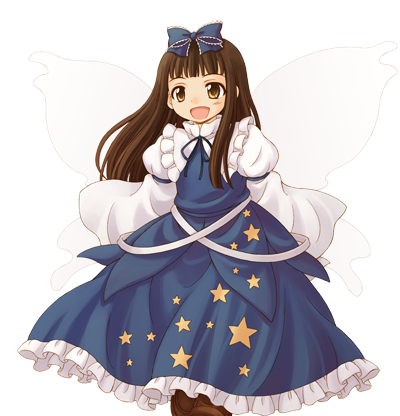
ZUN usually creates every aspect of his games from their code, art, and music; but in a rare exception, guest artist Makoto Hirasaka does the art in this game. This is because the Three Fairies of Light originated in a spin-off manga that Makoto does the art for, so ZUN thought it natural that he do it in GFW as well. Makoto’s artstyle is enjoyable for how unique it is compared to your run-of-the-mill anime art, which can be seen in the almost doll-like appearance of the Three Fairies of Light with their chunky limbs, expressive faces, and puffy dresses. Because of those dresses, GFW’s art might be the most modest I have ever seen in a game with how the girls are covered from head to toe, only showing slightly more skin when their dresses are damaged in battles. Makoto’s art is also very highly detailed with cresses in dresses, flowing hair, and expressive posing which is in contrast to ZUN’s art which aims for a much simpler style that focuses more on abstraction, colors, and texturing. ZUN does a good job integrating Makoto’s art into the gameplay by giving each fairy beautiful bullet patterns and even some really cool team attacks. He also created stunning in-game environments for Cirno and her new found foes to fight in such as a dense forest and a sunset lake, each giving off a very peaceful feeling. Overall the art does a really good job at immersing you into the whimsical nature of the game, my only complaints being the visual effects of certain gameplay elements being too distracting as mentioned earlier.
Music
The music is tonally different from other entries of the series due to its focus on characters who are eternally youthful, which leads its soundtrack to focus on recreating the childhood experience through instruments such as the flute and piano. The title screen and stage themes capture that feeling of adventure that always followed us wherever we went as kids, whether it was the playground or flower field, it felt no different from the fairy tales we read. The battle theme that plays when fighting the Three Fairies of Light is very playful and brought me back to when me and my friends would fight each other with our toy lightsabers and shoot each other with nerf guns, we truly believed we were engaging in epic battles with each other. In conclusion, ZUN once again adds another fantastic addition to his catalog of over thirty years of great music.
Spiritual Reflection
ZUN has often stated that the world of Touhou is one with beauty at its center. This emphasis on beauty has led to years of gorgeous bullet patterns, iconic character designs, and unforgettable music. ZUN’s chasing of beauty is commendable, as beauty is an important subject to ponder as it raises the viewer’s minds from the trouble of their daily lives to a higher reality as anything beautiful is ultimately a reflection of God. We see this sentiment in the words of Pope Francis, who once said “The world needs beauty more than ever… Beauty can awaken a thirst for God”. Seeing how good things can be when they are properly ordered should inspire us to reach Heaven where everything is as it should be.
Conclusion
Great Fairy Wars was a really enjoyable experience with its fun twist on the series’ usual shoot ’em up gameplay, unique artstyle, and upbeat music. I commend ZUN for creating a game where every aspect was built with its main character in mind, leading to a really immersive experience. However due to how much it deviates from standard gameplay, I could only recommend GFW to someone who is already familiar with the series’ shoot ‘em up titles, as it may be too challenging for newcomers.
Scoring: 90%
Story 5/5
Gameplay 4/5
Art 4/5
Music 5/5
Morality/Parental Warnings
Modesty: The girls are very modestly dressed, however after a battle their dresses become slightly damaged revealing a small amount of skin, however no heavily concerning areas of the body are shown, the worst being a shoulder.
Magic/Religion: The world of Touhou is heavily inspired by Japan’s history and mythology which means an abundance of magic, characters being referred to as demons, and various theological, cosmological, and philosophical positions arrived at from drawing from Shinto and other schools of eastern thought. Though, you won’t really see much of that in this game, because of fairies being from western mythology. What is present is magic circles appearing around characters when they use their attacks and the extra boss being a witch.
Wrath: As this is a shoot ’em up, be prepared to lose a lot, make sure to take breaks to prevent getting too angry at losing!
Temperance: The game gets intense pretty quickly, not in a brain rot way, but still enough where you may feel a dopamine crash if you play for too long.