
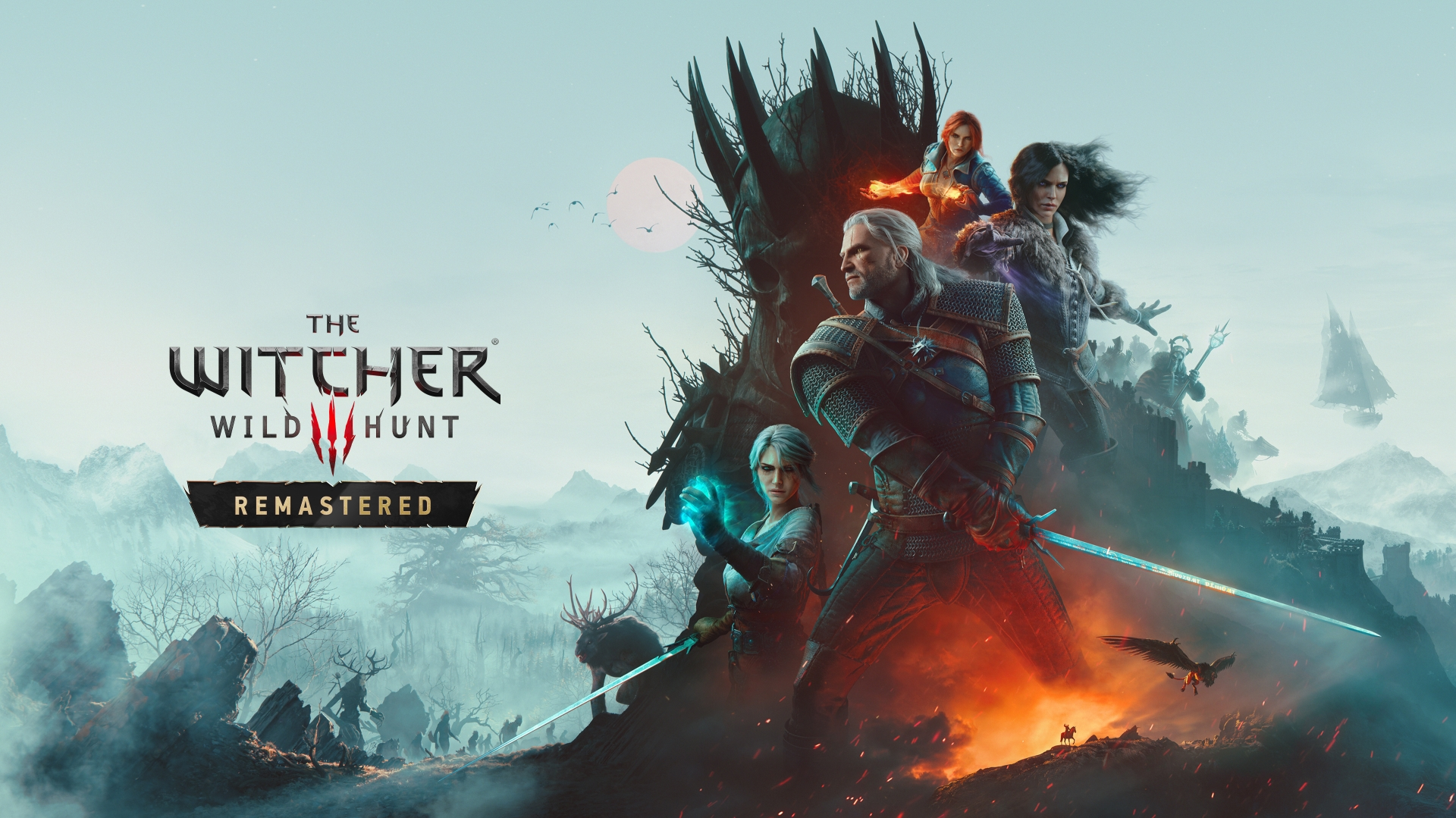
The Witcher 3: The Wild Hunt almost needs no introduction. It is one of the most lauded and decorated games of the last decade. But it has been a decade since it came out, and what was once fresh and new has been improved upon in other titles since. So imagine everyone’s surprise when CD Projekt Red announced that Witcher 3 was getting a free graphical and mechanical update for all owners of the game – and not only that, even if you never had the DLC before, you now automatically are given expansions Hearts of Stone and Blood and Wine! And what’s more, they even announced a new expansion coming out in 2027! This might be the longest any game has gone between expansions. For the purposes of this review, I played Witcher 3 in full on my PC 7 years ago, and dabbled briefly on the Switch. I am currently replaying it on my Switch 2; I’ve put in about 30 hours before the upgrade was released, and enough time post-remaster to analyze what’s new.
Witcher 3 takes place in a fantasy setting simply known as The Continent. Due to a cosmological aligning that takes place every few centuries, Elves, dwarves and monsters poured in from another dimension. The more rational (and less alien) species assimilated, though are still subject to heavy discrimination. As for monsters, well that’s what Witchers are for. Witchers are warriors mutated by magical concoctions and trained since youth to be (if I’m being reductive) magical pest control. They’re content experts in the study of monsters and how to eliminate them, and while not as strong in magic as mages, they get by with incantations called Signs. Of course, they can’t do this for free, so Witchers roam the Continent looking for trouble and then start negotiating their rate. You play as Geralt, an experienced Witcher that’s been involved in some hefty geopolitical stakes in his time despite not ever wanting to. Your task for the first few acts of the game is to find your foster-daughter, Ciri, before mysterious invaders known as the Wild Hunt do.
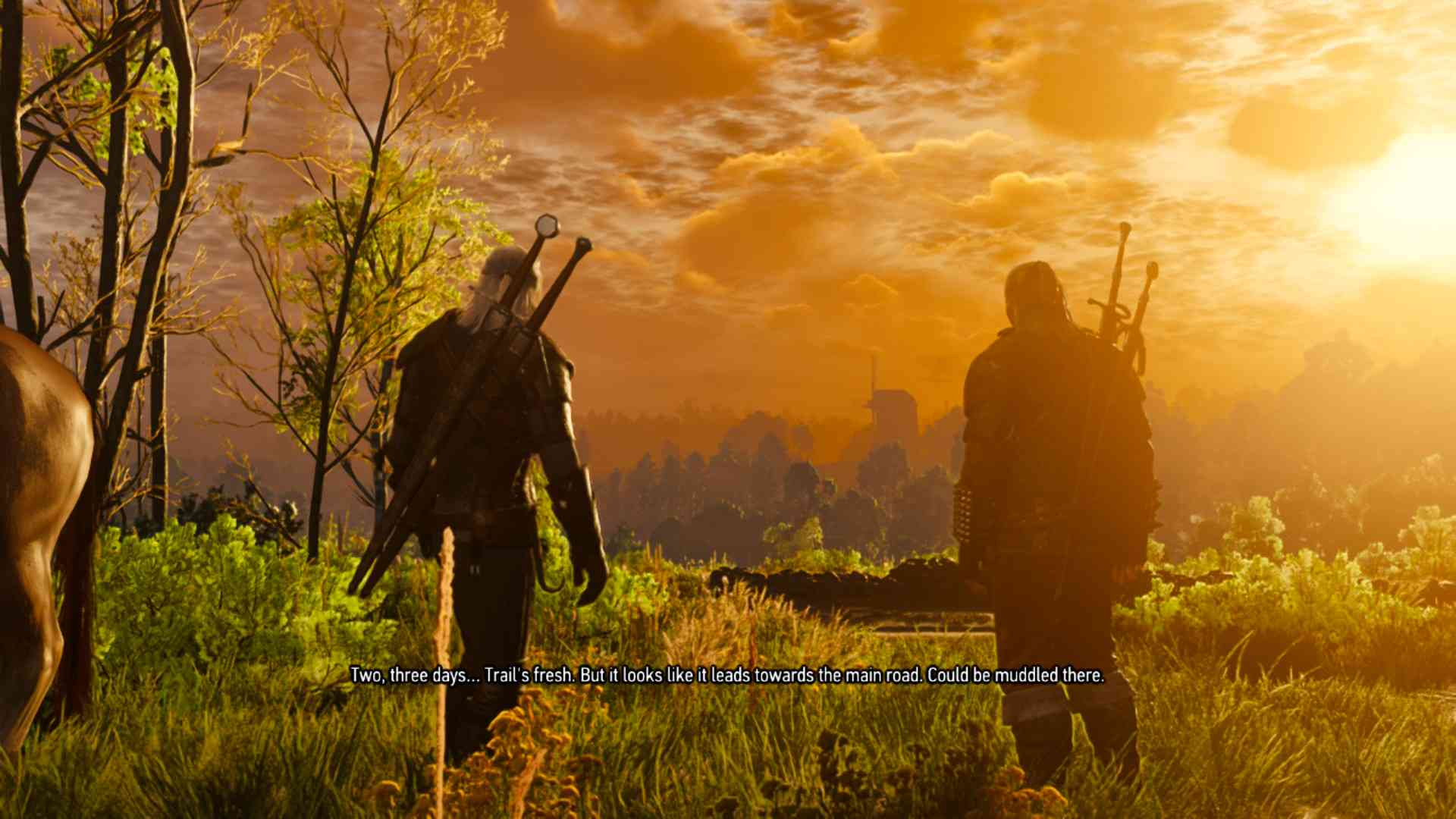
That’s enough for us to go on for the rest of the review. Despite never playing Witcher 1 or 2, or reading the books (at first), I was able to pick up on the game rather easily in my first playthrough. They keep it accessible by saying what’s necessary and not bogging you down with the details. Most of the world-building for the game has thankfully been relegated to the glossary. It’s a fatal mistake to introduce too much lore too fast. Leaving the rest of the lore in the glossary for those who want to pursue it works best. If the world-building is compelling enough (which it is), people will have their appetite whetted by the events of the game and will seek out deeper lore themselves.
Due to the mercenary nature of their profession, Witchers have an ill repute despite the need for them. It’s a tough life; it’s no wonder all Witchers are hardened. Generally I’m not one for gruff protagonists. The idea that seeming uncaring is cool just rubs me the wrong way. It’s not that I want touchy-feely protagonists everywhere, but would it kill writers to have flawed people with some emotional maturity? Thankfully, while Geralt makes a brusque first impression, after spending enough time with him the façade drops, and you see he is a caring hero. The cast that surrounds him are all well fleshed-out, though their likeability will vary from person to person. For example, I cannot stand Yennefer, Geralt’s fated lover. Fans told me if I read the books I’d like Yennefer over Triss. Fans were wrong! But I suppose it’s a testament to the characters that fans are so divided on this subject, and that I hate her so much. Indifference would be much more damning. [While I’m ticking off book fans, I might as well add that while the books have some interesting twists, the games have much better writing. Ultimately I think it comes down to the way the world is depicted.]
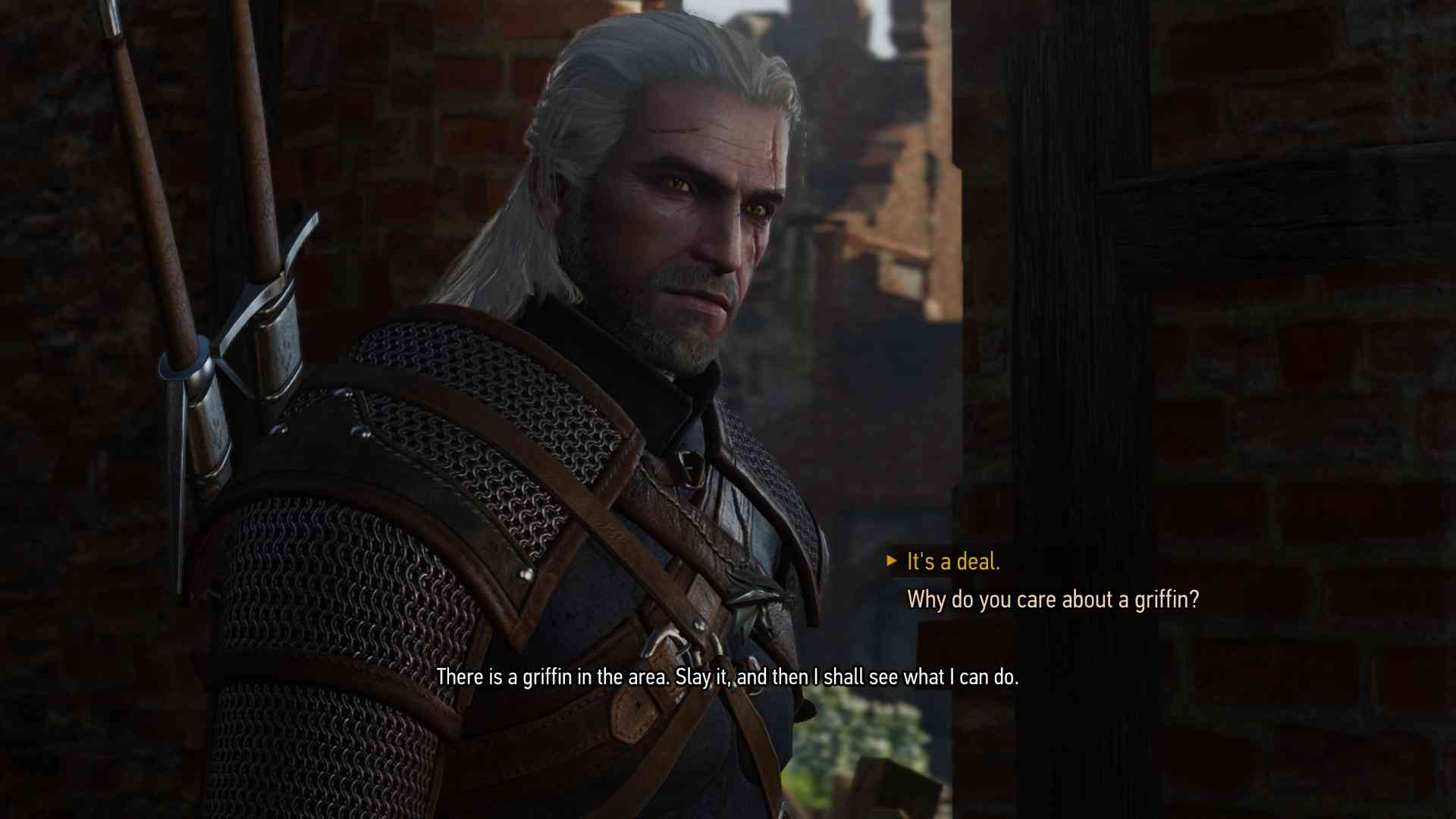
The world around Geralt can be rather jaded, and there are gruesome details galore. But deep down there is a core of hope that is tapped into when it is needed most. That touch of humanity is necessary when you’re overwhelmed by the darkness. There are certainly many moments that could have been pulled back on – the game is a sucker for using shock value to tell you this is a big important game for grown-ups. But at the very least it doesn’t fail to deliver on that, unlike other adult-oriented games that think lurid details are all that make a game “mature”. (An ironic ESRB classification, come to think of it!). Nor does it only ever show things from a dark nihilistic perspective. There is hope, cheer and song right alongside despair, sadness and evil. Overall, this game delivers narratively on every level, and is probably the strongest aspect of the entire game. It’s a fantastic story.
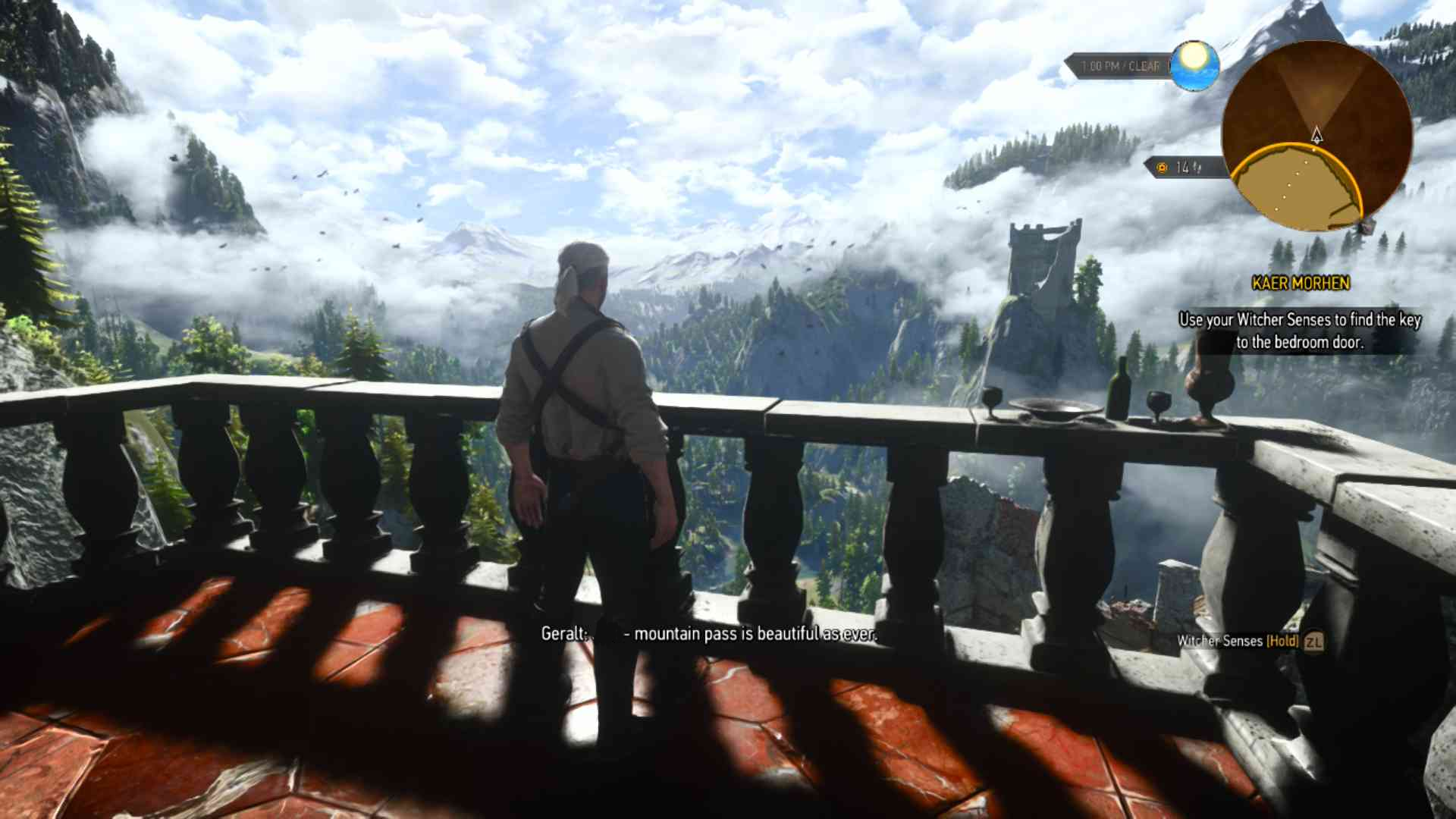
The environment itself is gorgeous, at least on PC where I first played. For a brief period I played it on Switch in 2024, but it looked much worse and still performed pretty badly. I’ve forgiven other ports to the Switch for looking worse, but I can’t look past a game that doesn’t function well. Once the Switch 2 released the upgrade in hardware was enough to make the performance much better, but the graphics still remained less clear and impressive than my first playthrough on PC in 2019. Even on the Switch 2 there was constant texture pop-in before the upgrade. After the remaster was released, I was shocked at how much better it looked. There was no more stuttering or texture pop-in. Instead, it looked phenomenal and performed flawlessly. There were still some lingering issues at release – the bloom was set exceptionally high, so that a sun covered in fog took up a quarter of my screen. HDR was finicky to finetune, and doesn’t have the best image in settings to help you adjust it to where it ought to be. And the gamma was in a similarly tough position – too high and the game was washed out, but too low and the dark sections were impossible to see. Thankfully the bloom and brightness have already been targeted in the first hotfix, and knowing ProjektRed’s responsiveness I’m sure they’ll be attentive to any other issues that pop up. I’m most pleased about the performance upgrade, but great graphics on top is always a treat.
Witcher 3 has fantastic ambient music that I find myself listening to all the time when I want to relax or focus. Its instrumentation is very evocative of medieval folk. That use of authentic instruments always gets me – it’s a surefire way of investing me in your world and transporting me back in time. The combat music can be very exhilarating, but sometimes a bit over the top, depending on how much that lady is screaming. (If I remember correctly, it’s the worst in Velen, where the early game takes place.) From there on the vocals can actually be used to great effect, but it really just depends – you get in and out of combat so much that if a song’s intro is bothersome, it will begin to grate on you. The music for the Gwent mini-game is all bangers though – perfect tavern music for a side-game that is surprisingly engrossing. Don’t write it off as overly simplistic like I first did – the complexity builds as you advance through the game.
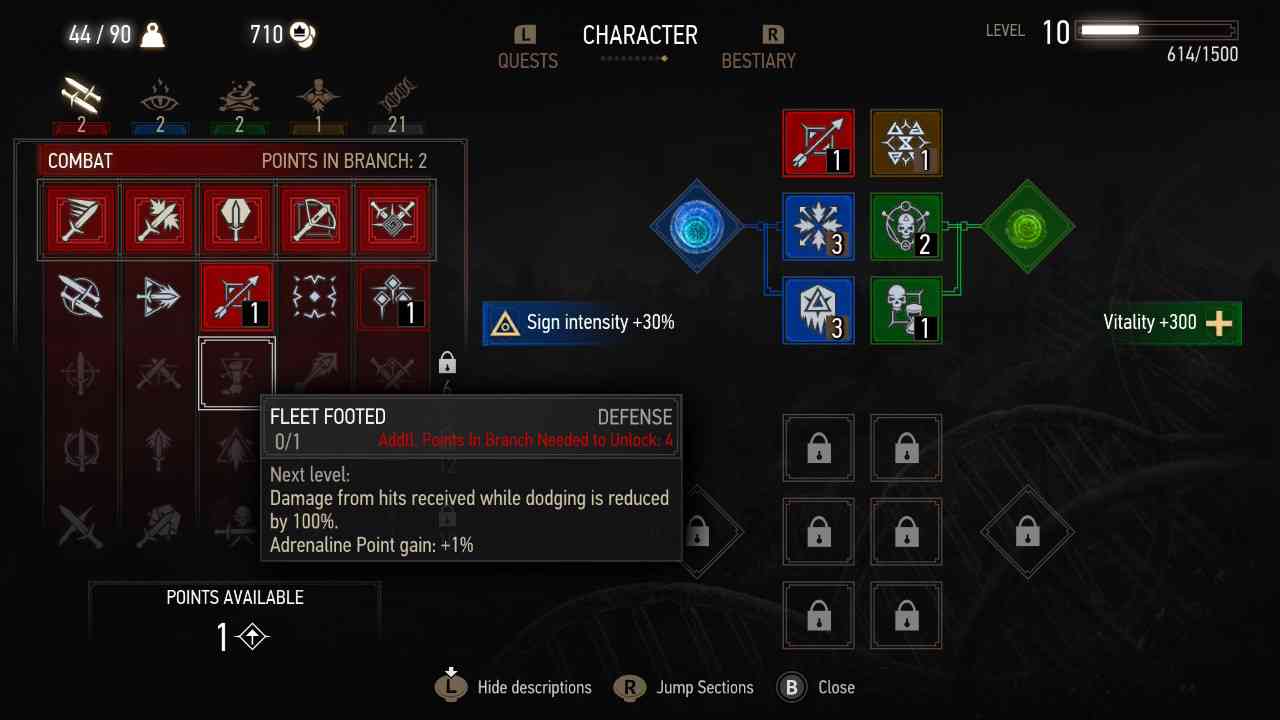
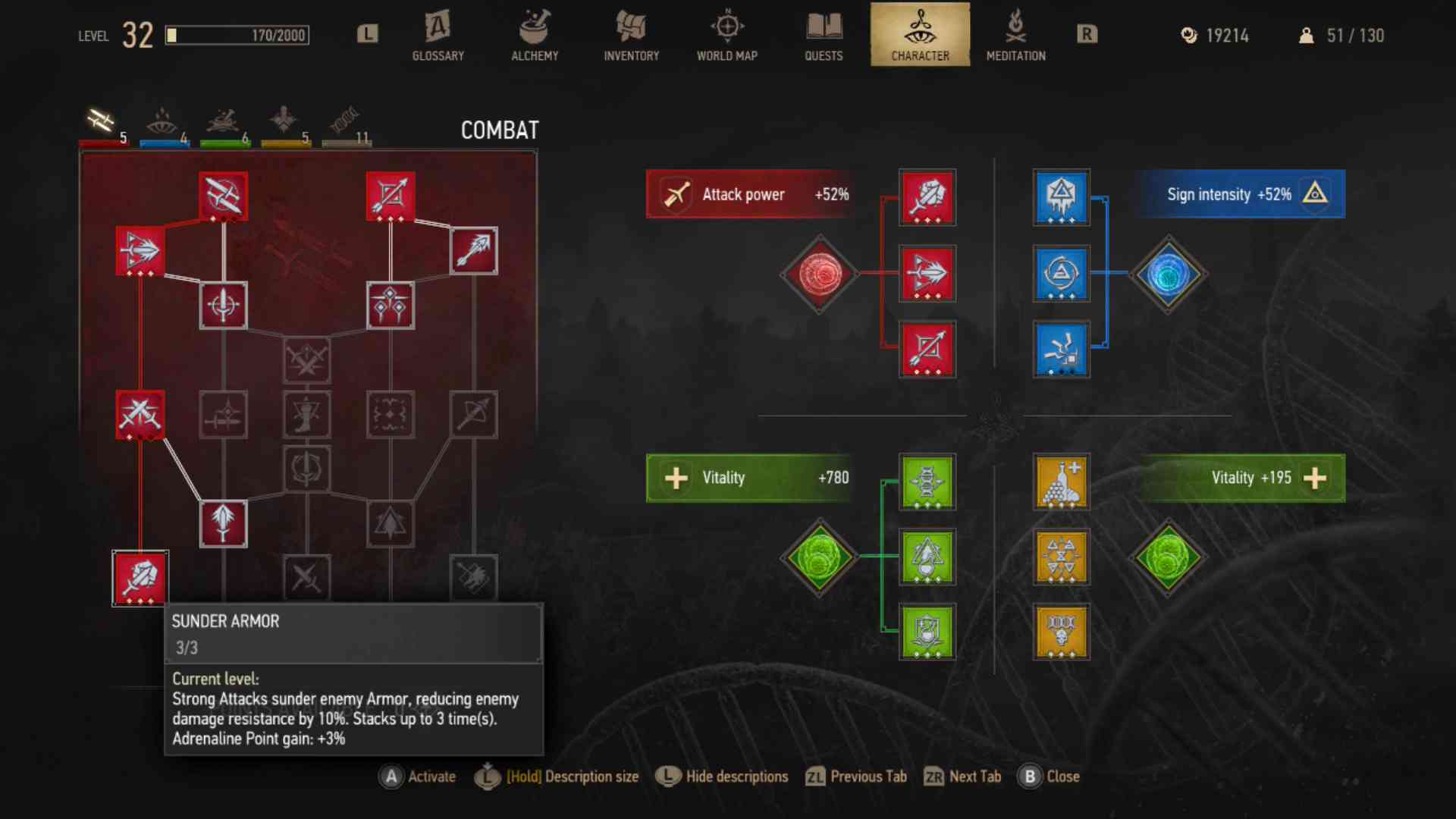
The bulk of the gameplay is fun, but it’s more enjoyable once you’ve leveled up a bit. Combat plays fine, but doesn’t feel great until you unlock more abilities in your skill tree in the old version. It’s not a song and dance design like you’d see in a FromSoft game – there are times you’ll just take hits due to the chaotic nature of combat. However, that doesn’t mean combat is entirely illogical. When you read the Bestiary for different beasts, you’ll find tips on how to handle them. The monster combat design when it comes to bigger threats is very good, but mobs of monsters are not very fun to play due to your inability to counter them like you can humans. Still, it’s not just a hack-and-slash. You have to remember what signs to use against what enemies, or some of them can’t be defeated. The remaster promised an update to the combat, and while the new camera and lock-on system are very helpful, the AI doesn’t feel noticeably different. Perhaps this changes in the late game, which I haven’t had a chance to get to at the point of this review, but honestly so far it feels exactly the same, so I have my doubts it will change. Difficulty levels make for such vastly different experiences that your mileage might vary. If you find the combat boring, kick it up a notch.
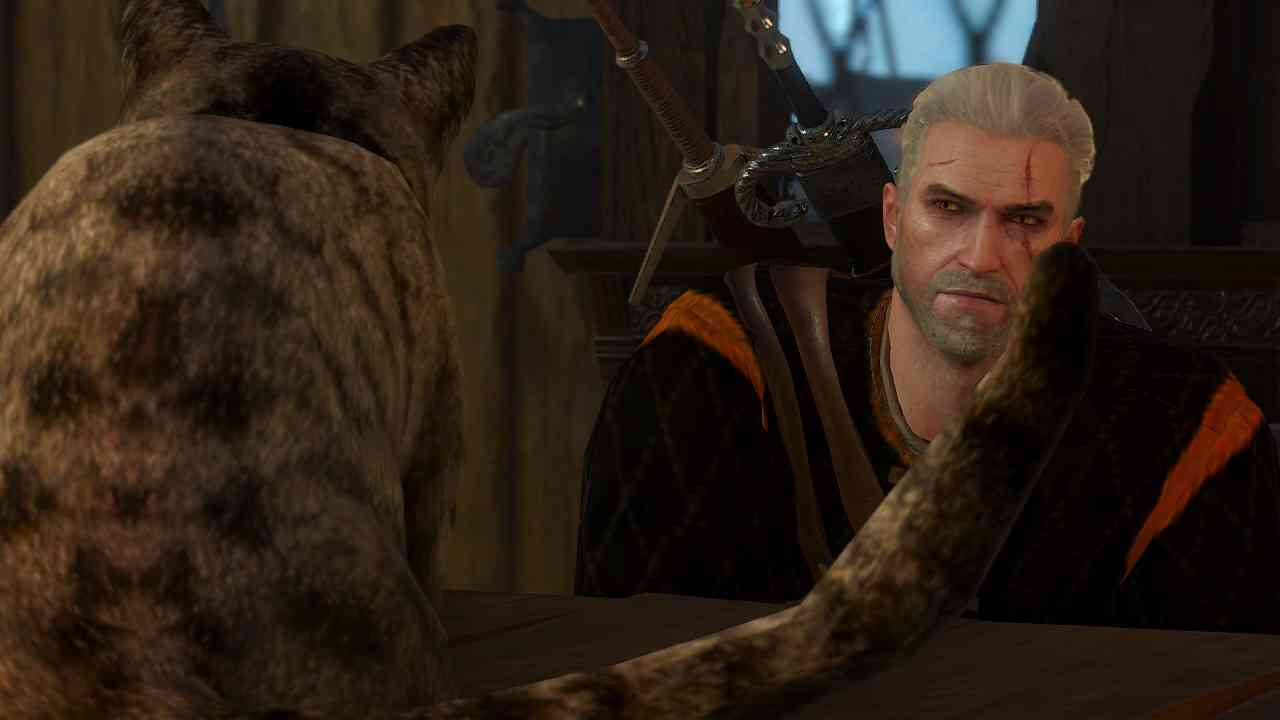
I remember in World of Warcraft where I was tasked with killing 10 wolves and that was the whole thrust of the quest. None of the quests, even the littlest of sidequests, ever felt like that in Witcher 3. It’s not that nothing is low stakes, it’s just that the writers cared as much about the small things as the big things. Every villager has some characterization and seems to be living their own lives – you’re just entering their story at a crucial point. To demonstrate: other games would be content to say “seems like a werewolf is living in the woods, go kill it.” In Witcher 3, you’re tasked by a villager to find a hunter’s missing wife. You examine clues, find tufts of fur, scratched bark on a tree, and a blood trail leading you to an abandoned shack. Geralt is approached by a neighbor and told that if he stops investigating, she’ll pay what he’s owed in full. (Which you’re free to do – this game was the pinnacle of player freedom before Baldur’s Gate 3 released.) You investigate the shack and find shackles and pure silver in the lootable compartments. You go underneath the shack to confront the werewolf, where you learn that the hunter who hired you is the one cursed by lycanthropy. Whenever the full moon approaches, he goes to that shack to keep himself restrained. A neighbor who was in love with the hunter knew his secret, and, jealous, brought the hunter’s wife so she could see him transform into a werewolf. The wife was appalled but approached him, and was killed while he was in a fugue state. The neighbor confesses all this as you’re about to kill the werewolf, and you’re free to decide whether to kill the werewolf then and there or to let the werewolf kill the jealous neighbor. If you choose the latter, the werewolf has nothing left to live for afterwards, so Geralt kills him without a fight. That could easily have been a checklist quest, but instead each moment was used to advance the story, including the environment. And this is a missable level 7 side quest with nothing to tie it to the broader story. This attention to narrative details is what Witcher 3 excels at. And the game is dense with quests and writing. It somehow pulled off quality and quantity, which is dangerous for a gamer with less and less time like myself. (If I stopped playing Gwent all the time, that’d certainly help though.)
The UI has a bit of a handholding issue. The mini-map has a compass direction, beaded trail, and distance marker all to make sure you KNOW where to go in this massive world. My first advice to you is to turn some of this off, to the level of your comfort. At the very least, turn off the trail to your objective and just keep the compass direction on. If your eye is on the map the whole time, you’ll miss out on the environment. Plus,the game is too big for you to just play it on rails. Go out and explore it!
There are some perks exclusive to the Switch 2 edition that I’m sure PC fans will be jealous of: motion controls! These are optional of course. Some fiddling with them in the settings is necessary – it assumes you always play with the joycons separated, but it doesn’t detect if you’ve snapped the controllers into a grip. Thus sometimes you’ll be moving conjoined joycons and the motion controls will think you’re trying to cast a sign or call for your horse. Turn off one of these and you can play whether your joycons are attached or separated with no issue.
While I’d be able to fine tune my settings to a granular detail if I played again on PC, I’m happy to be playing on the Switch 2 this time. Portability makes every game better. But there is one large issue that bothers me in the Switch and Switch 2 editions: because of the processing power required, you can’t take video captures of the game. It’s rather frustrating to have a system component disabled just so the game can run. I know the Switch version limped across the finish line, but I’m fairly certain the Switch 2 could have handled it. It’s a smaller trade-off for portability, but one worth mentioning for those on the fence.
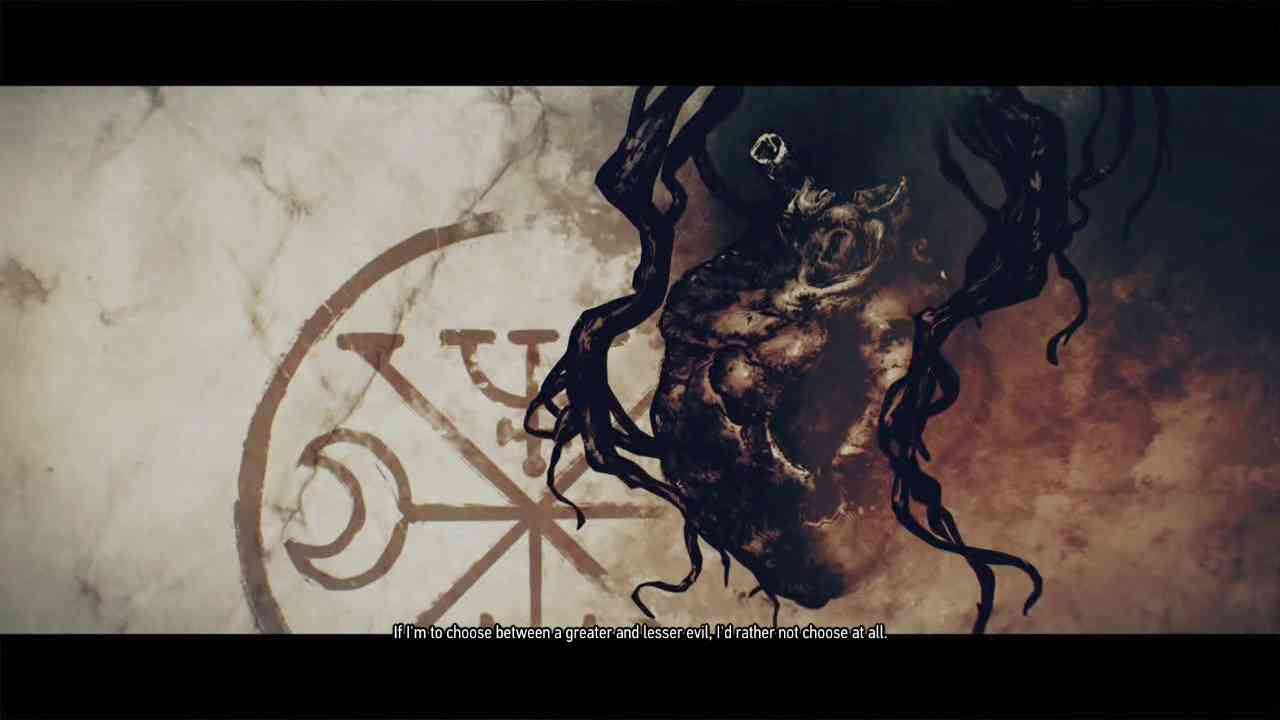
At first brush playing the game, you might wonder why a Catholic review of it would be so positive. And to be clear, there are a lot of morality warnings at the end of the article. There’s a lot going against it, but my approach usually starts with answering some questions. First, is it sinful? This question is kept in mind, but is usually unnecessary actually – if a game is actively sinful or causing me to sin in reviewing it, it’s rare for me to finish it, and it’s therefore unlikely to make it to the site. But these games are rare in actuality because for the most part, it’s obvious to almost all observers that this isn’t a game that’s safe for work; for example, all pornographic games are right out. Portions of games can still be sinful or near occasions of sin of course, but that’s where a lot of nuance comes in in reviewing. My second question, which requires much more grappling, is “is it morally or philosophically dangerous”? Not in the sense that it teaches new ideas and perspectives, but if something misrepresents or completely distorts the truth, that’s going to be a big strike against a game. While there are moral decisions in The Witcher 3 that I disagree with, the game is very interested in exploring moral quandaries where there might be no good answer to find, only lesser evils. And to Geralt’s credit, he doesn’t like lesser evils. At its core, The Witcher 3 is testing you to see what you prioritize morally. If a game passes these two smell tests, then I can usually find what’s good about it while delineating the bad in the warnings section. So even though that section is quite a doozy in this review, there is a moral core to The Witcher 3 that I think is worth discussing.
Perhaps you’d expect me to focus on spiritual warfare in a Catholic analysis of this game. There’s something to be said about equipping yourself for battle against sin similar to the way Geralt prepares to fight monsters. Heck, Geralt even technically fights devils! But I’d like to try a different tack. Earlier I mentioned Geralt’s gruffness belying an emotional maturity and sensitivity underneath. This gentleness is what I’d argue Geralt’s chief virtue is, and what I’d most like to dive into – because I think gentleness is a virtue largely missing from society today.
“Nothing is so strong as gentleness, nothing so gentle as real strength.”
St. Francis DeSales
I think the biggest misunderstanding about gentleness today is that it is a weakness, but it’s actually quite the opposite. Gentleness is the withholding of one’s strength for the protection of another. The game messages very clearly how strong Geralt is, but the narrative doesn’t really hinge on that. You’re not the strongest Witcher ever, and the fate of the world doesn’t rest on your shoulders. If we’re talking pure capability, Ciri is much stronger, and sorceresses can accomplish much more. What makes Geralt so influential is that his gentleness towards others equips them with the inner strength they need. That’s the true strength of a morally centered person – their relationship makes you a better person. And ultimately that’s what the game is about.
Yes, this is a dad game. I know there are a glut of dad games nowadays, and for some maybe that is no longer interesting. But most dad games focus on the sins of the father, and the relationship with their child is something to be won or won back. And that can make for a powerful narrative for sure, but it focuses mostly on the dad’s interior struggle. But I already know parenting is hard; I’m living it too! (Though I guess I should be thankful I don’t have the burden of being the God of War like Kratos does). Still, while these stories of reformed fathers can be important to show how to reforge parental bonds and break generational patterns, in these narratives actual normal parenting doesn’t get its chance to shine . The Witcher 3, on the other hand, actually taught me something about parenting. I hate to say it’d be a spoiler to reveal what, but it was a good realization to have. The Witcher 3 might have the best father-daughter relationship in gaming ever. Gentleness plays a big part in that. The writers understand parenthood on a deep level, and know what it means to equip your child with strength and independence while still showing them your love can always be relied on. So for all the guts and gore, all the gratuitous and disgusting content, I’m willing to give it a pass for the resounding truth and love at the center of it all.
Prepare for a doozy of a warning section! Due to the sheer amount of branching dialogues and available choices, a comprehensive warning section is not possible. However I’ve done my utmost, which will certainly be enough to indicate whether you’ll feel comfortable playing. As for parents, if you couldn’t tell by now, this game is in no way appropriate for kids.
Scoring: 90%
Gameplay: 8/10
Design: 9/10
Art: 9/10
Music: 9/10
Story & Writing: 10/10
Morality/Parental Warnings
Fantasy pagan imagery and rituals– there are druids, witches, and other depictions of black magic. Often, it is depicted with a connotation of crudeness and evil, but even though its a win to have evil depicted as evil, it’s still a rather disgusting depiction.
“Mercy” killings– There are a few moments where Geralt is asked to kill various rational creatures who want to die. The choice is usually in your hands however.
Nudity, Sex and Prostitution – boy howdy is there nudity in this game. There are plenty of times Geralt will have the opportunity to have sex, but he can also solicit prostitutes at certain taverns in game as well. While sex isn’t ever actually depicted beyond disrobing, this is hardly gently wafting curtains.
Violence & Gore– Gratuitous blood & dismemberment are present in the game. I mean some of the ways Geralt cuts through a person don’t even make logical sense! It’s like his sword ignores bones and stuff.
Disturbing Imagery– examples abound, but I’ll list off just one. A stillborn baby buried without regard comes back as a monster who, if left unchanged, will suck the blood of pregnant women. Though to its credit, to break the curse and cleanse the monster, the parent must name and embrace the child.
Alcohol & Drug Use– I don’t recall Geralt being able to use any drugs, though the fantasy drug “fisstech” is dropped by certain enemies in the game. There are quests where Geralt gets drunk, especially in the aptly named DLC, Blood & Wine.