
The Mario series is well known for its ability to reinvent the gameplay formulas that underpin itself fairly regularly, but that isn’t to say the series never takes the time to flesh out existing styles with sequels. Super Mario Galaxy 2 was one such iteration of Nintendo’s flagship franchise, released in 2010 for Nintendo Wii and recently ported to Nintendo Switch systems. This fairly infamous title has been the center of a lot of discussion over many years, with lots of opinions on how it compares to the original in light of its strengths and weaknesses. Where does it stand in this reviewer’s estimation? Let us see!
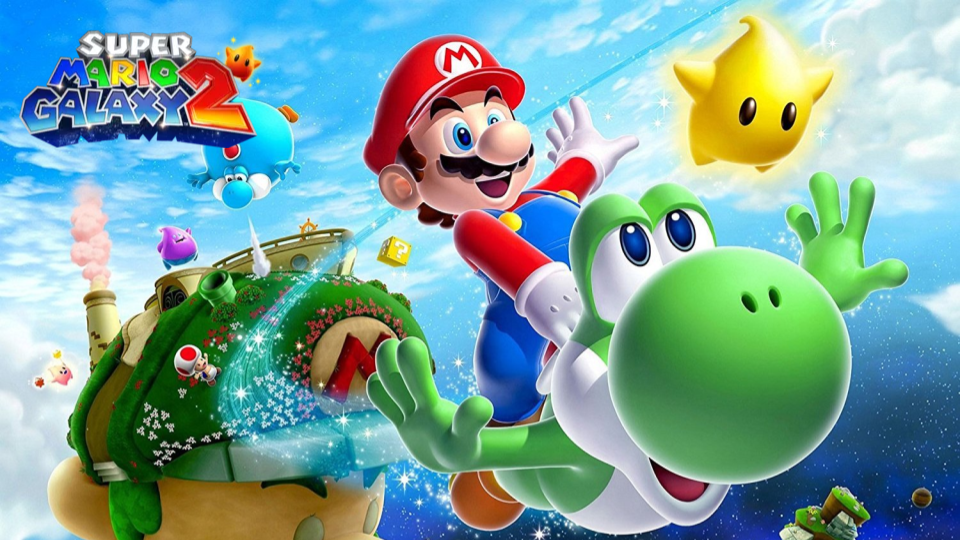
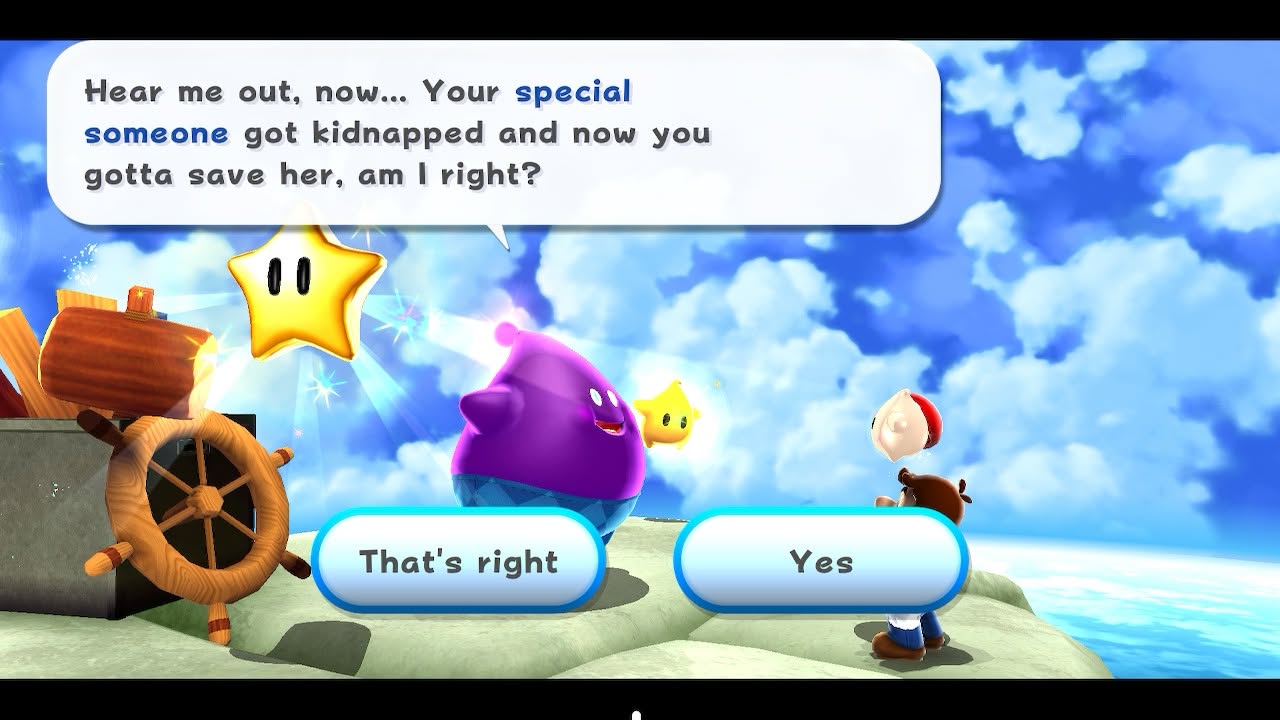
The story of Super Mario Galaxy 2 is on paper very similar to the original game. The Mushroom Kingdom is holding its 100 year comet festival, Bowser shows up to kidnap Princess Peach, and Mario traverses the galaxies of the universe alongside little star people called lumas in hopes of reuniting with his beloved and stopping whatever Bowser has planned. In practice though, just about everything about the story has been simplified and truncated to be as unobtrusive as possible. Instead of the game’s opening being this epic opera that helps ground Mario in his new environment, and introduce a unique setting that blends the series’ usual surrealism with the more somber and contemplative atmosphere of outer space, it instead reads as an incredibly straightforward Mario adventure which doesn’t prime the player for anything greater to be explored. This title very clearly does not want to impress upon the player anything more than the barest amount of narrative needed to contextualize the rest of the game. Normally I wouldn’t have a problem with this, but given the game is a sequel to Super Mario Galaxy the bar was set significantly higher such that it comes across as uniquely disappointing. If you’re just here for the gameplay then I understand seeing this as a non-issue, but those looking for something with a little more narrative or artistry in general will definitely find Super Mario Galaxy 2 a downgrade.
Gameplay in Super Mario Galaxy 2 is mostly identical in feel to the previous game. Mario’s core three-dimensional moveset is well maintained across his many similar outings, and the spin attack returns from the previous entry with no change. Most of the game’s advertised new gameplay features come in the form of new powerups and contextual actions. From Yoshi’s return offering a round of levels themed around eating special foods which provide neat effects like high-speed dash sections and balloon flight, to new forms for Mario like a Cloud Flower that creates temporary platforms, or a drill that allows him to pass through the floor, it would be dishonest to say that the game provide no new ideas or styles of play. That being said, the lack of novel mechanics that persist beyond a single powerup does ultimately make Super Mario Galaxy 2 feel more like a level pack for the original game rather than a true sequel. Ironically the one player who got legitimate upgrades is Player 2, who in addition to the full cursor functionality comes with a playable Co-Star Luma who can perform a spin attack and collect items for Mario at no risk. It is still very much something you hand to a younger player to make them feel included, but Co-Star Luma has the benefit of completely trivializing most non-boss combat scenarios and 1-UP mushroom challenges if the player knows what they are doing. Not what I would call the intended way to play the game, but an entertaining addition nonetheless.
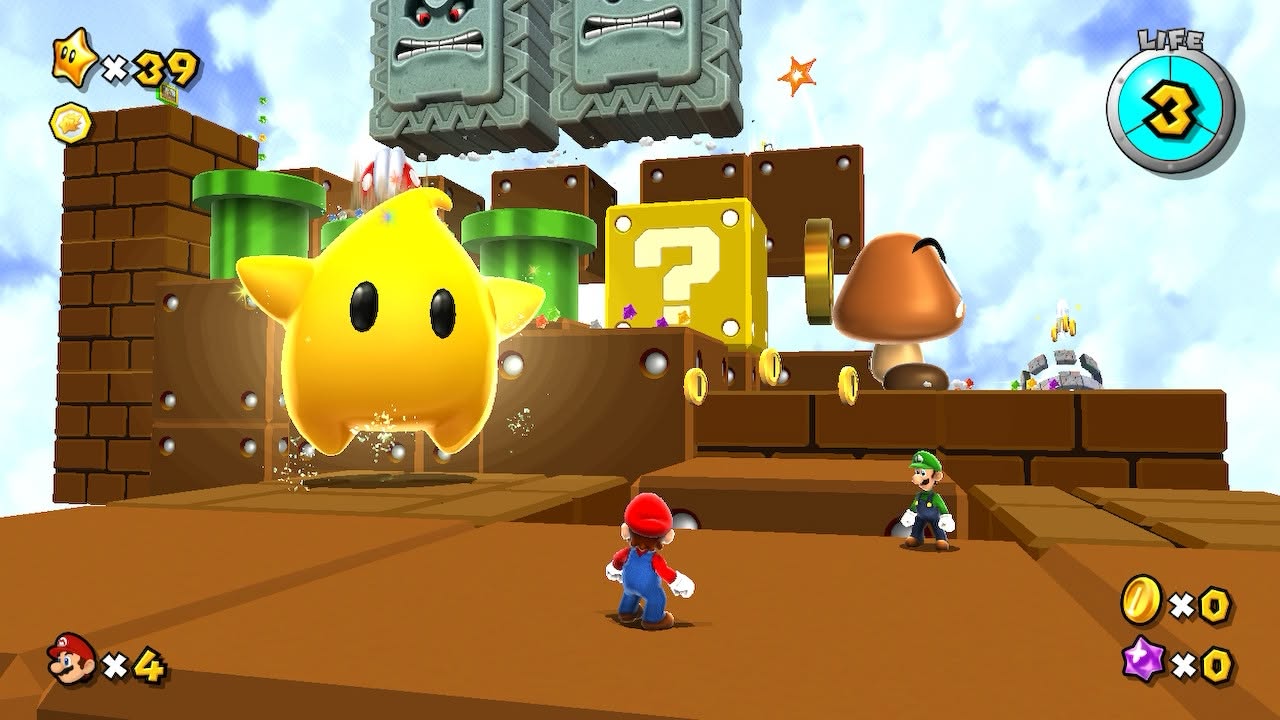
Given these circumstances, Galaxy 2 has to mainly be carried by the quality of its level design in order to be worth playing, and thankfully this is indeed the case. The level design is about on par with the original game, with the added benefit of being somewhat harder than the previous entry. Obviously there’s nothing here which would cause a younger player to not see the end of the main campaign if they work hard enough, but Nintendo was at least cognizant enough of the number 2 in the title to increase the complexity to keep returning players interested. Personally I wish the game leaned more into the original’s use of varied gravity as some of these levels start to lean into Mario 64-esque design pretty often, but this is honestly a minor complaint.
Visually speaking, Super Mario Galaxy 2 unsurprisingly follows the style of its predecessor faithfully. If you like the look of any other Mario game’s vibrant aesthetics, you’ll enjoy this one. It does lack a little bit of that spacey feel in areas that can dampen my appreciation for the visuals such as World 1’s hub skybox being in the clouds, but it’s not like the original Galaxy never used similar skyboxes in its levels. The music takes a similar orchestral direction as its predecessor has, albeit with a stronger inclusion of remixed themes from across the series. I’d have preferred more original tracks myself, but it would be ludicrous to deny that music on offer is good in its own right.
Finally for today’s spiritual reflection, Super Mario Galaxy 2 doesn’t have too much to work with on its own, but there was a new picture book added to the Switch version that we can look to for inspiration. It doesn’t contain that many chapters, and to complete the whole thing you have to complete some post-game challenge content, but the story does have a valuable lesson to share about persistence in the search for the things important to us. The story of Lu’s quest to reunite with her friend Mari may not have the emotional depth of Rosalina’s backstory, but there is a concerted effort to weave together a variety of thematic ideas like binary stars and reunification with a loved one à la Mario’s quest for Peach. In some ways I think the dogged quests of Lu and Mario have parallels to the Christian life, broadly in the call to spend one’s life following after Christ but I think more specifically in the pursuit of one’s vocation. Life here on earth hardly ever goes as we plan it, and the search for our vocation is itself fraught with uncertainty. Whether it be the priest’s struggle to answer the call to Holy Orders, the monks who (classically) have to show abounding persistence in their desire for the communal life to even start their novitiates, or a man’s challenge of seeking out one’s spouse amidst a battle against potential rejection and failure, things rarely go right on the first try for those looking to grasp their raison d’etre. In many ways this struggle continues even after the vocation itself is measurably attained! Nonetheless we can be certain amidst this trial God has a place prepared for us in this life and the next, and must continue onward no matter how long the journey takes. It took Mario 70+ levels to finally find his beloved, and we should have the courage to similarly persist in our quest to find the place God means for us to find. Please remember to pray for vocations of all kinds.
In conclusion, Super Mario Galaxy 2 is an odd game to recommend. In my humble opinion it exists purely as a level pack for the original game, featuring quality new playable content but sacrifices just about every opportunity to carve out any real identity of its own in any other category. Dare I say it is perhaps spiritually the Nintendo equivalent of a Call of Duty sequel? Regardless, if you really enjoyed the first title’s gameplay then it will provide more of what you want, and considering most people will now be buying the two-in-one Switch port of the game it’s not like I’m about to tell you to not play this half of the game collection you just bought. Just know going into it that your expectations should be managed, because you won’t find the innovation here that the Mario series otherwise excels at. Starship Mario is still worth embarking into the cosmos upon, but it definitely travels in the Comet Observatory’s shadow.
Scoring: 80%
Gameplay: 5/5
Story: 1/5
Art and Graphics: 5/5
Music: 5/5
Replayability: 4/5
Morality/Parental Warnings
Super Mario Galaxy 2 is fairly light on objectionable content, largely due to its cartoony nature. The enemy Kamek is a magic-user but it bears little resemblance to real-world magic, and most other powers the various characters wield are mostly just part of the world’s surrealism. Violence is non-graphic and enemies disappear in a puff of smoke. There are a few skeleton and ghost enemies in the game.