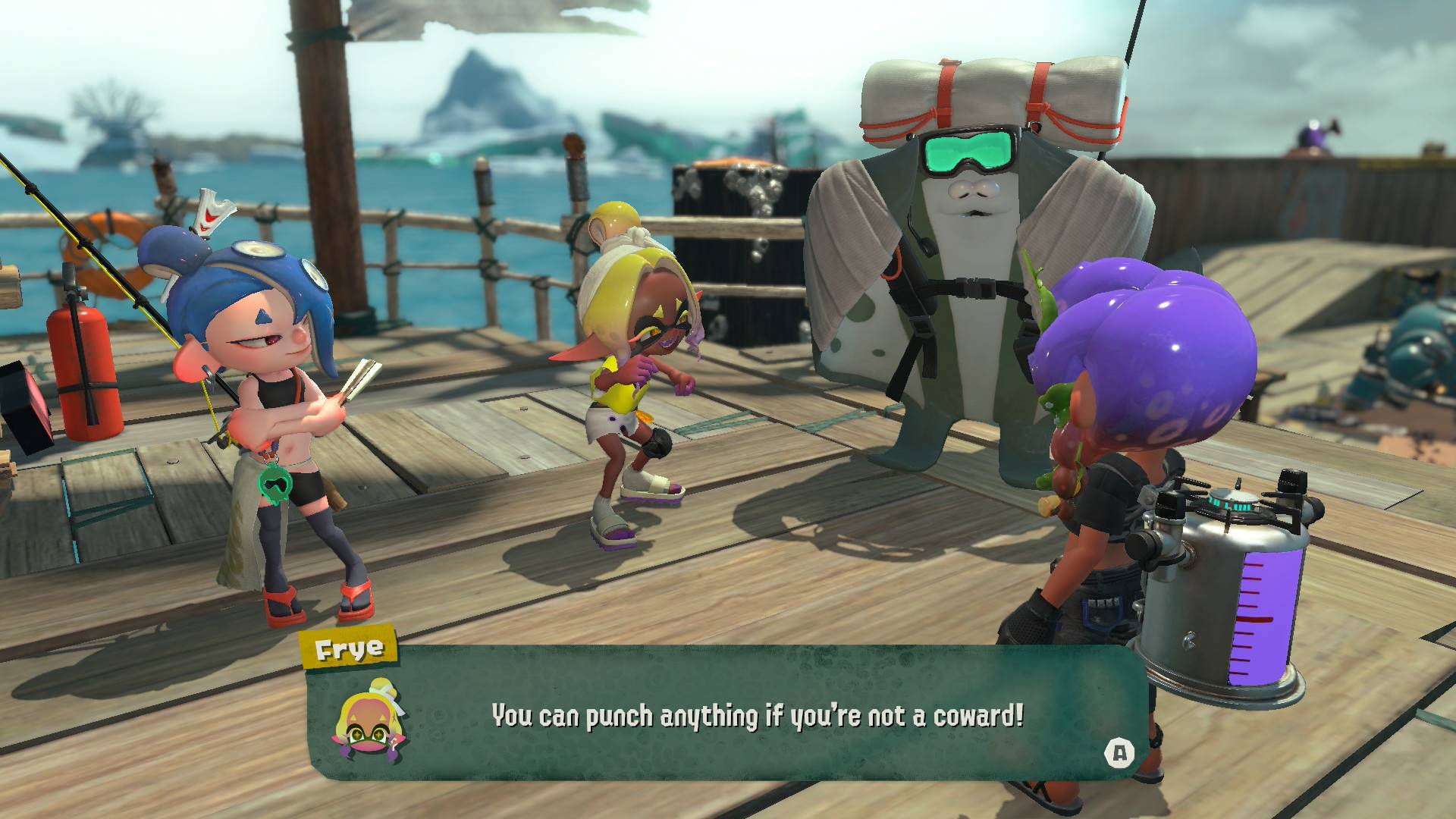
It’s not lost on us at CGR that we take things seriously, and there are times it is silly things we have to consider from the critic’s perspective. For example, when it comes to Splatoon Raiders, I could go into the evils of colonialism and its near relation to consumerism. It’d be a touch dramatic, but the elements are there – Splatsville, our protagonist’s home, has been despoiled and attacked by salmonids before, and Deep Cut’s response is to despoil the Salmonid’s cultural artifacts in retaliation. I could investigate the true culture war present in the game. (That’s cultural attacks on another culture, as opposed to casting in a movie you don’t like.)
Some of that’s pretty good actually, maybe I’ll use that later.
Still, I don’t want to miss this lovely forest for the trees. Getting too focused on the details by definition means we cannot see the bigger picture. And Splatoon Raiders is not a game you need to be taking seriously. The fourth game of the Splatoon series, Splatoon Raiders is the first spin-off of a numbered entry. Mechanically it has the same rudiments – you shoot ink from your weapon, and can turn into a squid to swim in it and recharge. The levels are like if you designed a whole campaign around Salmon Run, which is Splatoon’s name for its survival mode. But the customization and skill progression is what puts Raiders on a whole other level.
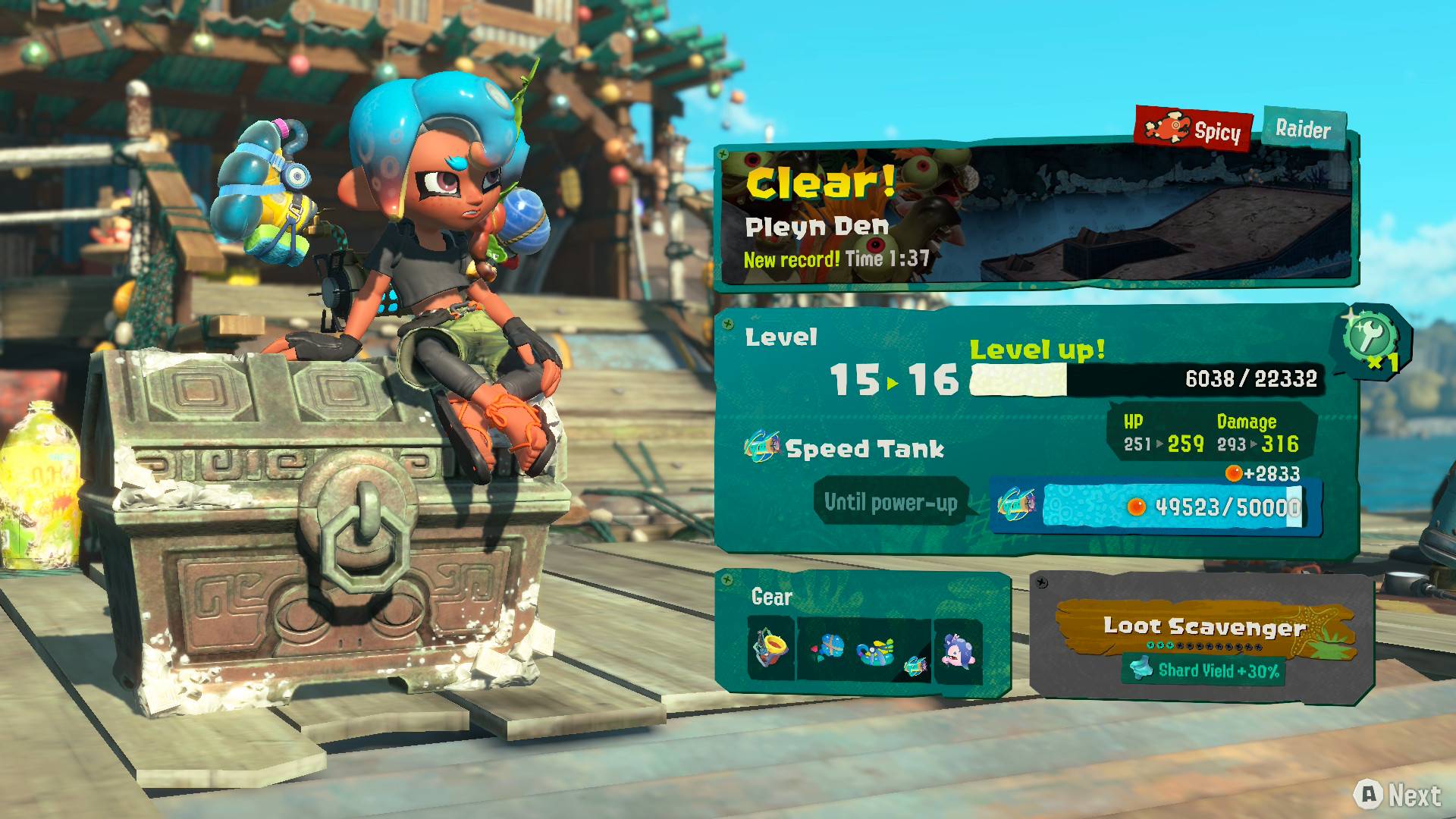
Unlike other Splatoon games, this one can be completed entirely in single-player. (But if you’re missing your squad, you can do 90% of the levels in multiplayer too.) Due to the single-player focus, the game was balanced by making you much more powerful than your normal Salmon Run game. There’s your standard leveling up, where HP and strength is increased. But as well, there are weapon levels and rarities. A rarer weapon will have more slots for passive abilities that make you stronger. There’s also the relic system, where you equip further abilities.
There are 3 tanks you can equip on your character, and you can freely swap between them when not in a mission. One is more movement-based, the second more attack heavy, and the last is more strategically minded. Each of these tanks come with gadgets, which are replacing sub-weapons from the main game. These let you attack enemies and traverse levels in entirely new ways. And then you can customize the gadgets…
Look, there’s a lot you can do, and I didn’t even realize until typing it all out. Nintendo does a good job of tutorializing it without overstaying their welcome, to the point where the mechanics feel less dense than I just described. But the sheer power it grants you is insane. With the right builds, waves of fish will lie dead at your feet. (Well, they would if they didn’t sublimate into nothing when they die.) That’s not to say you’ll steamroll enemies all the time – the difficulty is well tuned. There’s a constant push and pull between struggle and success, and leveling up and tinkering with your equipment is the bridge between the two. And the nice thing is, there is still always something harder to cut your teeth on, as you can retry earlier levels on Spicy mode.
The core gameplay loop is raiding the Spiralhite Islands for treasure, where you have to survive waves of attacking salmonids as you try to advance through the level. As is signature for Nintendo, the design is impeccable. There are some unique levels focused more on platforming or solving a puzzle, but mostly you’ll be trying to survive against waves of enemies as you make your way to the end destination. The enemy and boss design does borrow from Splatoon 3, but it is expanded upon quite a bit. Old enemies are altered, and new enemies have their own creative tricks to figure out. Once they’re all gone, you get home and count your loot! The gameplay loop of raiding so you can tinker and tinkering so you can raid is strong – it’s an optimizer’s dream.
Raiders is an odd duck musically. I really enjoy the soundtrack for most Splatoon games, and when it wants to be Raiders rocks just as much as them. However, a lot of the music around Salmonids is purposefully discordant. I’m no classicist, I can stand a bit of disharmony, but there were a couple of songs that were still too harsh on my ears – they were just not enjoyable to listen to in the slightest. I know music is not always meant to make you feel good and there can be a purpose to that, but you’re not gonna get that idea across if all I want to do is turn down the volume. Still, Raiders knows how to make bangers when it counts. Like always, the music at the endgame is on another level from the rest of the soundtrack. I was practically buzzing listening to it.
Visually, the entire game is designed around spirals. Even the world map is a spiral. It serves to pull you in as you go around, getting closer and closer to the end. Like circling a drain, there’s a feeling of inevitability about it. When you get to the center of the world map, there is a dark threat waiting. I would not be surprised if the final boss was inspired at least in part by Ito’s Uzumaki.
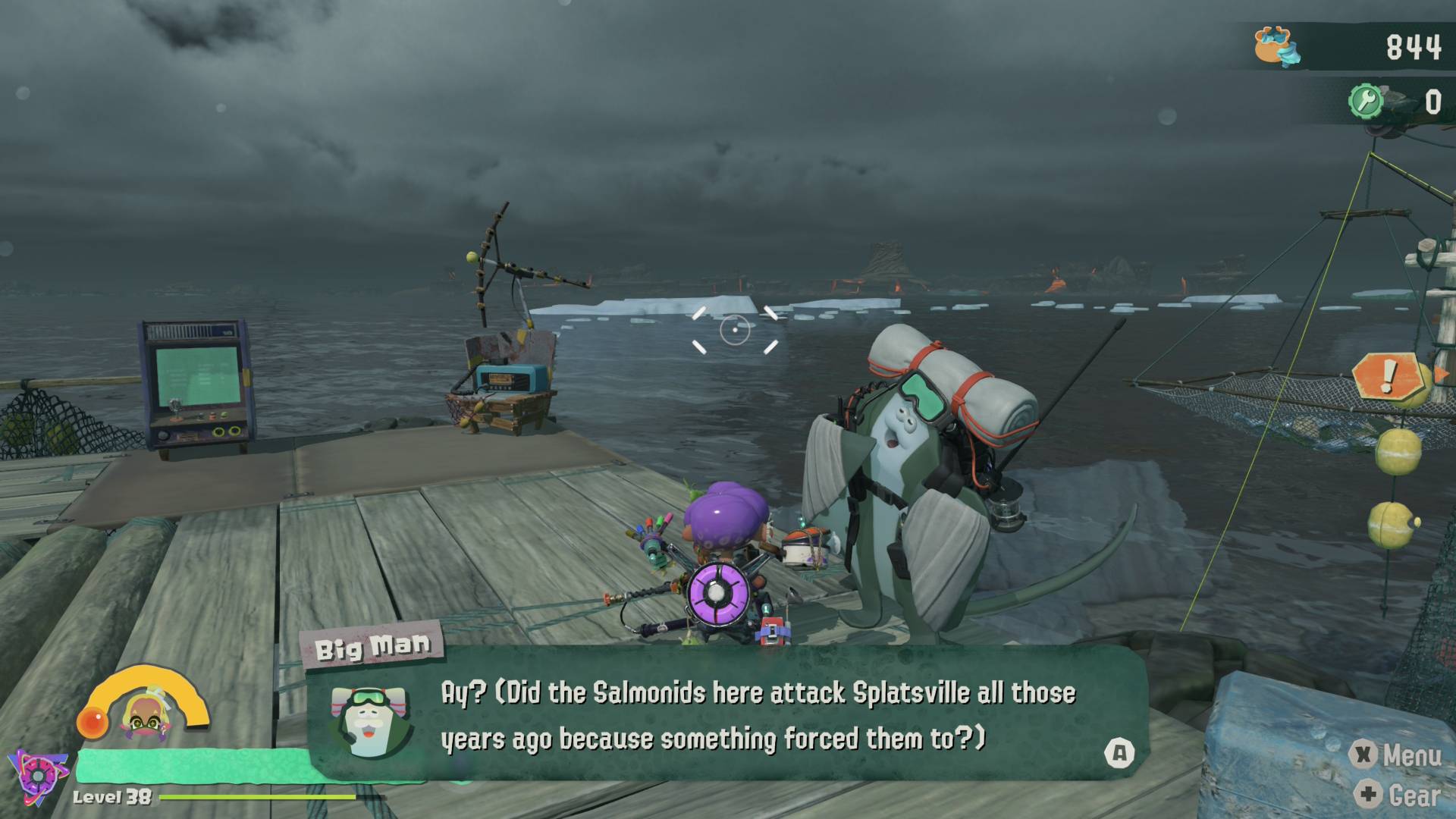
While there is more underneath the surface than you’d expect, the game, thankfully, isn’t interested in exploring this. Look, sometimes a game has themes and they don’t need to dig into it! If you’ve done enough due diligence to know they aren’t problematic and don’t affect how you live your day-to-day life, then you’re permitted to just turn your brain off and enjoy some despoiling. Obviously it’s my job to think about these things and tell you my findings, but to be honest, I have to spin this one up a smidge to make it problematic. In the actual game, Deep Cut’s motive really is just to find more treasure. These themes are just means to an end for a satisfying gameplay loop. Enemies are bad guys, even if they indicate sapience with the artifacts you’re mercilessly stealing from them. (It’s the orc problem from Lord of the Rings – stories sometimes need faceless bad guys. But we know this is impossible in real life. This is an article in itself…but another time). Still, because it gives me the opportunity to do so, I’d be remiss if I didn’t talk about the vice of greed.
Greed is the desire to amass goods without limit, beyond one’s rational need. It’s perhaps the first sin we instinctually recognize as bad when we’re kids – someone else has more, and I have less, so their having it is “unfair”. As we grow our understanding of greed changes, because we understand better what each person ought to have. (If we’re lucky we eventually learn that equity is different from equality, and some people, due to greater need, truly are entitled to more than others.) As our sense of justice grows it becomes easier to see that some people do have more than they ought to. St. John Chrysostom goes as far as saying that anything we own that is above our needs does not truly “belong” to us, and is in fact stealing from the poor.
“Not to enable the poor to share in our goods is to steal from them and deprive them of life. The goods we possess are not ours, but theirs.
Jesus lectures a great deal about greed. It is still just as uncomfortable to talk about today as it probably was back when He talked about it. But the truth is the truth: it is very hard to enter the Kingdom of Heaven as a rich man. I struggle with this, not because I am rich, but because I often want to be. The desire for security and my desire to provide for others is so strong. That’s what greed is though – it’s the desire for security and comfort, taken to a disordered extreme . I am tempted to think that if I magically became rich, that is all I would do, and the rest would go to the poor. But knowing myself and knowing human nature, I would likely start to feel entitled to it, and would be loath to part from it. This is why the rich man went away in sorrow from Jesus, because he had many things.
Ostensibly, you are raiding for treasures so that you can pay off the enormous debt that Splatsville has incurred repairing itself from Salmonid incursions. That is more noble than just treasure hunting for one’s own wealth…but I suspect there is still a bit of banditry just for banditry’s sake based on the dialogue. Still, accusing Deep Cut of the mortal sin of greed is very silly. If you, however, are ever in this same situation where you can raid islands for treasure, please remember that accumulating more wealth than you need, especially through illicit means, ain’t good chief. It will have to be paid for.
Scoring: 86%
Art: 8/10
Music: 8/10
Story & Writing: 7/10
Gameplay: 10/10
Design: 10/10
Morality/Parental Warnings
Lightly Disturbing Imagery: While the design of the final boss is certainly Lovecraftian, I would say it’s more creepy than actually scary or disturbing.
Cartoon Violence: You control a character who uses paintguns to cover enemies in ink which causes them harm.