
It only took me half a decade, but it’s finally time to review a game from the infamous Shin Megami Tensei series. Other writers have covered other titles on this site in the past such as Starwarp’s review of Persona 5 Royal, and I myself reviewed the rather adjacent Metaphor: Refantazio, but I do think there’s more to explore through seeing how this series’ relation to the religious material it draws from shifts or stagnates over time. With that in mind I landed on today’s title, Soul Hackers 2, due to both its recency and some of its more unique surface-level qualities compared to other games in the series. It was released in 2022 by developer ATLUS and publisher SEGA, and is available on PS4, PS5, XBox One, XBox Series X, and PC. I played the Steam version of the game, and did not buy any of the DLC. Let us dive right into things and see if there’s anything here other than the nonsense most of us expected.
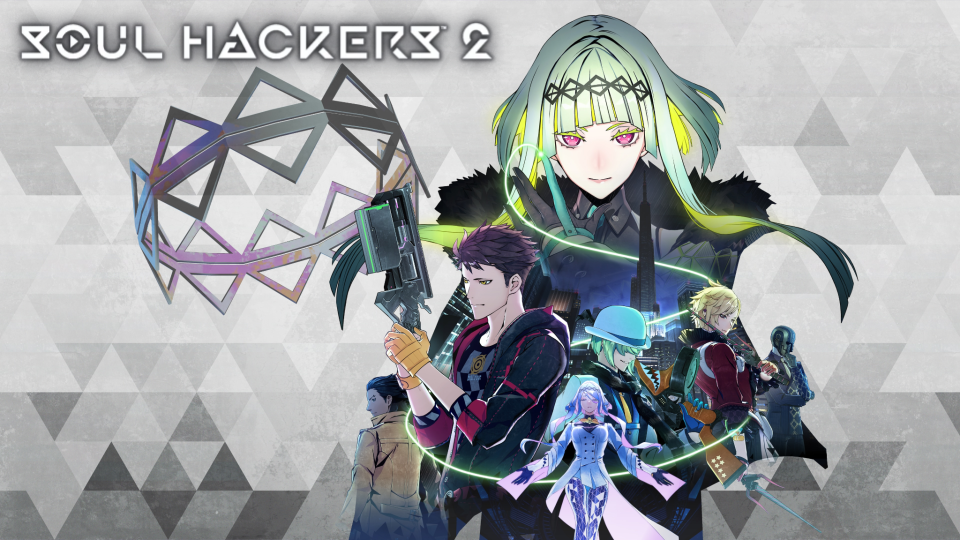
The story of Soul Hackers 2 takes place in an unspecified city in Japan in the near future, and follows the tale of a being named Ringo. Ringo exists as part of Aion, an entity born of the mass of data underpinning the information technology era, and was given a physical humanoid body alongside her ‘sister’ Figue to intervene in the human world after Aion calculates an imminent apocalypse. Ringo’s investigation quickly hits wall after wall as key witnesses are killed, but thankfully Ringo’s ‘Soul Hack’ ability allows her to reunite these witnesses’ souls to their bodies. These end up becoming Ringo’s party members: Arrow, an agent of a supranational occult task force called Yadagarasu, Milady, a former member of a doomsday cult known as the Phantom Society, and Saizo the freelance Summoner. Together these very different people find themselves forced to work together on a quest to uncover the source of the world’s impending doom, and hopefully find a way to change their predicted fate.
The key positive of Soul Hackers 2’s story is its main cast of characters, as the party you’ll be spending most of your time with is significantly above average as far as JRPG protagonists go. Ringo is especially unique, in that she plays the role of the mysterious outsider of inscrutable origins and power that few games would place into the lead perspective, while also being an earnest and endearing protagonist in her own right. Her three companions also leave a very strong impression, with Arrow, Milady, and Saizo all having fleshed-out backgrounds which make them fun to engage with, and more importantly are insanely entertaining when they clash and bounce off one another. Each of them lines up with the traditional SMT alignment system of Law-Chaos-Neutral, but through the circumstances of being bound together by Ringo and their more mature attitude to setting aside differences for a common goal, they manage to hit that perfect sweet-spot where they can still fight amongst themselves and explore those perspectives without derailing the story or breaking up the band. It’s easily one of the best ensembles in modern entries of the genre, and is probably the game’s biggest selling point.
Of course, the game commits so hard to these protagonists that the gravity of their quality makes it challenging for… pretty much everything else in terms of being solid independent of this quartet. The main plot is a fairly straightforward hunt for a collection of world-shaping McGuffins with twists rarely having an impact outside of a particular curveball related to Arrow’s true role, and very few side characters have much of anything to them. Some are pretty decent like Ash, but such cases are usually only because of how tightly their stories intertwined with one of the four leads. There are even instances where side characters are killed before you really understand their significance to one character or another, and while the story tries to retrofit them with significance through flashbacks it’s just too little too late. The problem of a weak supporting cast is especially significant during the third act of the game, where the final antagonist’s motivations unfortunately aren’t nearly compelling enough to carry the grand finale because they depend upon bonds between secondary characters which the game simply has no time to spare building up. There are even multiple characters with names and unique portraits who barely appear in the story, which absolutely reeks of ‘was going to be more important but had to be cut down significantly’ development troubles. Soul Hackers 2 clearly not having the time or budget to explore every idea it wants to will be something of a running theme going forward, and in the case of the story it might have been better rounded out if the narrative leaned more into its strong leads. Making all the characters more involved personally with the main party might have given a weird sense that the world revolves around them, but at least it would have masked how underwritten the world around them actually was.
Gameplay-wise Soul Hackers 2 reminded me quite a bit of Tokyo Mirage Sessions #FE, which itself was originally an SMT and Fire Emblem crossover before it started to do more of its own thing. The player navigates dungeons and triggers battles against enemies to progress through the game, with a large emphasis on exploiting enemy weaknesses to pile-on bonus damage. Dungeons themselves really don’t have anything interesting going on mechanics wise, other than the fact that the camera trades in practicality for more visibility of Ringo’s hotpants, so the combat is where the bulk of the discussion will go. It’s a fairly standard turn based affair, with each side taking turns launching attacks or performing support actions until one side comes out on top. The key wrinkle in the formula is called the Stack, a mechanic which rewards the exploitation of a weakness by adding a demon (note: the game uses ‘demon’ as a catch-all term, and can include non-demon entities such as fairies, urban legends, angels, etc.) from your party’s stock to a numbered meter. This number is then spent at the end of the player’s turn to perform a Sabbath Attack, dealing damage to all enemies proportional to the number in your Stack. As the game progresses individual characters will gain new ways to add to the Stack, such as Saizo having a chance to contribute while using his turn to heal or Milady gaining extra Stack when inflicting a status effect, so later battles start to center themselves around your ability to do whatever you need to survive while still consistently Stacking for your Sabbath Attack. This system opens up some pretty interesting strategies like building Stack against one enemy to nuke another enemy at turn’s end who you otherwise can’t easily strike the weaknesses of, but it does make the game very easy once you come to grips with the system.
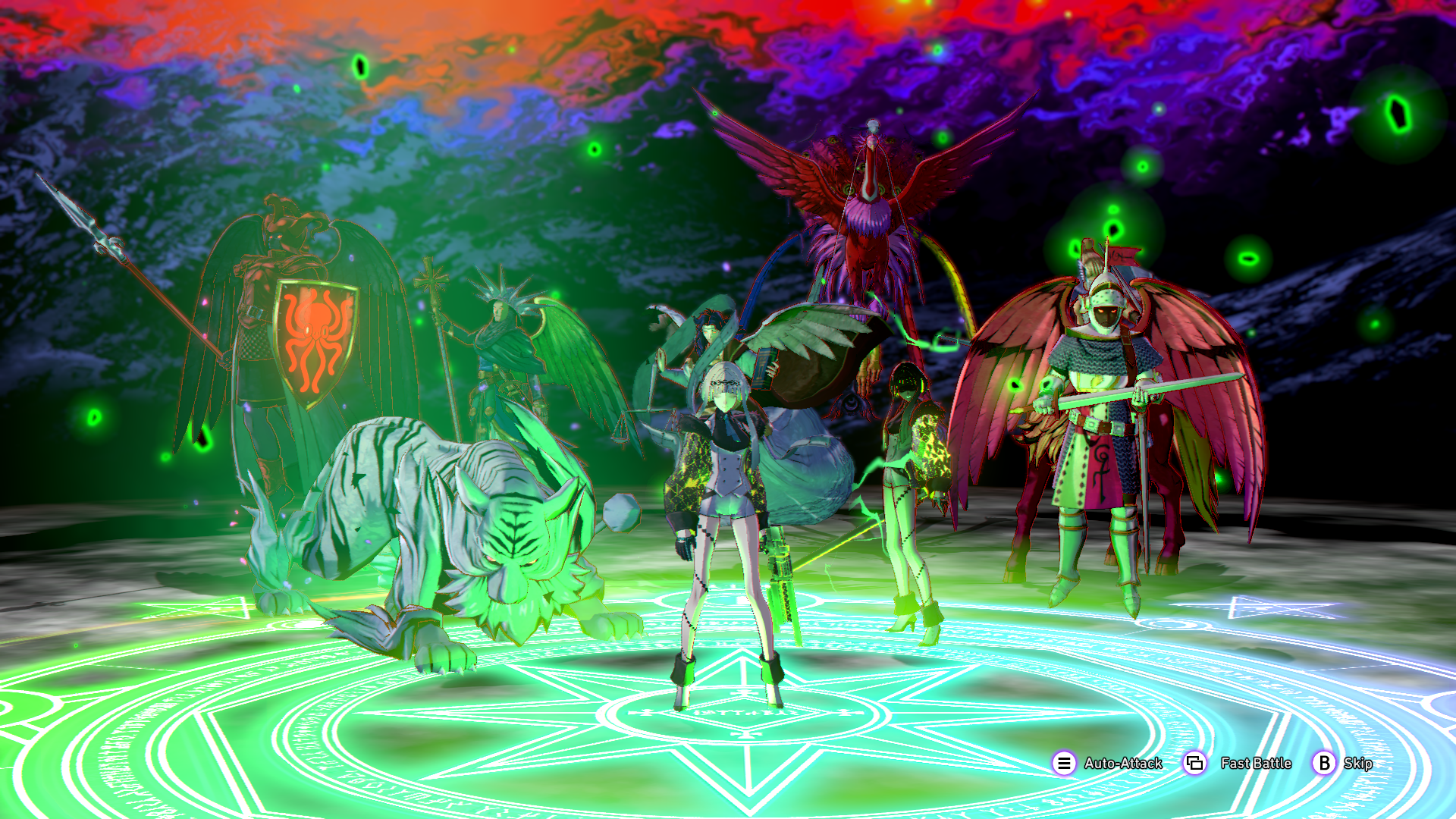
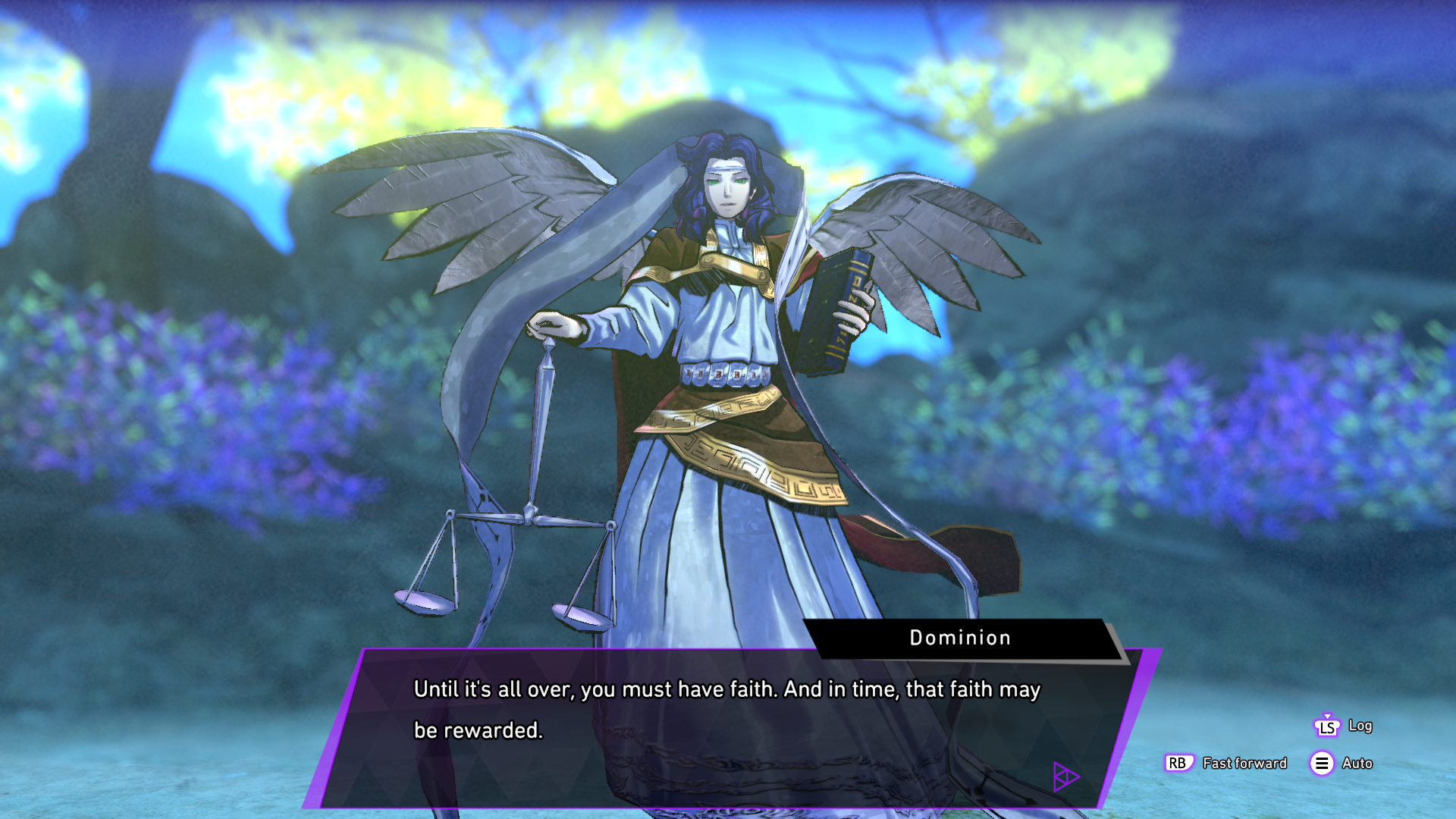
Upgrading your characters is the other big part of the core gameplay loop, which is split between the core cast and their stock of demons. To start with the latter, demons level up when used in combat and learn various passive and active skills, which the equipped party member will have access to, but they cap out on their available skills to learn pretty quickly. This is because the average demon is intended to have a relatively short shelf-life, and eventually replaced by a stronger one. You can recruit new demons by finding them in dungeons and paying whatever cost they ask of you, but more often you’ll find yourself fusing two of them together to make a new one. Demon Fusion is special because it allows the newly created demon to inherit the skills of the ones used to fuse it, and allows you to keep skills you like while still upping your stats. I generally avoided skill inheritance to make the game more challenging and make each demon feel more unique to use, but it was nice to add a little spice to my endgame build when I gave Dominion a strong Ice skill which this Gunfire-focused angel otherwise wouldn’t have had.
Upgrading your individual party members on the other hand is more about upgrading their COMP weapons, which for money and materials can provide flat attack upgrades, new passive abilities that make their basic attacks more potent, or rank up their affinity with pieces of equipment called mystiques. This is all pretty well and good and makes each character have a distinct feel, though it’s hard to say whether you really benefit from trying to build away from what each character is already clearly intended to excel at. Remember how I said you gain abilities over time which give your characters new ways to increase the Stack? Critically, some of the earliest upgrades each character grants a bonus Stack based on weakness exploiting specific elements: Electric and Physical for Ringo, Ice and Gunfire for Arrow, Fire and Physical for Milady, and Wind and Gunfire for Saizo. Due to how central Stack is to success in this game, upgrading your proficiency with elements outside of the character’s specialty is simply inefficient, and even disincentivizes the use of demons outside those niches unless the boss enemy in front of them locks down said niche. I won’t say this makes all of the game’s various build systems an illusion and it can still be fun to engage with, but it does undercut the customizable nature of the ‘creature-collector rpg’ subgenre quite starkly.
Presentation-wise, Soul Hackers 2 is brought down significantly by its visuals. To start with some positives: the main party’s models and weapon attack animations do look pretty good considering you’ll be staring at them for the entire game, and the demons are largely asset-flipped as far I’m aware but that does mean most of them look pretty solid despite their limited animations. The shops and shopkeepers turned out to be surprising highlights, as despite just being 2D backgrounds and character portraits they have a striking amount of life and care drawn out of those limitations. The rest of it… not terribly impressive. The main culprit behind this trouble is the environment design, as it is simply repetitive, unflattering, and mundane. The main story levels reuse the ‘dark subway tunnels’ and ‘shipping district’ environments twice, neither of which are especially gripping settings to explore. I get that this is supposed to be an urban setting and all, but if these environments are going to be so simple and familiar they could at least make a greater variety of them. Never mind the idea of using magic more often to introduce more wild locals than just the final dungeon. The worst offender here by far though is the Soul Matrix, a side dungeon which is more or less mandatory if you want the true ending (I kind of liked the neutral ending more though), which despite supposedly being constructed from each party member’s individual psyches is just a big blue void with grey platforms to walk on. You’re telling me that the same company that gave us television sets based on people’s true feelings and literal mind palaces of major villains couldn’t be bothered to up the variety of their dungeon designs for the souls of the core characters of their new game?! Literally the only good environments in the whole game are the various city districts, and that’s just sad.
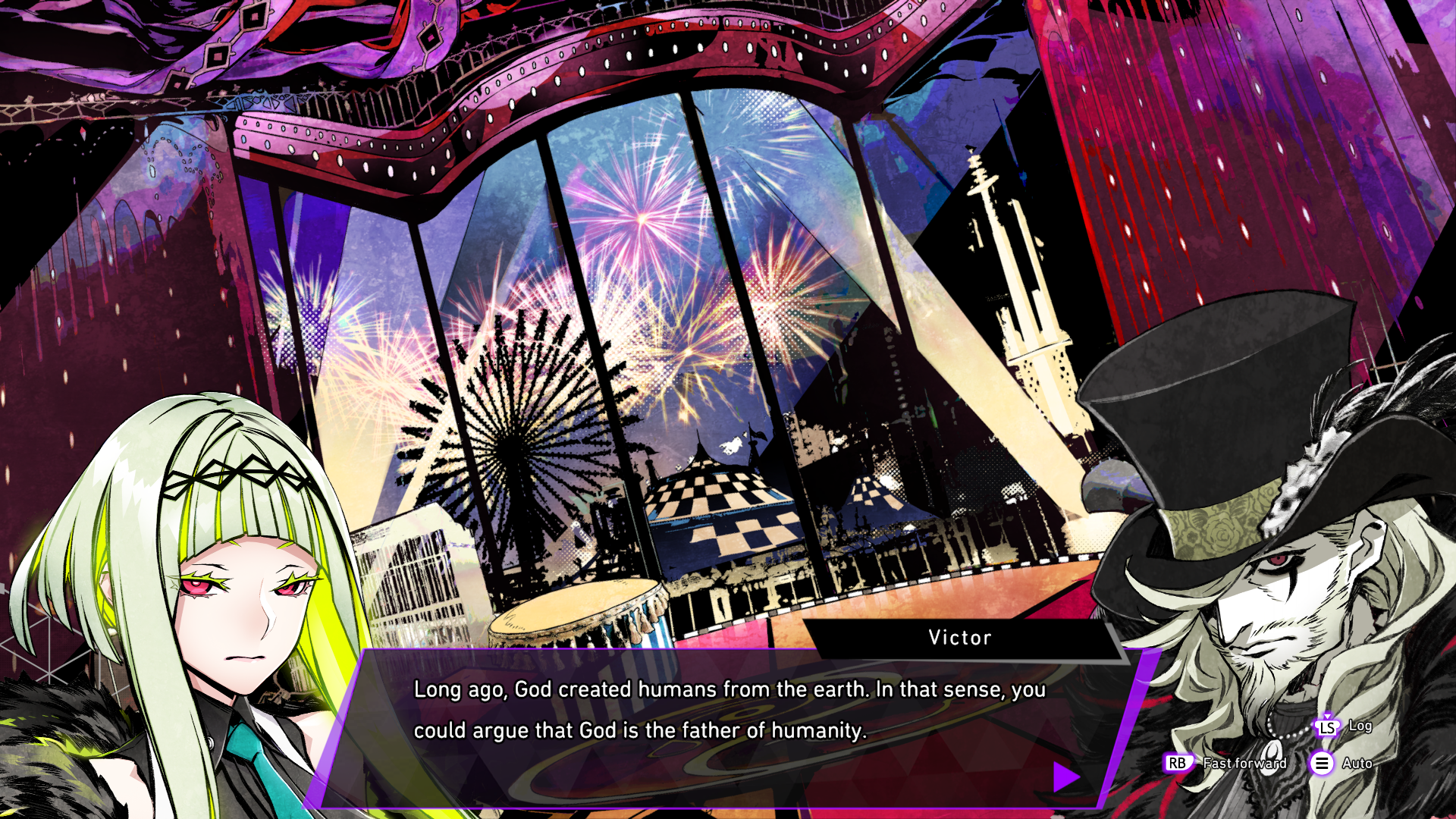
Beyond the environments, the cutscene animations are also a bit lacking. This is normal for JRPGs if I’m being honest, but when the set the actors are placed upon is so unflattering the stiffness of their movements gets a little more highlighted. The voice acting for the English version does primarily feature some relatively prominent dubbing VAs who can handle their roles just fine, but I think the voice direction could have been a bit tighter across the board. Even the music isn’t much to write home about, as a lot of it is just a bunch of muted cyberpunk background noise. The boss themes were generally pretty fun and some of the more strongly thematic areas like Shinasado Bar and the Circus left an impression, but that’s really about as much as there is to say on the matter. Overall the presentation is easily the biggest victim of the game’s lower budget, and I think greater care should have been put into working around that limitation than was ultimately done.
Lastly, as for the Catholic reflections on Soul Hackers 2, I suppose we should start with the game’s use of Christian figures as a part of its broader spiritual backdrop. The main story of the game surprisingly has very little direct plot relevance of existing theological or mythological figures, so for the majority of the game the most you’ll get out of Christian figures is fighting some of the angels as enemies and adding them to your party where you can. With the exception of the ninth order Angels, these figures are given relatively appropriate designs even if they run into some bizarre or uninformed choices. Unfortunately in the side quest half of the game, it seems that they couldn’t quite help themselves. Over the course of the game certain npcs in the town areas begin to ramble about a mysterious Glorious Night, and near the end of the game you can play through a side quest that reveals a local government worker started a cult to amass “glorious knights” to purge the world of evil after being visited by an Archangel (not like one of the named Saints, just an angel of the eighth order). I’m almost certain this questline is loosely based on modern Japanese history in general as I’m aware that the country has faced major problems with cults in relatively recent history, albeit my understanding of the specifics is rather limited. Combined with Japan’s existing cultural prejudices against Christianity I certainly understand that this questline didn’t come out of nowhere, but man does it suck when they had a whole bestiary (including other law-aligned figures) to choose from for this cult, and they ultimately landed on the angels. Even the bar hangout you get for finishing the quest is one of the worst in the game, in which the main party members psychologize all religious faith in general even though they live in a setting where demons are overtly present and often out to get humans. In the end this is only a small part of a much bigger game with other priorities, but it is significant enough that I would definitely call it a dealbreaker for a lot of prospective players in my audience.
As for the reflections on Soul Hackers 2’s main narrative, I feel the story and the events that unfold in it can at least be somewhat edifying when taken in a more tragic sense. I know it would be low-hanging fruit to tie today’s article in His Holiness Pope Leo XIV’s latest encyclical, but anyone with experience in the JRPG genre and proper metaphysics could tell you Ringo and Figue’s grappling with human identity is built mostly upon sophism designed to let them have it both ways, so instead I want to examine the ways in which the story explores conviction in the modern era. The set up for the game being one in which characters of radically different alignments are made to work together for a common goal shifts the tone of the narrative dramatically, and a good deal of the games conflicts between the party members and outside enemies alike are often laced with this sense that they are self-aware of how their beliefs push them towards violence despite whatever common ground may exist between them. One might see this as the game learning into modern moral relativism on the question of Law-Chaos-Neutral, and I learn towards agreeing with that interpretation for the most part, but I can’t help but feel Soul Hackers 2 unintentionally casts this relativism in a fairly negative light. Whether it be Arrow almost wordlessly agreeing to fight an old friend to the death or Milady threatening extreme measures against innocents to accomplish her goals, characters’ deepest held convictions regularly push them into perpetuating the violent cycles that grip the game’s world with an almost haunting level of resignation. Interestingly the only character to truly escape the cycle following the events of the game is Saizo, which is accomplished not by doubling down on the essence of what makes him a Neutral character, but in choosing to fight for love above all else and become more honorable (and not in that shallow hook-up kind of way either, dude legitimately wants to spend his whole life with his girl).
Taking these observations into real life, I think this aspect of Soul Hackers 2’s narrative makes for an effective warning about our current state of polarization. Driven by both algorithmic pandering and rising tribalism, the modern conversation in the western town squares is heavily dominated by those who have very strongly tied their very sense of self to the convictions of ‘their side’, be it out of a need for a narrative, fame, wealth, or any number of possible reasons which ironically are often beyond rationality. The particular stubbornness with which these convictions are held and the desperate attempts to be ‘right’ have left a truly unmissable mark on how all of us perceive other people, especially in as much as we have lost sight of what common grounds we actually have. Amidst this tumult, Christ calls His faithful to adjust our perspective by centering it in Him, and in doing so realize that all this bustle and conflict of our time can only truly be understood in the sight of eternity. “Heaven and earth shall pass, but my words shall not pass.” (St. Matthew 24:35) This of course is not to say we should become fence-sitting ‘both-sides’ impotents, but to reflect upon whether the way we treat those of differing convictions helps them and ourselves walk the path towards unity with the Word which does not pass. Will this argument open someone to Truth, or harden them against it? Can this action provide a person space to find God, or close off their chance to witness Him? Will standing by be an act of mercy to my brother, or permission for my brother to gravely sin? These are difficult and adult questions we must grapple with, but they are indeed the only true alternative to the resignation we see in the Arrows and Miladys of the world. The Lord has given us His Son, and with Him everything we need to pursue the Good free from the relativism and tribalism of our times, we need only the fidelity to embrace that gift.
In conclusion, Soul Hackers 2 is a tough sell for its asking price. It features a wonderfully realized core cast of characters and some decently fun combat, but budgetary constraints severely impacted the creative direction for the story, presentation, and progression systems. If you’re really curious about the game it does tend to go on deep sale every now and then, but honestly I would probably recommend playing a similar but superior title like Tokyo Mirage Sessions before I suggest giving this title a go. There was a lot to like about Ringo’s ragtag crew, but they could have been so much more if the game surrounding them better matched their quality. Maybe I could have picked a more well-regarded title to satiate the superfans, but at least I have now indeed taken heed of their age-old demand to ‘play a real SMT game,’ and personally I’m glad I got to explore a new side of the genre.
Scoring: 52%
Gameplay: 3/5
Story: 3/5
Art and Graphics: 2/5
Music: 3/5
Replayability: 2/5
Morality/Parental Warnings
Soul Hackers 2 is a JRPG part of the long running Shin Megami Tensei series, which is rather infamous for its brazen use of religious and mythological figures as the stars of its creature-collecting loop. While the term ‘demon’ might not accurately describe every playable figure available to the player, there is still definitely enough here to justify calling the setting’s magicians ‘Devil Summoners’ as the game does. If I tried listing off every figure worth being warned about then we’d be here all day so I will trust you to do independent research on this. A few worth stating here is that ‘Baphomet’ is a mid-boss in one of the dungeons, ‘Baal’ is obtainable via fusion in the late game, and while locked behind DLC and a level requirement that’s only relevant for New Game+, ‘Satan’ is indeed playable. As mentioned in the article, some angels are involved as villains in one of the game’s last side quests. In general be prepared for a variety of encounters with figures of legend and the occult in various side-scenarios. There is an accessory in the late game called “Jesus Greaves.”
In terms of other major content heads-ups, the battles are generally not graphic but some cutscenes feature fairly explicit stabbings and blood. One major character cuts his arm off. Elemental attacks are derived from your equipped demons, meaning the magic system is more similar to actual magic than most titles. The setting of the game is a mystic-cyberpunk future where humanity has stagnated, and prominently features the conflict between two major factions that kill innocents in the course of their conflict. Perhaps the most extreme element of the background story is the fact that Milady was saved by Iron Mask as a child and became his lover as an adult, which despite going unacknowledged by the story itself heavily implies grooming. Some demons in the game sport immodest or sexually provocative designs, especially the female ones but also a few males. Milady is naked in one of her flashback scenes, albeit with digital pixelation covering the most sensitive areas. The camera when exploring dungeons is optimized to show the player Ringo’s butt as much as possible. The demon Mara is available as DLC, if you know SMT you know why I’m mentioning this. Foul language is fairly common in the game’s script during more heated moments.