
Explicitly Catholic video games are quite difficult to come by in any meaningful sense, as the average gamer is not especially looking for religion-centered experiences, and even when they are made they can fall into the trap of being so education-focused that they fail to provide any real hook to keep players invested. Sainthood on the surface might seem like just another one of these titles, but I wouldn’t be writing about it today if there wasn’t something more to examine. It was developed and published under Sainthood Project, released in November of 2024, and is currently available on Steam, Xbox, PS5, and mobile. Its premise involves a sister washing up on a little island community and living out days of prayer and community service as her departure time draws near. Players interact with the game through lots of reading, basic tactical traversal, and time and resource management. Please note the Steam version was used for this review.
The story of Sainthood takes place on the Isle of Santa Maria and follows a nameless sister who is more or less a stand-in for the player. You lack memories of how you made it to the island or why but the local priory has welcomed you in all the same, and it’s up to you to fill your days with prayer and lend aid to the various community members who occupy the other locations of the island. This takes place over 33 days up until you are scheduled to make a journey to the Distant Land. The narrative of Sainthood is fairly simple, and most of the story is more or less intended to be felt through how you allocate your time in-game rather than any specially crafted arc. The island’s various residents do have some minor backstories to reveal and epiphanies to reach as you clear each of their questlines which are nice, but it is not exactly the deepest stuff in the world. A large part of this is undoubtedly due to how much of the game’s script is dedicated to discussions of various prayers, fables, meditations, and culture which is featured in the game.
Despite this parallel to other faith games, I actually didn’t find the heavy inclusion of these elements to detract from the game’s quality all that much. It can certainly be a lot to read but it doesn’t take too long before you’re loosed back into the gameplay sections, and I felt the pacing between the educational content and in-game content was better than anticipated. A large bit of the credit probably goes to the lead creative on the game being of Nigerian descent, and how he takes the opportunity to share African history, cuisine, culture, and fables in amongst the more familiar discussions of the Saints’ writings and prayers. To someone familiar with all of the above I could imagine a lot of this would culminate in a very brow-beating experience, but those less familiar such as myself might find the variety on offer unexpectedly satisfying. It helps that Sainthood tends to treat the audience with respect, such as often inviting the players to verbalize for themselves the meaning of its various fables. At the end of the day I can understand if the arrangement of Sainthood’s narrative content and educational material limits the overall appeal of the game, but I think a healthy dose of intellectual curiosity can make it more engaging.
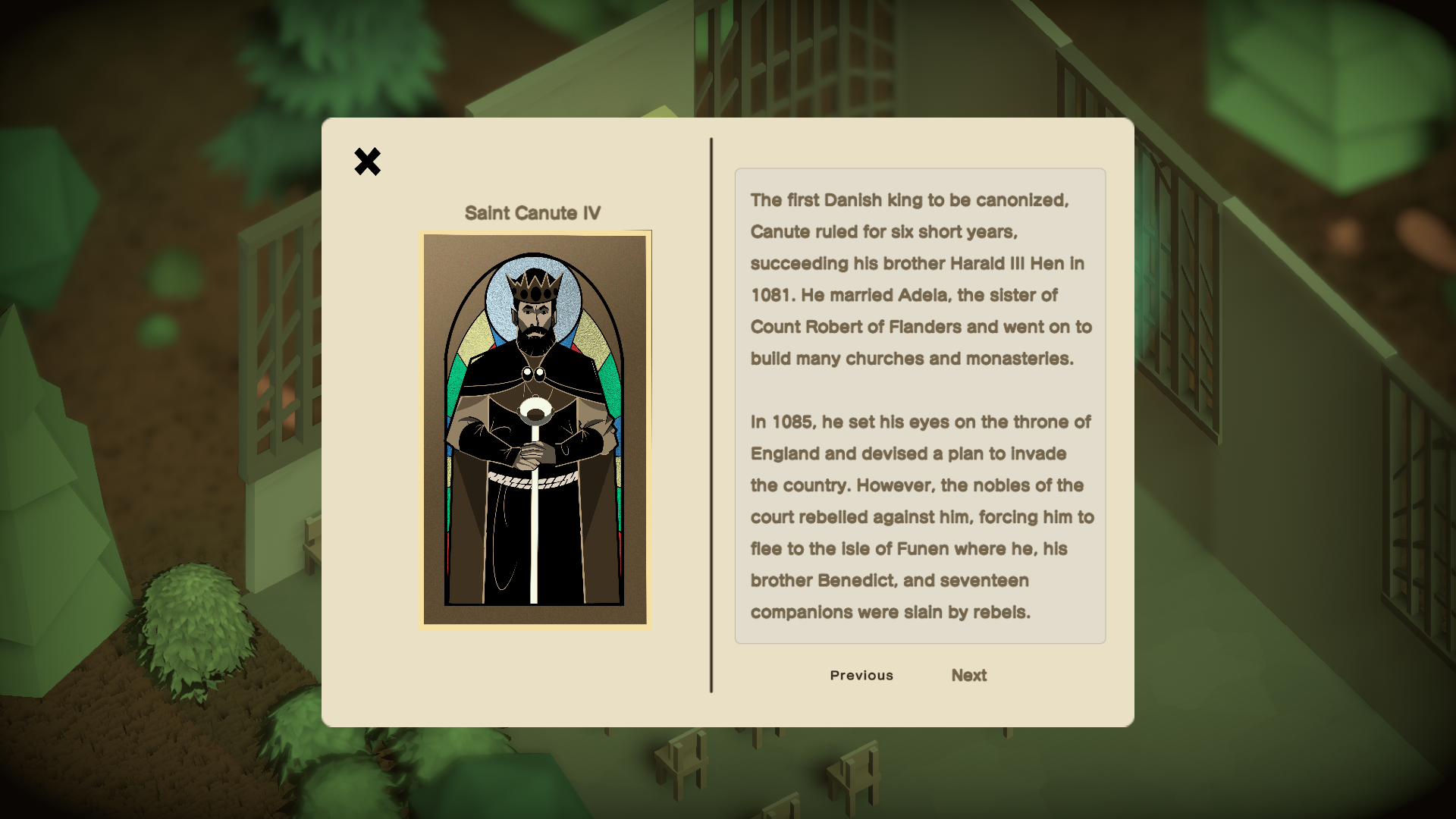
Fortunately all these various texts are broken up by genuine and relevant gameplay, which is a sizable boon in the game’s favor. Over the course of 33 days, the player is tasked with visiting various locations around the island and spending time to complete various objectives, which generally reward you with either Faith Points or Charity Points. These two sets of points are the main determinators of the game’s ending, with Faith Points additionally rewarding the player with biographies and artwork of various Saints from across history. Between the two Faith is significantly easier to accrue on any given day as you’re allowed to take the Pray action inside of almost every building, while Charity is typically only acquired through completing the requests of the island’s residents up until you clear their questlines and gain access to more consistent sources of Charity. Either way you can only hold 5 Faith and Charity each on any given day, so generally the best strategy is to complete as much Charity work you can on any given day before spending the remainder on Faith.
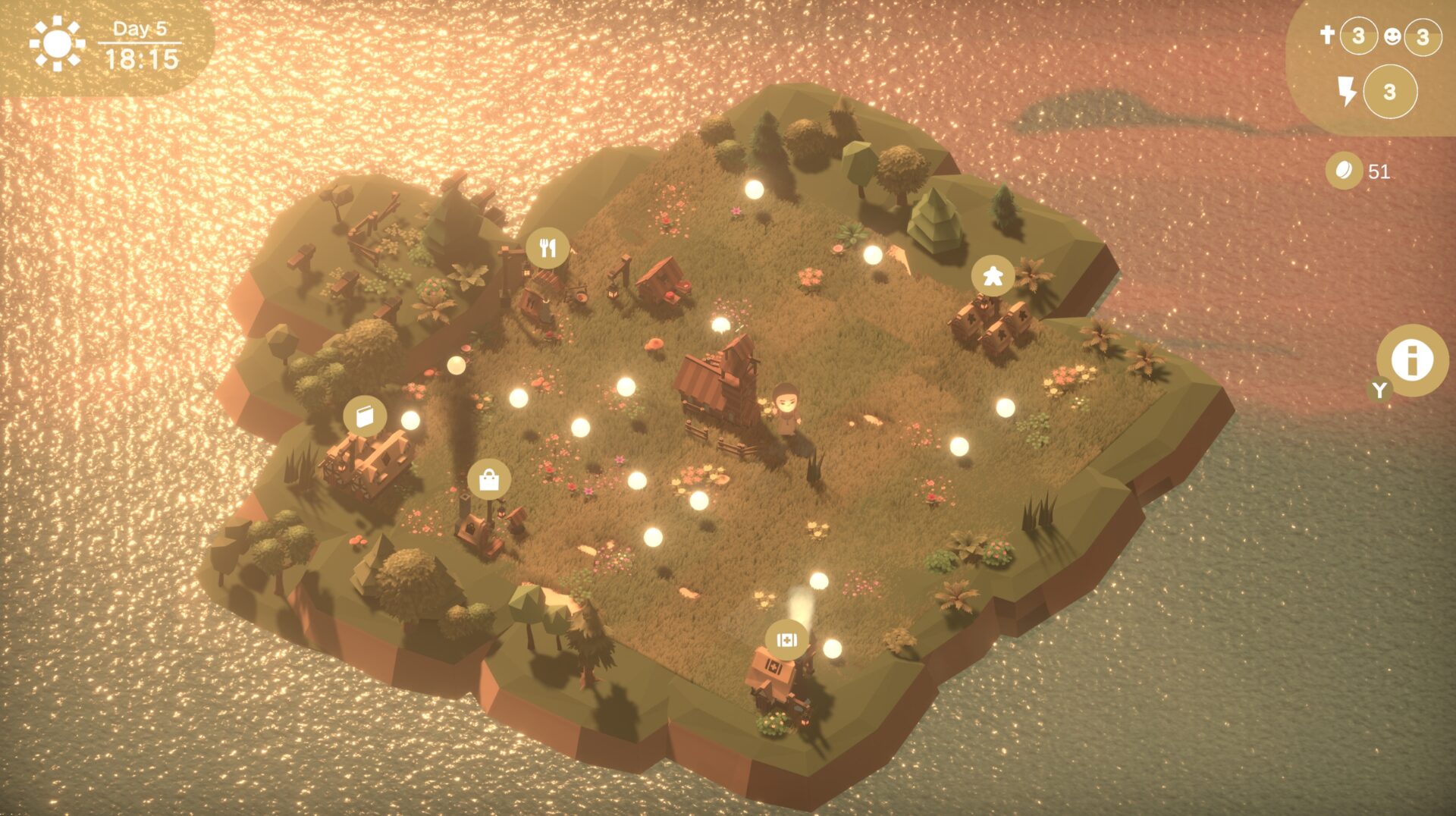
This rush to accrue points is limited by time and energy, the main source of resource management in the game. The day starts at 5:00 AM and ends at midnight (horrifying sleep schedule by the way), and most all major actions in the game require you to spend this time to accomplish your objectives. Moving a square on the island takes 15 minutes, stopping to pray takes an hour, and the various other activities require personalized amounts of time. The amount of time any given activity will take in total isn’t easy to plan around either, as the buildings other than the central priory shift locations at the start of each day. There’s a very careful balance between knowing when to go all in on a delivery or activity and when to pivot to something less time-consuming, and while it’s not that hard to get the best ending there is some fun in learning how to take care of your tasks efficiently. Energy is another important factor to this calculus, as Charity work is often gated by your character’s available energy when departing for the day. This creates nuance like some activities being time-efficient but energy inefficient (such as the Orphanage work), and taken altogether it’s an enjoyable system even if it’s pretty easy to master.
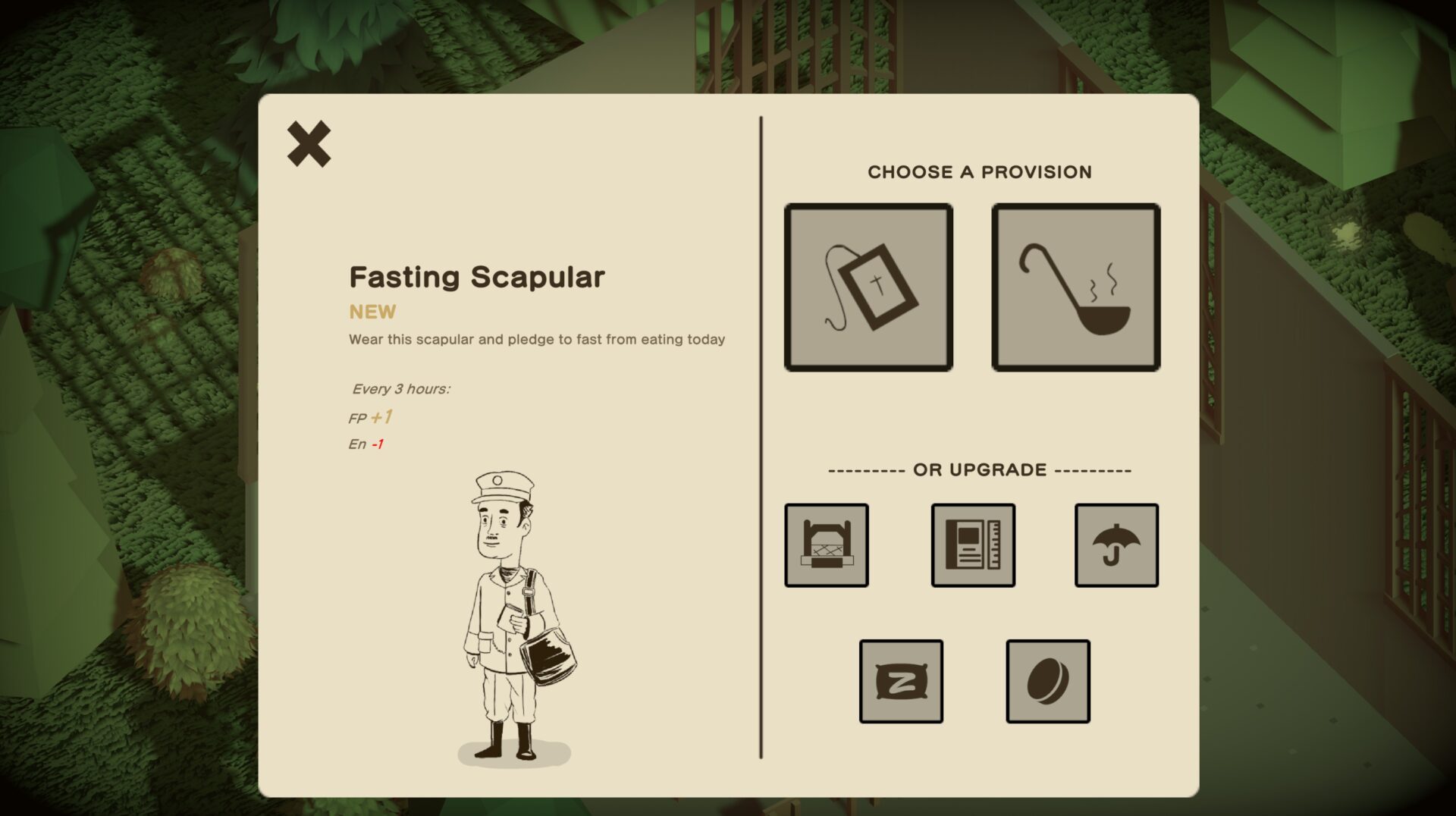
Your first departure from the priory each day also presents you with a item system, giving you five slots of tools to fill with items that affect costs and rewards of just about anything that you can think of. There’s some fairly simple ones like an umbrella to prevent pneumonia on rainy days and a persistent boost to the priory’s income, but the really strategic ones boost the rewards of specific activities while imposing additional costs. This is because these start as pretty intensive tradeoffs, but if you commit to upgrading those items they can eventually become strict upgrades. I myself picked up a flagellant’s whip which increased the Faith generated by prayer with the downside of giving the activity an energy cost, but by fully upgrading it that energy cost was waived and it made Faith significantly easier to cap out each day while still getting in all the charity work I wanted to. It’s very roguelike-esque in its design minus the hyper-challenging repeating runs structure, which I wasn’t expecting at all but works surprisingly well.
Beyond these core mechanics though, there are also systems which are advertised as central to the game but in practice aren’t actually worth all that much to it. I am of course referring primarily to the game’s construction mechanics, which after the initial building of the various island locales do not offer much practical incentive to be upgraded. There are technically items you can acquire to make upgrades worthwhile, but without them all they really do is make the building interiors more lively. This has the knock-on effect of making coins significantly less valuable despite all the upgrades dedicated to accumulating more of them (since building upgrades are the game’s main money sink), and collecting the Ehi spirits does nothing except gate higher tiers of building upgrades so those are actually just plain irrelevant as far as I can tell. Perhaps the most pointless system is the manuscript collecting, as you can only collect these after dark (meaning you have to risk getting your Faith Points lowered by malicious spirits wandering around) and all they do is provide a summary of the manuscript’s contents without any real benefit. I don’t think the game is worse for having either of these systems, but it’s clear more could have been done with them.
Presentation-wise, Sainthood is an intentionally simple-looking game. Its 2D character art consists mostly of cartoon character sketches, and the 3D environments are polygonal and somewhat impressionist. The color choices for the game in particular stand out as very soft and sepia-toned, giving the game a sort of hazy, nostalgic feel. All things considered it’s not my first choice of art style, but considering the cozy feeling the game is trying to cater to I can’t say this less stimulating approach isn’t appropriate for the overall vision. The music featured in the game largely consists of classical music and chants played softly over the activities at hand. It’s very much the sort of thing you’d add to a playlist for rest and prayer, and I think it does its job admirably even if it wasn’t a highlight of the experience.
Finally we come to our spiritual analysis of Sainthood, for which the game positions itself as being centered around the quest for holiness and the lives of saints. Anyone with even remote familiarity with Catholic teaching can tell you most of the parallels in the game. Faith Points and Charity Points are the goal of the game because faith in God and a life of virtue is the means of salvation, with the Distant Lands being the stand-in for Heaven. The changing seasons represent both the passage of time and the seasons of life that bring new challenges, the various buildings represent various corporal works of mercy, and so on and so forth. I don’t really think there’s much to say here other than yeah, this game could be a strong means of communicating to a younger person what the average saintly life looks like. My only real criticism is that the game’s portrayal of salvation through a points system does lose out on the nuance of how salvation is typically understood, as God in reality is not keeping a numeric score that qualifies you for salvation after passing an arbitrary target number. This is demonstrated most explicitly in Jesus’ parable about workers being hired at different points in the day but all receiving the same compensation, reminding us that what matters is not how much we accomplished for God but rather the simple question of whether we unite our wills to Him in the time we are given. Perhaps this is a reality the majority of video games will not be able to capture, as both predetermined endings that negate the promise of player choice and endings you decide only last minute are generally not especially satisfying when the ideal video game narrative should be all about culmination of choices across your playthrough, but it is precisely because of that limitation I feel inclined to give Sainthood a pass. A strategy game needs some kind of goal to achieve after all, so salvation is far from the worst goal to build your game around!
In conclusion, Sainthood does not entirely escape the didactic reputation of the Christian game subgenre, but unlike many of its peers it manages to be worth playing anyways on account of its solid construction and gameplay mechanics. The game is definitely easy enough that the average hobbyist will probably solve the game’s meta without difficulty, but what it does offer is a comforting little world to engage with while learning a little bit more about faith, culture, and Saints than you might have known before. If you’re looking for a nice little pallet cleanser of a game to wind down with, I’d say Sainthood is handily worth picking up. It knew what it wanted to be and executed on it well, and perhaps that’s more important than anything else.
Scoring: 76%
Gameplay: 4/5
Story: 3/5
Art and Graphics: 4/5
Music: 4/5
Replayability: 4/5
Morality/Parental Warnings
Sainthood does not have any major moral issues. At night you do have to avoid fallen angels (represented as red balls with a dark aura) who are trying to attack your accumulated faith, and the plotline of the infirmary involves references to a war happening on the mainland, but that’s about it. It should be noted that angels and fallen angels are referred to in game as Ehi and Shetani, which are words rooted in African religious lore but are used as a local translation. It’s not that different from a Japanese game calling God ‘Kami-sama’ despite the roots of the word ‘kami’, for instance.