
Genre is perhaps the single most critical element of marketing within video games, as the ability to quickly signal to your core audience that your game appeals to their tastes is indispensable in a market crowded with competition. From markers as broad as Strategy, to so narrow it literally references its inspiration as Souls-like, genre is perhaps more ingrained in gaming culture than other similarly arranged mediums. This makes the existence of games with unconventional classifications inherently disadvantaged, but occasionally developers can find the nerve to make experiences which push the limits of our greedily guarded molds. Today’s title has long stood in my mind as my favorite example of such a game, so let us revisit this peculiar little indie game and see if it still holds up.
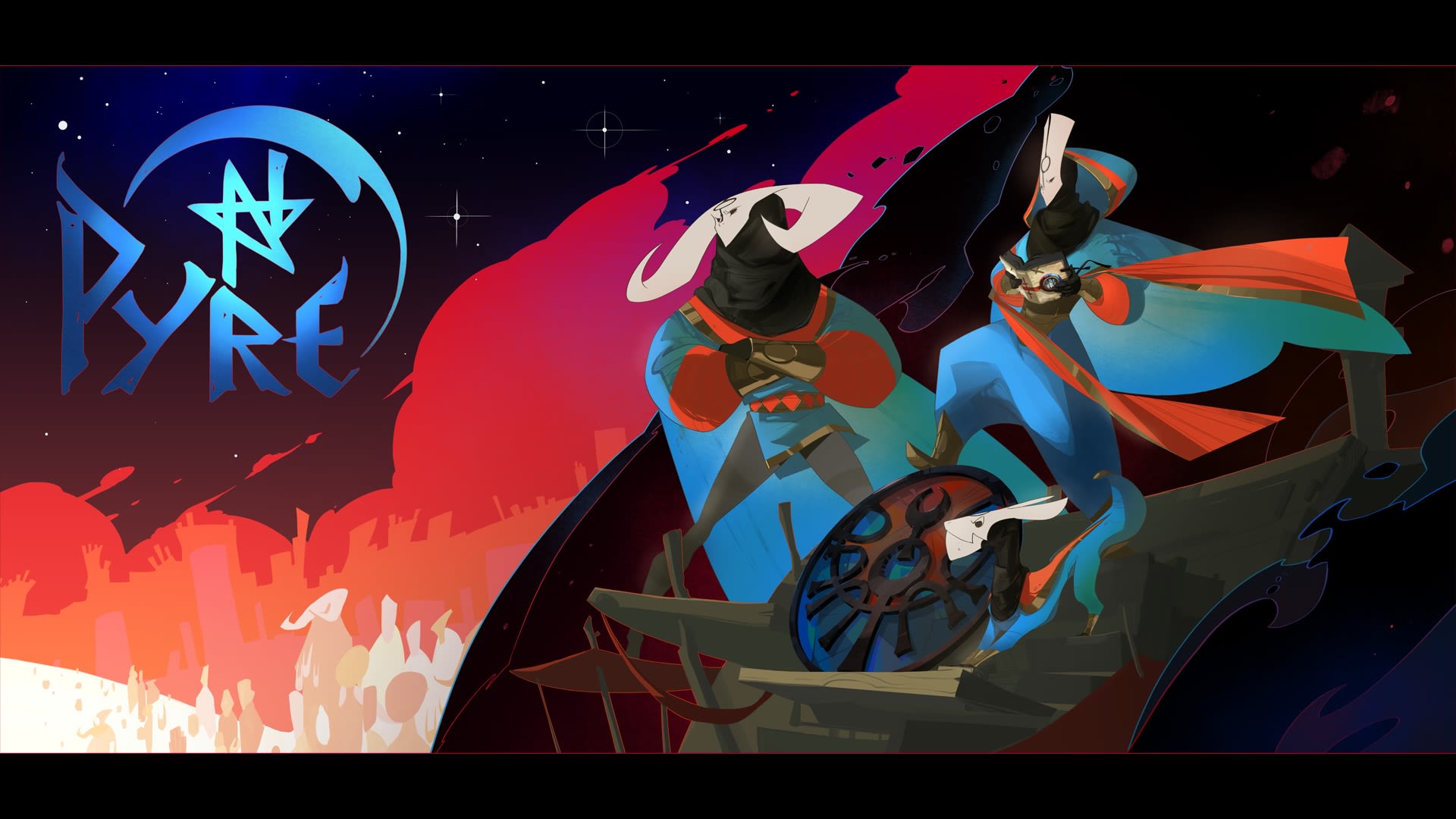
Developed and published by Supergiant Games and released in July of 2017, Pyre is a fantasy sports RPG visual novel chimera available on PS4 and PC via Steam. Its premise involves the player descending into a gloomy and fantastical purgatory and teaming up with a variety of colorful characters to return from whence they came through ritualized wizard rugby. Players interact with the game by reading dialogue, selecting from branching paths, managing time and inventory, and competing in a fantasy ritual sport. Please note the PC version was used for this review.
The story of Pyre takes place within a fantasy world, in a forsaken land called The Downside, and follows the exploits of a player insert known only as The Reader. All the characters in the game once lived in the nearby nation of The Commonwealth but were found guilty of various crimes and sentenced to exile as is their custom, and your crime is the scandalous vice of being literate. You are quickly taken in by a trio of exiles named Hedwyn, Jodariel, and Rukey, who in exchange for saving your life have you take up the role of Reader for the Nightwings Triumvirate in a clandestine series of competitions called The Rites. These Rites are the only way to return in glory to the outside world, so naturally The Reader tags along in search of their freedom. From there the Nightwings gather a large roster of exiles in their travels across The Downside, and the story explores the histories and motivations of the involved parties as grand designs for the future of the world begin to emerge.
Much like the game’s many genres, Pyre‘s story can be difficult to pin down because it basically operates on three different levels at the same time. Calling Pyre an adventure roadtrip tale of friendship and self-discovery, a mythological account of a religious pilgrimage at the dawn of a new era, and a tale of revolution against a broken social fabric, are all technically correct in one way or another. I personally feel the game presents each of these lenses for the player himself to choose which sits at the heart of the story. I can’t deny that after the introduction of Volfred into the narrative a lot of space is filled by discussion and progression of his Plan to rebel against The Commonwealth, but at the end of the day the game’s core focus is on The Downside where all of its main narrative takes place and thus elevates the character-driven road trip side of things for me. In fact the lack of direct exposure to the outside world means a lot of weight is placed upon anecdotal worldbuilding, and the player generally builds more of a connection to The Downside you know rather than The Commonwealth you don’t. Taken altogether the Nightwings are a strong cast of protagonists who more than carry the majority of the story’s runtime, and are the beating heart of what makes the narrative worth experiencing. The story would certainly be lesser without the pilgrimage and the Plan, but it simply wouldn’t be Pyre without the quixotic sea wyrm and the grumpy warrior-maiden. The only major flaw in the overall story is that freedom as defined through Volfred and thus the game as a whole is “living without fear of judgement,” and that just isn’t what freedom is, thereby weakening the whole Plan side of the narrative. Freedom is actually defined as one’s ability to do what is moral and good, at least if you want a healthy definition, and by coupling itself to the definition it does Pyre’s entire arc about freedom and political change is held back by flawed first principles which are wholly Libertarian and fragile.
Gameplay wise, Pyre is fundamentally centered around its fantasy sports competitions. No, not those derpy spreadsheets you keep during your favorite sportsball seasons; a literal fantasy sport. The player fields three characters from their Triumvirate in each Rite they participate in, and the goal of the game is to get the Celestial Orb into the opponent’s pyre until it is extinguished while preventing them from doing the same. The main obstacle that you and your opponents pose to each other are the exiles’ Auras, emanations each participant produces which temporarily banishes foes on contact and leaves them out of the game for a few crucial seconds. Different exiles have Auras that function slightly differently, but their two universal features is that they grow larger when overlapping with their allies and they are gone completely while holding the Orb. Couple all of that with the ability to Cast the Aura and strike at foes from afar, and rushing to your opponent’s pyre can get quite tricky. When you do finally score, it can happen in one of two ways. If you choose to score from a distance by throwing the Orb into the pyre, you will deplete it based on the amount of time you held the throw button beforehand. You may also dive directly into the flames to immediately score the maximum possible damage, but this removes the character from the Rite entirely until another blow is struck. The last major feature of the sport is that both sides may only have one moving character at a time, so learning how to tactically position your players before swapping to control another (usually to block off areas with their Aura) is arguably the most vital skill you can learn.

This is all quite a complicated web of elements which Pyre throws at you at all at once, but thankfully the game’s tutorials get you on the ground floor pretty intuitively, and the difficulty curve of the Normal difficulty is well considered for a first-time player (though as a returning player I probably should have played on Hard…). Once you learn how everything fits together, there’s a lot of fun in experimenting with team composition and implementing your own little tricks. You could try a defensive team which seeks to banish the enemy with their large Auras before striking the pyre for high damage, an aggressive team built for two speedy runners to weave into the goal and secure victory by a thousand cuts, learn how to pass the Orb or generally swap characters during their run or jump momentum to push multiple players deeper into enemy territory, learn how to attack your opponents by throwing the Orb into their hands and disabling their Aura, and so, so much more. It’s one of the most unique core gameplay systems I’ve ever encountered; both mechanically and flavorfully rich in ways others haven’t come close to.
As regards the structure surrounding the Rites, this is where the RPG and visual novel elements come into play. As you traverse The Downside you’ll make a variety of decisions on where to go on your way to each Rite, and different routes offer different rewards. The simplest rewards are the temporary stat boosts which can affect who you bring into a match, but you can also find items to sell at the Slugmarket or special Talismans, and rarely you can find spots that give an exile experience points. All three of the benefits are available at stops suitable for pursuing Vocations, with the added benefit of stat boosts being permanent if you pursue them. Experience points are fairly self-explanatory: you get enough of them and you obtain a perk point to upgrade your exile with. The perks are contained within two specialization trees of four perks each, and an exile can have four perks maximum, so you are encouraged to allocate these points wisely to build each character in a way that will give you an advantage. Stamina and mobility perks are almost universally the best options by far, so unfortunately the build system doesn’t offer nearly the amount of customization it should unless you’re ok with a weaker build, but occasionally there will be later perks worth spec-ing into the weaker tree for such as Jodariel’s initial pyre health boost. Items on the other hand are mostly worth their weight in cash at the Slugmarket, which offers a wide selection of Talismans that serve as the game’s equipment system. Talismans can unlock some unique ways of engaging with the Rites such as giving you a chance to respawn instantly after banishment or turning the Orb into a projectile attack, so if you like customization then this will be your main activity. Personally I don’t spend all that long shopping when each exile can obtain a uniquely tailored Talisman for free just by completing a Scribe Trial offered through the practice feature, but those more inclined to min-max will definitely be seeing a lot of Ron.
The more notable side of the space between Pyre’s main competitions is the fact that each decision is often tied to unlocking an exchange of words between yourself and one or more of your allies. This is often where a lot of each character’s backstory and chemistry are to be found, and as such you’ll often want to ignore the practical features of a route just to see more of an exile you don’t know as much about. This is especially important because of the impending Liberation Rites, regular boss encounters where victory means sending a teammate back to The Commonwealth and saying goodbye seemingly for good. It’s rare to send back an exile who you know truly nothing about since only your strongest partners are eligible to leave, but the limited time you have to spend with each character is a solid motivation to explore each character nonetheless.
After the credits roll the main activity is to replay the game on higher difficulties, as this not only makes the game more challenging but also allows you to enjoy using different characters and triggering story events you otherwise might have missed. There is also an exhibition mode which allows you to play with nearly any combination of characters, Talismans, perks, and even Triumvirates in the game, with the added bonus of being local PvP compatible. Considering the RPG elements of the game would make constructing a standard ruleset quite challenging and you would need to find local players who also played and enjoyed the main campaign to appreciate this feature, you’re definitely not going to start any esports Pyre leagues anytime soon (much to my dismay). It is a great sandbox in its own right though, and definitely worth messing around with for a few matches.

Presentation wise, Pyre continued the Supergiant tradition of having captivating art without missing a beat. Their titles have often been about capturing a sort of desolate beauty amidst hostile environments, which is a thematically appropriate direction for a game that allows its protagonist to ponder the idea that freedom might have less to do with escaping The Downside than it first appears. Its world is undeniably dour and gnarled by the scars of ancient conflicts with unfathomable beasts, but balances the pain with a certain whimsy in the land’s shape language that almost feels like a midpoint between comic books and Dr. Seuss. The character design is also quite sharp and memorable, with the many exiles having details about themselves which avoids boiling its characters down into mere avatars of the races they belong to. Rukey being a talking dog might have been the stopping point for most people, but instead his design is littered with ostentatious displays of wealth which speak to his desperate desire to emulate the garish nouveau riche-esque life he once had, and even has a mustache which he will conscientiously shave if the player recommends. And the other Curs in the game have styles distinct from his!
As for the game’s music, it’s one of those soundtracks so good that I bought the full album on iTunes. It generally centers itself on a few different kinds of guitars like acoustic and soft electric, but the music does not shy away from throwing in just about any instrument for the sake of coloring its leitmotifs. From breakbeats to harpsichords to brass sections and more, every song in the game is engineered to have a strong connection to whatever it plays over. This is all compounded by the fact that dynamic layers are front and center in the game’s most climatic songs. The various Triumvirate themes have second layers, usually percussive, which kick in whenever someone grasps the Celestial Orb as if to hype up an impending goal. The vocal theme of the Liberation Rights, Never To Return, has different lyrics altogether depending on the team you’re facing, which is to say NINE different variations. Truly a labor of love in the sound department, and one I wholeheartedly recommend you check out even if you never play the game itself.
Finally to reflect upon Pyre from the Catholic perspective, there is a lot of material we could go over so I will attempt to keep things more in the broad strokes. Starting more on the level of positive parallels, I’m actually very impressed with how the Rites embody Purgatory which the game as whole heavily draws from. The exiles’ Auras are manifestations of their sins, which they gather up into the Celestial Orb (a grace from Heaven) and throw it and themselves into the pyre (the flames of Purgatory). Through this repeated trial these exiles attain enlightenment (purgation and forgiveness), with success primarily determined by their ability to have three act as one (a meditation on and rudimentary imitation of the Triune God), all with the ultimate goal of ascending to freedom and glory in their homeland (entering our true home in Heaven). Obviously there are elements and discrepancies worth critiquing here, and I certainly will, but in offering the game at least some leeway to be its own fiction I find the parallels on offer to be strikingly satisfying. Purgatory is not a subject most people have really dwelt upon to a serious degree, especially not in video games, so to see a game engage with it in a symbolically serious way is definitely appreciated.
This all must of course be understood within the context of how other spiritual influences distort the overall applicability, which while not a problem in and of itself in a fantasy story does merit warning so that the prospective Catholic player can identify what is inspired and what derives from a superstitious origin. The most self-evident point of difference is of course the heavy use of astrology which permeates the language and aesthetics of the game. This should be pretty obvious, but to make it explicit: no, the stars are just fixtures of the universe God made and do not contain any particular divine power and wisdom. Those versed in astronomy might be able to licitly use them as guide posts such as the wise men following the Star of Bethlehem, but using them for divination and horoscopes (both present in the game but the former more significantly than the latter) falls well outside true religion and mustn’t be engaged with.
The more subtle yet more concerning side of Pyre’s fictions is without a doubt its gnostic elements. This element is significantly less obvious because most of the hard evidence for this is gleaned from the text in The Book of Rites, aka basically the equivalent of lore dump datalogs in other games, but there are certain terms and minor lines that point to it too. The key element of this parallel is the Rites being a highly secret affair, with The Book being magically unable to be reproduced and returned exiles being charged with not telling others of the Rites. This combined with the experience points in the game being titled ‘Enlightenment’ and the return to The Commonwealth being a literal ascension, all gives the game an eerie resemblance to the heresies that posit salvation as a function of hidden knowledge to be guarded jealously. This of course is all counter to Christ’s commission to make believers of all men, and ironically makes me agree with Volfred’s Plan’s necessity on the grounds of overthrowing a literal gnostic cabal that runs society. Overall I do genuinely want to extend props to the purgatorial references in the game, but it does have enough superstitious influence that I would recommend a healthy skepticism going into the game.

In conclusion, Pyre is an excellently crafted game with a truly original gameplay loop backed by endearing characters, memorable art direction, and an amazing soundtrack. Ultimately its occult references notably limit the pool of gamers I would actively recommend the game to, but well-formed Catholics with a similar taste for smaller artsy projects like this are sure to find something here that will impress them. It’s not a title for everyone, but you won’t find anything like it elsewhere. Now if you’ll excuse me, I’m going to listen to Downside Ballad for the eightieth time.
Scoring: 96%
Gameplay: 5/5
Story: 4/5
Art and Graphics: 5/5
Music: 5/5
Replayability: 5/5
Morality/Parental Warnings
Pyre’s chief concern for prospective players is its occult themes, as the main narrative draws heavily from astrology and gnostic sources for is mystic fantasy sport, as discussed in the article proper. This sport is literally called The Rites, the in-game codex is diegetically presented as an esoteric text, and it gives instructions on how The Rites are to be carried out. The sport itself and the game as a whole features nothing violent beyond the players plunging into purifying flame, as players who are struck by opposing auras are just banished from the field for a time. Beyond The Rites themselves, the bog-crones are a race of snake ladies who specialize in enchantments and curses, the Eight Scribes who first created the path to liberation are regarded as a pantheon of gods or saints depending on who asks, and the lands of The Downside are blighted by the remains of evil titans slain in ancient times. These titans have stars associated with them in the night sky, which the player is allowed to invoke for exp bonuses in the Rites. The bog-crone Bertrude even asks you to invoke one during a particular encounter. The player is also allowed and encouraged to collect various Talismans which affect players’ performances in The Rites. In general this game is not especially suited for players fascinated by the occult.
The game’s story focuses mostly on the main cast’s drive to be freed, but there is a major subplot of revolt in their homeland which ends more or less violently depending upon the number of exiles you free. Both Volfred’s definition of freedom and the player’s options to respond to the question of what freedom means are both wrong, and betray the game’s ideological biases. Foul language is not super common but definitely present. Female character design is largely appropriate, with the most immodest character being Pamitha due to her cleavage window. The player may designate The Reader’s pronouns as ‘they’ and ‘them’. In a conversation between Pamitha and Hedwyn, Pamitha attempts to be inclusive by not assuming Hedwyn is attracted to women (which he is).