Faith: The Unholy Trinity is an independent horror game developed by Airdorf Games and published by New Blood Interactive on Steam and Nintendo Switch in 2022. Some might question why I would play a game with such a blasphemous sounding title, but others might ask why it took so long for CGR to cover a game with such obvious religious themes. To the latter point my only defense is I wasn’t into horror games 4 years ago and to the former I assure you if this game was truly blasphemous I wouldn’t be writing this review at all. Needless to say we’re in for one heck of a review so brandish your cross and buckle up.
In Faith: The Unholy Trinity you play as Father John Ward, a priest struggling with the trauma of a failed exorcism which left a girl named Amy Mason trapped in a demon’s clutches. At the beginning of the game he returns to the Mason’s house to set things right, but what he’s about to do has not been approved by the Vatican. The tricky part about analyzing Faith: The Unholy Trinity’s story is the somewhat blurry lines between past events and present takes a little time to wrap your head around, not to mention the many alternate endings it is possible to achieve. That being said, I do think it’s a compelling tale of guilt, redemption, conspiracy, and the occult that’s not for the faint of heart.
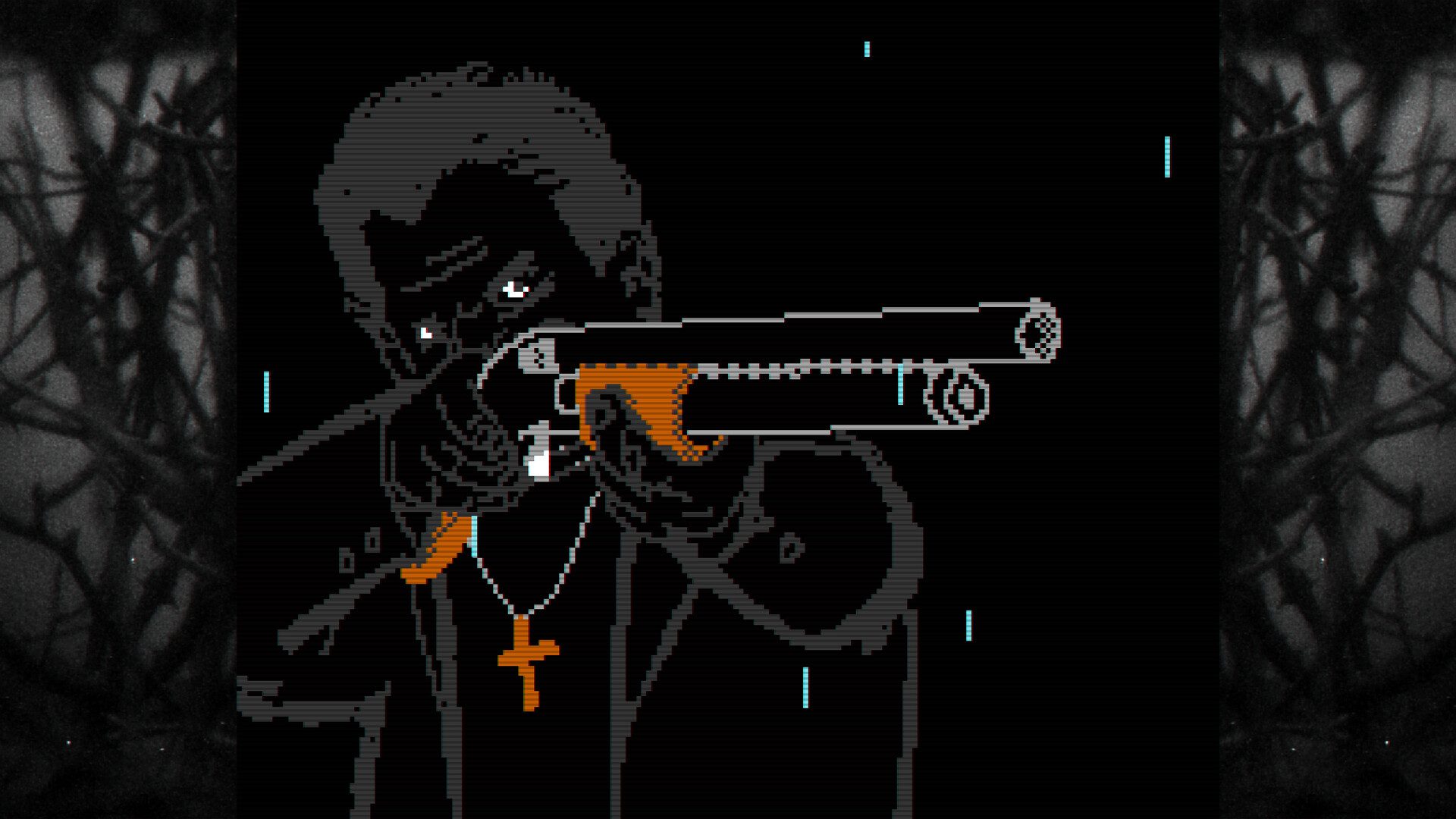
One of Faith: The Unholy Trinity’s most striking aspects is its presentation, which attempts to emulate the look and sound of an Atari 2600 game with only a handful of modern flourishes here and there. Characters and locations are rendered with big, blocky pixels and often use only one of two colors. The player’s imagination will have to do most of the heavy lifting to parse together what’s happening on screen, but occasionally the story will throw much more detailed cutscenes at you to punctuate a dramatic or scary moment. Music is also rather simplistic, but also intentionally strange and even discordant to create a tense, creepy, and unsettling atmosphere. I also want to highlight the voices, which are synthesized in the same technologically primitive style and creates an uncanny, robotic sound that compliments the horror perfectly.

Simplicity seems to be a key word for Faith: The Unholy Trinity because that is exactly how I would describe the gameplay as well. For story reasons Fr. Ward walks with a limp so moving around the screen is a much slower, more deliberate action that you might think. This becomes especially important during encounters with demons where one bad step could get you killed. The only other action besides movement is a button that causes Fr. Ward to raise his cross in front of him. This action allows the player to exorcize spirits hiding in environmental objects and deals damage to demons attempting to approach you. The game’s simplicity makes it very easy to pick up and play, but the fights against the demons are designed to push these mechanics to their absolute limit so don’t expect the game to be a walk in the park either.
It should also be noted that Faith: The Unholy Trinity includes a plethora of alternate endings based on certain choices the player makes in each of the game’s 3 chapters. In the 1st chapter I was able to get the best ending by making the most moral choice from the options presented. In the 2nd chapter your ending is determined by how you perform against the final boss which was admittedly really hard, but I was once again able to achieve the best outcome. In the 3rd chapter I was able to get a pretty good ending all things considered, but the best ending is locked behind a laundry list of optional side quests that aren’t directly spelled out for the player. While I did find this gatekeeping of the true ending a little irksome, the game is already quite short so it’s understandable the developer would want to use this system to increase the game’s replayability.
By now it should be obvious that Faith: The Unholy Trinity’s quality as a game isn’t in question, but the extent of the game’s occult content still remains. Well to make a long, and somewhat esoteric, story short I think the game handles it relatively well. I don’t like the fact that it perpetuates the common misconception of the inverted cross being a satanic symbol when in actuality it’s the cross of St. Peter, because St. Peter was crucified upside down. Though to be fair by the same logic you could say the same thing about the pentagram, which was used by Christians in the medieval period as a symbol of the 5 senses, the 5 fingers of the hand, the 5 wounds of Christ, the 5 joys of Mary, and the 5 virtues of knighthood, but the pentangle(unlike the cross of St. Peter) hasn’t been a prominent Christian symbol in a very long time so I won’t pretend to be especially outraged by the way it gets co-opted by anti-Christian groups. Symbolic nitpicking aside, Faith: The Unholy Trinity makes it very clear that God is good, Satan is evil, and the human characters in the middle are flawed people being pulled in every direction so I don’t have any major issues with the game from a Catholic perspective.
I’m only barely scratching the surface when it comes to spiritual analysis of Faith: The Unholy Trinity, but that’s because a much better analysis made by a more qualified individual than I already exists. My ultimate decision to play this game was heavily influenced by a priest who reviews video games and anime on YouTube under the name Pixel Padre so go check out his video on Faith: The Unholy Trinity if you really want to see just how deep the rabbit hole goes. As for the conclusion of my own review however, I enjoyed playing through the game as it is very well made despite its simplicity, but that simplicity is a bit of a double edged sword as I don’t feel a desire to replay the game again anytime soon. It’s definitely a game I would recommend to fans of other horror games, so long as you spiritually discern your ability to grapple with the occult themes presented. “The Lord is my light and my salvation; whom should I fear?” (Psalm 27:1)
Scoring: 84%
Gameplay: 4/5
Visuals: 4/5
Sound: 5/5
Story: 4/5
Replayability: 4/5
Morality/Parental Warnings
Violence/Gore: In encounters with demons, the player character will collapse to the ground in a pool of blood if touched by a demon. The game features many bloody human and animal corpses within demon infested locations. At one point the player is given a gun which they can use to execute a possessed person or use in self defense against a demon. Later in the game a supporting character uses a shotgun to hold off waves of cultists while the player completes another task. Some scenarios involve the player or other characters being stabbed with scissors and keys or injected with needles.
Language: Swear words appear within the game’s dialogue both in English and in Spanish.
Substances: Journal entries detailing the game’s backstory contains references to alcoholism and drug addictions. Some cutscenes depict characters smoking cigarettes.
Sex: There are naked bodies in the game, but no genitalia is depicted. During the game’s true ending the player can choose to romance a side character they rescued earlier in the game.
Occult: The player encounters demons and demon possessed humans throughout the game. A cutscene occurs with an unnamed figure obscured by white light who is heavily implied to be the devil. A satanic cult is revealed to be responsible for most of the demonic activity seen in the game. Pentagrams and other occult symbols are present throughout the game. St. Peter’s cross is mistakenly used as an occult symbol.
Abuse: Journal entries sometimes detail domestic abuse and prostitution. The satanic cult controls both an abortion clinic and an orphanage where children are abused.
Horror: There are many shocking scenes throughout the game intended to scare the player. The demons the player encounters often have grotesque appearances. The music is purposefully discordant to invoke an intense discomfort in the player.