Compared to video games, board and card games don’t typically feature the same kinds of discourse around whether its design should be more casual-centric or enthusiast-centric. A free competitive video game where everyone can jump in and immediately start having opinions makes it easier for one side or the other to try and impose a certain vision on the game’s design, especially due to the culture which has developed around patch notes. By contrast the upfront cost of buying a tabletop game, and the commitment of making time to play it with a local player, puts much more onus on the customer to simply buy something they can be relatively sure hits the experience they are seeking. Is it possible that a tabletop game exists that hits both crowds at once though? Today I think I’ve found something that gets really close to that happy medium, so let us examine it in further detail.
Exceed Fighting System is a product line from Level 99 Games that has existed since 2016, and was designed around being a collectible board game featuring various different Intellectual Properties with each installment. Whether it be something original by Level 99, a board game series by another company, or various video game collabs, it’s all fair in XFS. However, hooking the product so heavily to collaboration makes the series’ long-term availability quite difficult to maintain, so a lot of these products are difficult to come by (other than the free Tabletop Simulator mods of course). In fact the newest season of Exceed, a collaboration with the Skytear board games spearheaded by a company of the same name, is exclusive to the people who crowdfunded it! However, with the recent reprint of season 2, Seventh Cross, we now have at least proof of the potential for more long term availability in the future (even if only for the in-house IPs), which is part of what made this review worth writing. Going forward, keep in mind that all seasons of Exceed are compatible with each other and share enough DNA for this to be a comprehensive review of the game series as a whole, but I will be focusing on the Seventh Cross content since that is the most readily available version as of writing this.
I wouldn’t go into Exceed looking for a narrative, as the game is only focused on its gameplay and isn’t terribly concerned with explaining the worlds it features so much as it wants to make them look cool. Seventh Cross is a particularly interesting case though, as it’s based on a campaign-style board game Level 99 was developing at the time (think Gloomhaven and similar titles) which seems to have more or less died in development, and consequently XFS became the main medium through which its world and characters exist at all! Consequently there’s not much to learn about its playable characters unless you really dive into the annals of the interwebs, but expect a dark fantasy-noir atmosphere where monsters hiding in human visages do battle with paladins, mages, and adventurers with inhuman sides of their own. A lot of this is actually communicated through play via some incredibly flavorful season mechanics, but we’ll get into that soon.
Playing a game of Exceed sees players select a character from whatever pool of fighters they have available, and setting their character cards on a straight 9-space board before shuffling their 30-card decks. These decks consist of eight Normals, five Specials, and two Ultras, with two copies of each card. Normals are identical between each character and form the foundation of Exceed’s combat theory, while Specials are unique to each character and focus on furthering their core gameplans, and Ultras are payout cards which cost extra resources but secure devastating advantage when timed correctly. The goal of the game is to reduce the opponent’s life total from 30 to 0 through straightforward but strategic card-based combat. On a player’s turn they can take one of seven actions, six of which also allow you to draw a card after resolving them. The Reshuffle action generally is only ever used if you run out of cards, and it can only be used once per game (with decking out being an alternate lose condition if Reshuffle is used up). The Prepare action effectively eschews the other actions in favor of drawing two cards on turn’s end, which is a stable but low-tempo option in most situations.
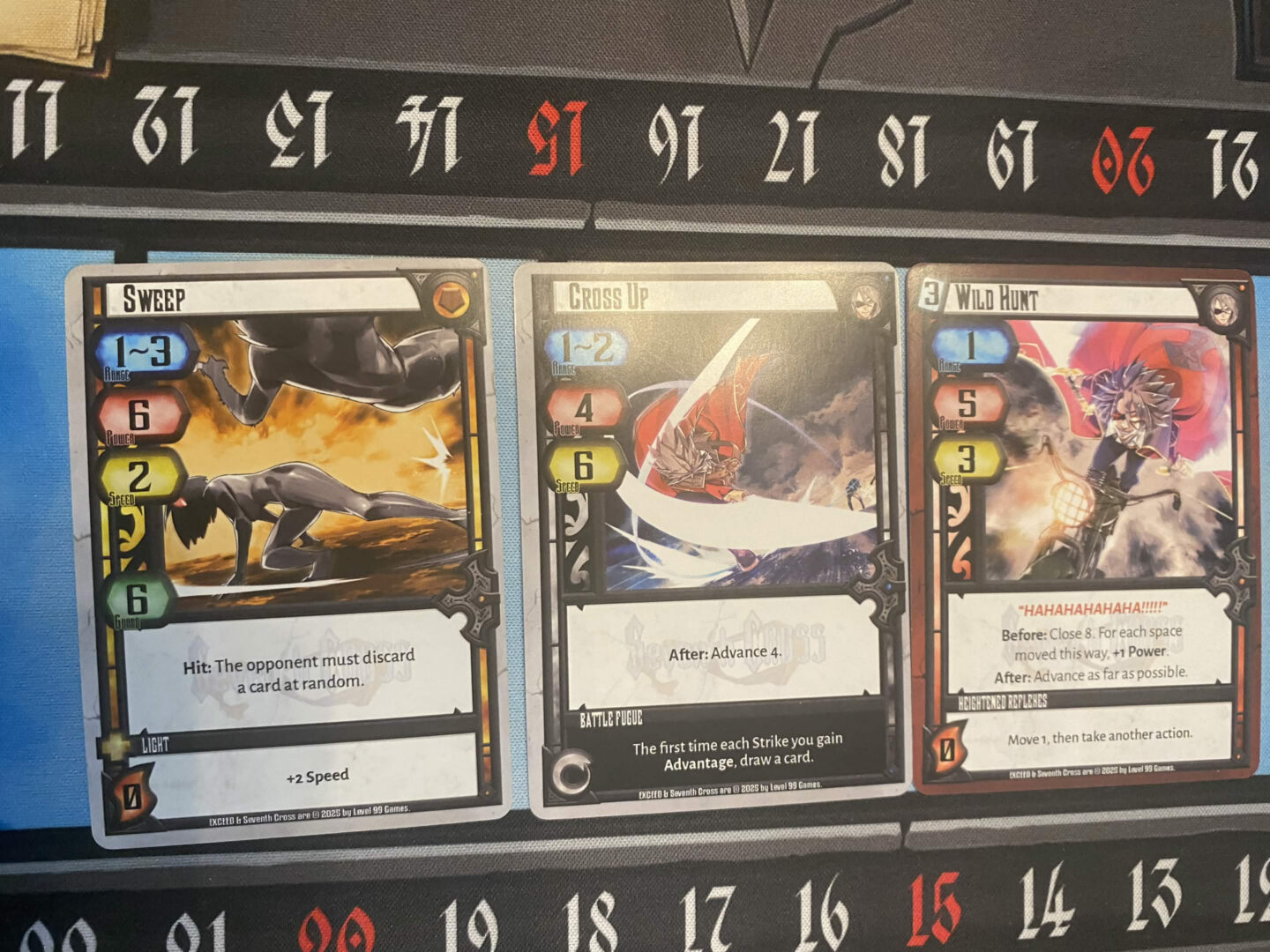
The real meat of the game comes in the form of the Strike action, which allows you to attack your opponent with a card from hand and is the only action that you don’t draw after. Both players set their attacks face down, then reveal and resolve. Each attack has a Range which denotes where it can hit based on the number of spaces the fighters are from each other, a Power that communicates how much damage it deals, a Speed which determines whose attack resolves first (initiator wins ties), and sometimes Armor and Guard which reduce damage and grant a stun threshold respectively. The vast majority of attacks also feature card text with effects and triggered abilities which can add anything from repositioning characters, to changes in hand economy, to conditional bonus damage to the Strike. An attack which lands deals damage equal to its Power minus the opponent’s Armor (if any), and if the damage total is above the opponent’s Guard (if any) they are stunned and cannot resolve their counter attack. After both sides have resolved their attacks if able, those who landed hits add their attack to their Gauge while those who whiffed or were stunned simply discard them and a new turn begins.
The bottom of most cards also contain a secondary use called a Boost, played using the action of the same name, which allows you to use cards in ways other than directly attacking. Some are instant effects like advancing or retreating a number of spaces, while others are continuous effects that usually last until the end of the next Strike and often boost the stats of your attack. Some Boosts can only be played by generating Force due to the strength of their effects, which is obtained by discarding cards from hand or Gauge at a rate of 1 per card and 2 per Ultra card. Force is also used in the Move and Change Cards actions, which do roughly what they say on the tin. Force effects are certainly pretty boring casually, but they are essential to learn how to use correctly if you want to play more competitively.
The last main action you can take is Exceed, which for a cost in Gauge allows your character to obtain a leveled-up passive ability for the rest of the match. Seventh Cross characters typically have above-average costs to Exceed, but this is because most seasons of XFS have a special mechanic that enhances their gameplay identity, and Seventh Cross’ mechanic directly interacts with Exceed. Said mechanic is Transformation, which replaces the Boost section of some Specials and Ultras and can only be put into play either by discarding another copy of it, or by landing the attack it is written on in a Strike as an alternative reward to Gauge. Once Transformed, these cards effectively become permanent Boosts that can’t be discarded through normal means. On top of whatever passives or unique actions they unlock, they also discount the Gauge cost of Exceeding by 2 (even down to 0!).
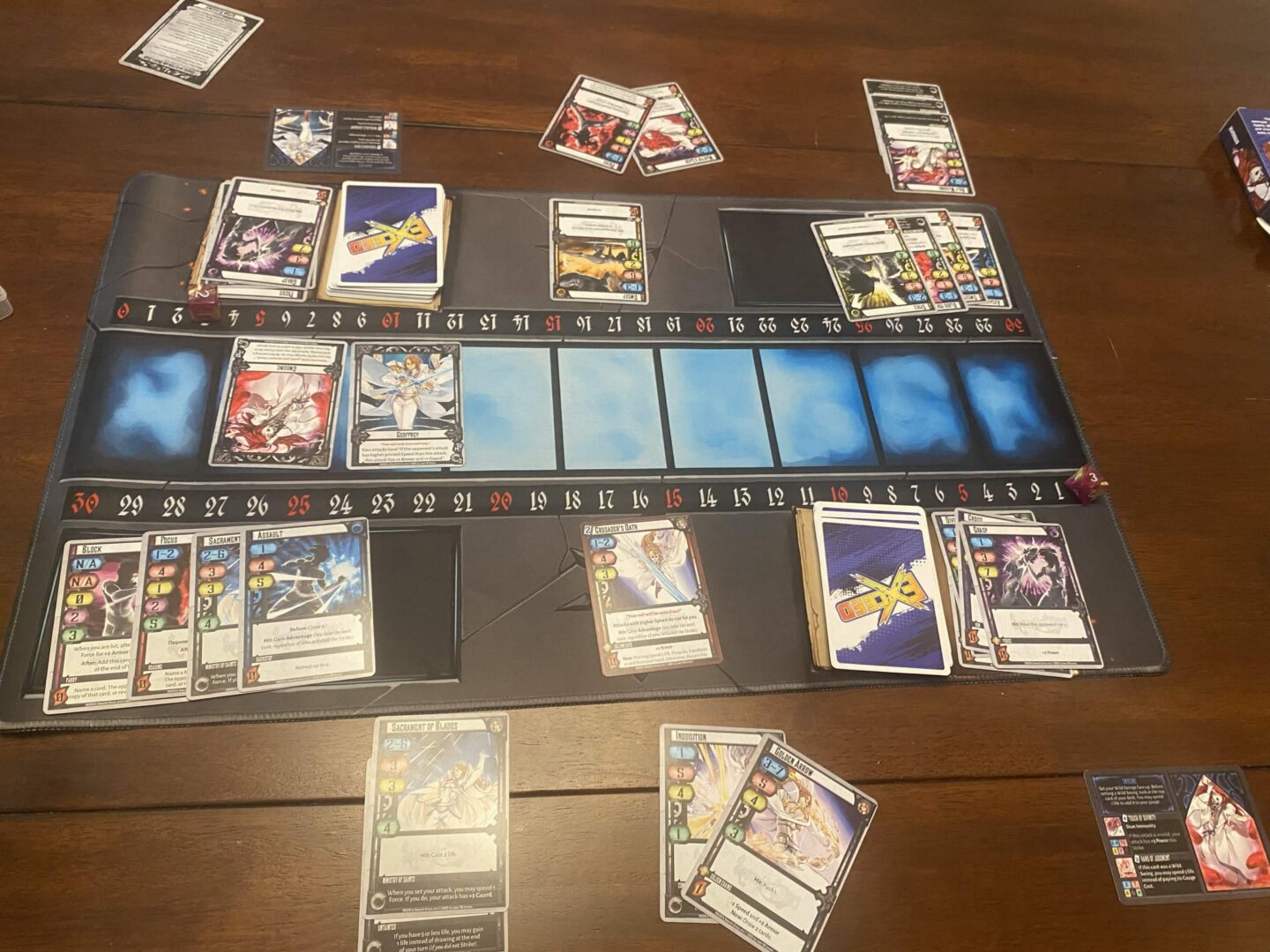
This covers all the basic rules, so how does Exceed feel to play in practice? In my humble opinion, pretty great. Once both players know the mechanics well enough to make relatively informed decisions, matches can either move very quickly due to the simplicity of each action’s resolution, or very slowly as each player carefully considers what could be in each other’s hands to choose the right tool at the perfect time. As I alluded to in this review’s opening, this game series has plenty of depth to master in the realms of resource management, understanding each card’s use cases, and learning to combo different cards together for unbeatable effects, but it just as easily works as a game for two friends to casually pull off flashy moves against one another. The choice to build the game around fixed card decks adds enough luck to the game to keep things casual and avoid potential deckbuilding skill gaps, but offers just enough consistency for the advanced player to learn and exploit. It’s very close to that golden mean, which is not only solid game design in itself but also makes Exceed a relatively safe choice if you’re not sure if the person across from you is a casual or a nerd.
The Seventh Cross season in particular earns extra points for being a triumph of flavor through gameplay. Each fighter’s hidden side is represented by their Exceed side often being a brand new ability that plays off their existing powers in a new and usually aggressive way, as opposed to other seasons leveled-up sides which are often flat upgrades. Timing this form change is important to actually sealing the deal however. Sometimes you might be in a situation where your more conservative base ability is objectively more useful, or the level-up might rely on cashing out a resource only your base form can generate efficiently. Subsequently, every match becomes the epic conclusion to a dark-fantasy tale of monsters and hunters fighting for the fate of the world. At first the fighter’s secret power lies far beyond their reach and their humanity is largely intact, but by successfully putting your Transformations into play the character draws closer to their other nature and potentially might even be able to effortlessly shed what remains of who they are at any given moment. And once the big moment where their true colors are revealed finally comes, it might turn into a story where their terrifying new might utterly crushes the foe before them… or a tragedy where they threw away their humanity carelessly when remaining human (even if only a little bit longer) could have saved them. That is DELICIOUS ludonarrative harmony for a game that’s not even about story.
As for my critiques of Exceed’s gameplay, there aren’t too many but they are worth sharing. The one worth mentioning for Exceed regardless of season is that the Boosts featured on the Normals that every character has access to are deceptively powerful despite the simplicity of their effects, with a strong suite of options for stat-sticking, gathering intel about your opponent’s hand, and repositioning. It’s very much a scenario of “if everyone is overpowered, no one is overpowered”, but it can nonetheless be very obnoxious to play against. Anyone who has played this game for a moderate amount of time can tell you that Sweep’s Boost giving +2 Speed is one of the most frustrating things to deal with no matter what matchup you’re running! My critiques get a little more broad when focusing on Seventh Cross’ iteration of the game specifically. The main issue is that while most characters effectively capture the core fantasy outlined in the previous paragraph, some unfortunately didn’t pan out due to some weird design choices. The most famous example being the poster character Geoffrey, whose base ability is so generically effective such that actually becoming The Faceless Judge actively weakens him unless you happen to already be in a strong position to win the game. All of this season’s characters should have good and bad times to change forms but a few of them, and this one in particular, are just way too niche.
It’s also worth noting that while I do believe Exceed is an excellent middle ground between card game casuals and enthusiasts, some seasons cater more to one side than the other and Seventh Cross is definitely more on the enthusiast side. This is largely due to the fact that Transformation effects can really add up if you manage to get a bunch of them out, and it can be hard to remember them all in the heat of the moment as a less experienced player. The design of earlier seasons of Exceed in general are also still very card game-y compared to later seasons which better reflected the fighting game inspirations this one is built upon (due in part to many future seasons being collabs with fighting games, but the point stands), which applies quite well to the Seventh Cross set. This might actually be more of a positive for you, but as a more well-traveled player of the game it does kind of stink that Seventh Cross has no character dedicated to the Advantage keyword which would let me do silly Strike-chains like I would with some other seasons (Zsolt is pretty close though).
If you do decide to take the plunge, Exceed: Seventh Cross is divided into five boxes at $20 dollars apiece, with four characters featured in each box. The game is fully playable with even one of these boxes, but you’re free to buy more to have a higher volume of potential matchups to play instead of just running the same four characters over and over. It’s obviously a matter of prudence how many boxes you’ll buy and I will trust you to do your own research as far as whether a specific box is right for you, but I’ll also give a quick buyers guide here for those struggling to pick just one (or one to try first). Church vs. Empire is probably the most quintessential box in the entire set, featuring a strong spread of characters in terms of complexity and power level, on top of its featured characters capturing the feel of the Seventh Cross universe exceptionally well. Hunters vs. Demons is pretty similar in quality while also featuring some of the season’s strongest characters in the same place for the more competitively minded, at the cost of being a slightly more complex box overall. Magic vs. Monsters has probably the highest density of easy to play characters if you’re mostly aiming for casual play, though personally I think other boxes capture the theme and setting of season 2 a bit better. Guardians vs. Myths is more orientated to the more tabletop savvy clientele, but features solid gameplay variety and comes with a character great for playing against newer players when teaching the game (Iaquis). Ancients vs. Artifacts is a bit unique as it’s actually a collection of characters who were originally sold as standalone fighters, with two of the characters being reskins of fighters from crossover content, and as such they can be on the tougher side to master (it does have a Wild Swing focused character though, which is a very funny archetype to break out at any skill level).
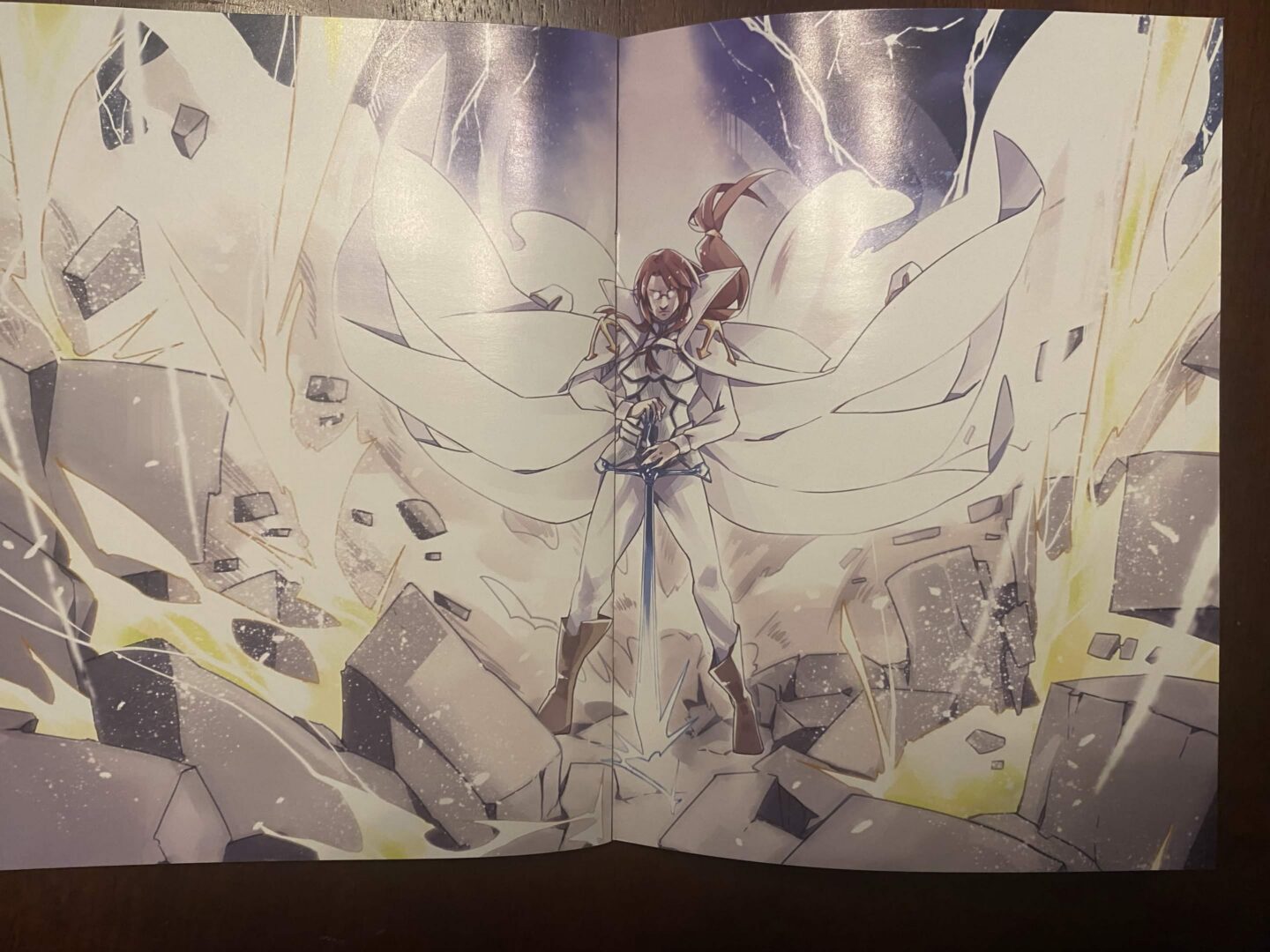
Presentation wise, Exceed cards have always been relatively easy to understand, but the Seventh Cross season was especially well designed. The bold black designs on the various borders of the cards, inspired by gothic architecture, help to make each piece of information easy to read, complete with a pleasantly thematic font choice. To this day the Normals of season 2 remain a fan favorite for their readability and style. The artwork for the various characters and their special moves are all great too, with plenty of exciting action scenes that make the duel happening on the board come to life in the mind’s eye. The anime aesthetics are definitely a bit of an acquired taste, but if you enjoy that art style then you’ll find the pieces showcased here most memorable. And compared to other Exceed seasons which often just adapt existing pieces of art, Seventh Cross being entirely original makes it stand out even more.
Due to the lack of any real story content in this game, there isn’t too much to reflect upon spiritually with Exceed: Seventh Cross. There can be something to be said for the Transformation mechanic though, largely in how it can be a reflection on how power changes people and inspires us to discern what lies in our own hearts before we attempt to do something that may bring what’s under the surface to light. Power certainly need not always make a person worse as demonstrated in-game by Geoffrey becoming more angelic, but for most of the cast Seventh Cross does a solid job showing just how far we can fall if we give into power which is bad for the soul. In real life, seizing power may not literally transform you into a scary monster, but power might unbar your normal inhibitions against sinful desires if you take it without clear purpose and humility. The examples of this are too many to recount here. Ultimately power is a gift from God like many others, and we have a responsibility to recognize Him as our source of strength in order to hold ourselves accountable and take no more than is necessary to fulfill the Christian mission. In that way we shall be able to defeat the darkness of the world not by abandoning who we are, but by becoming what the Lord has made us to be.
In conclusion, Exceed Fighting System: Seventh Cross is a solid 1v1 board game which is easy enough to learn and lends itself to quick bursts of competitive fun, while still offering a lot of depth to those who go seeking it. Its dark fantasy horror aesthetics and willingness to depict some fairly violent scenes in some of its artwork do limit the scope of people I would recommend this specific season to, but older players looking for something they can play together without cutting into their schedule much might find a ton of value in this one. It’s rare for a simple reprint to capture my attention this much, but XFS is definitely worth enjoying all these years later.
Scoring: 93%
Gameplay: 4/5
Art and Graphics: 5/5
Replayability: 5/5
Morality/Parental Warnings
The second season of Exceed Fighting System features the dark fantasy setting of Seventh Cross, with a big emphasis on characters who transform into monsters. Most of them are directly based on various pieces of mythology and folklore from the real world. Expect plenty of reference to magical powers of varying resemblance to common occult or fantasy tropes. Some of the battle scenes on the cards depict blood and/or gore, and while most of the characters are modestly designed there are a few sporting more surface area than others. For more specifics, please refer to the section on the box(es) you have interest in playing:
Church vs. Empire: Celinka’s hidden side is a Gaki, a type of ghost from Buddhist mythology. She also wears an outfit with a lot of arm and leg surface shown. Taisei’s hidden side is a Dullahan, and his head predictably detaches on his Exceed side. D’Janette is a witch and heir to a “diabolic empire” who is clearly selling her soul to hell for power based on her flavor text. Her hidden side is even referred to as “The Devil’s Own,” representing the culmination of her dark pact. Her special mechanics include a spell circle which she places on the board for some of her attacks, and a “Diabolic Aura”. Some of her unique cards feature blood, as though she’s using a spell to siphon it from her victim. Both of her outfits expose her arms, shoulders, and upper chest.
Hunters vs. Demons: Zsolt’s hidden side is his bloodlust from a murderous past catching up to him, and the artwork for his Exceed side features some blood as he plunges into his foe. Renea has a couple cards which depict some blood at the site where she or an ally shoots a man. Minato’s hidden side is a modern twist on the Japanese yokai called the Oboroguruma, and he assaults people with various passenger vehicles. Tournelouse’s hidden side is The Bargeist, a corruption of the English folk monster Barghest, and is said to wield “diabolic” power. He also has a small mist of blood on his Southpaw card.
Magic vs. Monsters: Eugenia the sorceress wears a short skirt, and her Queen of Hearts card depicts her literally harvesting a man’s heart. Galdred’s Eviscerate card also depicts him goring an enemy, likely also a human based on the visible anatomy. Remliss wears a form-fitting jumpsuit, and her Exceed side shows her hidden side (a living nuclear weapon) bursting from her torso. Umina as a character is a unity of the concepts of lounge singers, femme fatales, and Lovecraftian horror, and as such her design and artwork lean into these things in various ways. Her outfit is the most sensual of any character in the season, and she is sometimes posed rather provocatively. On the card Terror Whispers, she is depicted ensnaring another woman in her eldritch tendrils with erotic undertones.
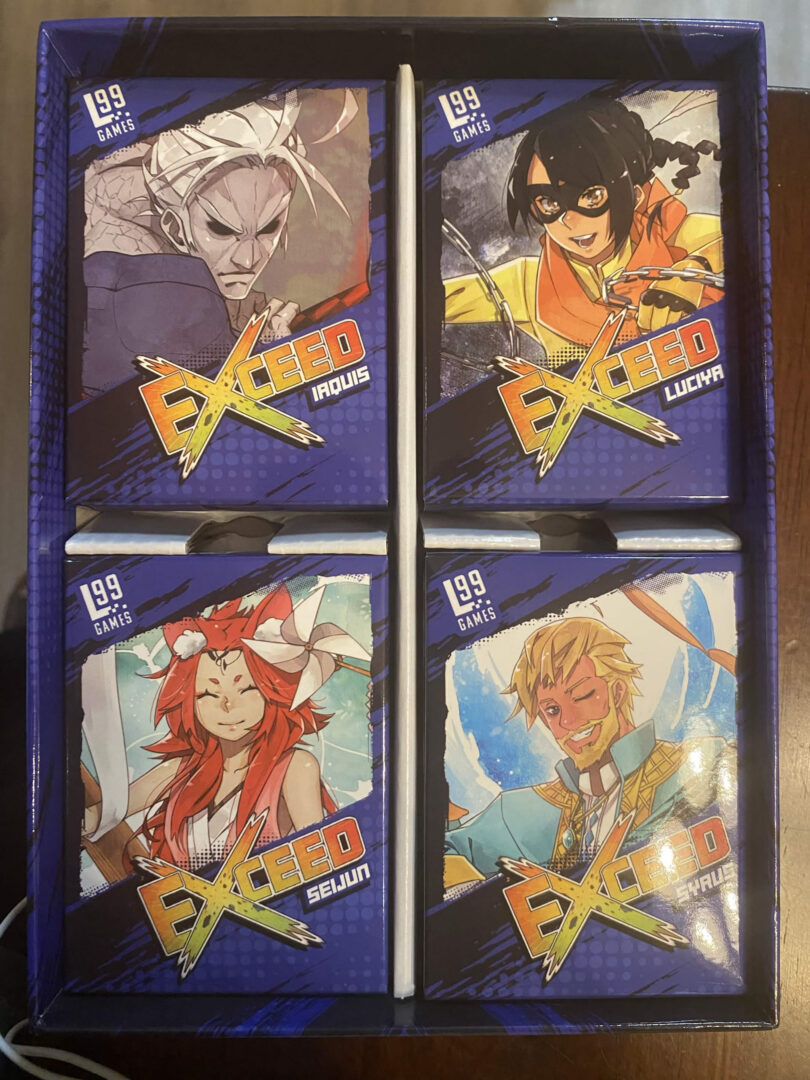
Guardians vs. Myths: Luciya’s hidden side is named after the Thunderbird from native American mythology. She also wears a spandex suit befitting a superhero. Syrus’ hidden side, The Lord of the Deep, does not sport much clothing, and his signature power is commanding dead spirits. Seijun is a nine-tailed fox from Chinese mythology, and her shrine-maiden-esque outfit shows a noticeable amount of legs and arms. Iaquis has a noticeable amount of upper body exposed in both forms, and his Dragon’s Tongue card has a mild amount of blood shown.
Ancients vs. Artifacts: Emogine’s hidden side is based on the hundred-handed Hecatoncheires from Greek mythology, which seems to allow her to use some sort of blood magic ability depicted in some of her cards. Part of Sydney’s gameplay fantasy is that his killer plant Serena eventually eats him and starts fighting on its own, which is not shown too graphically but some blood and a severed limb is depicted. Meron is a snatcher of souls. Teodora has some fortune-telling references in her art.