
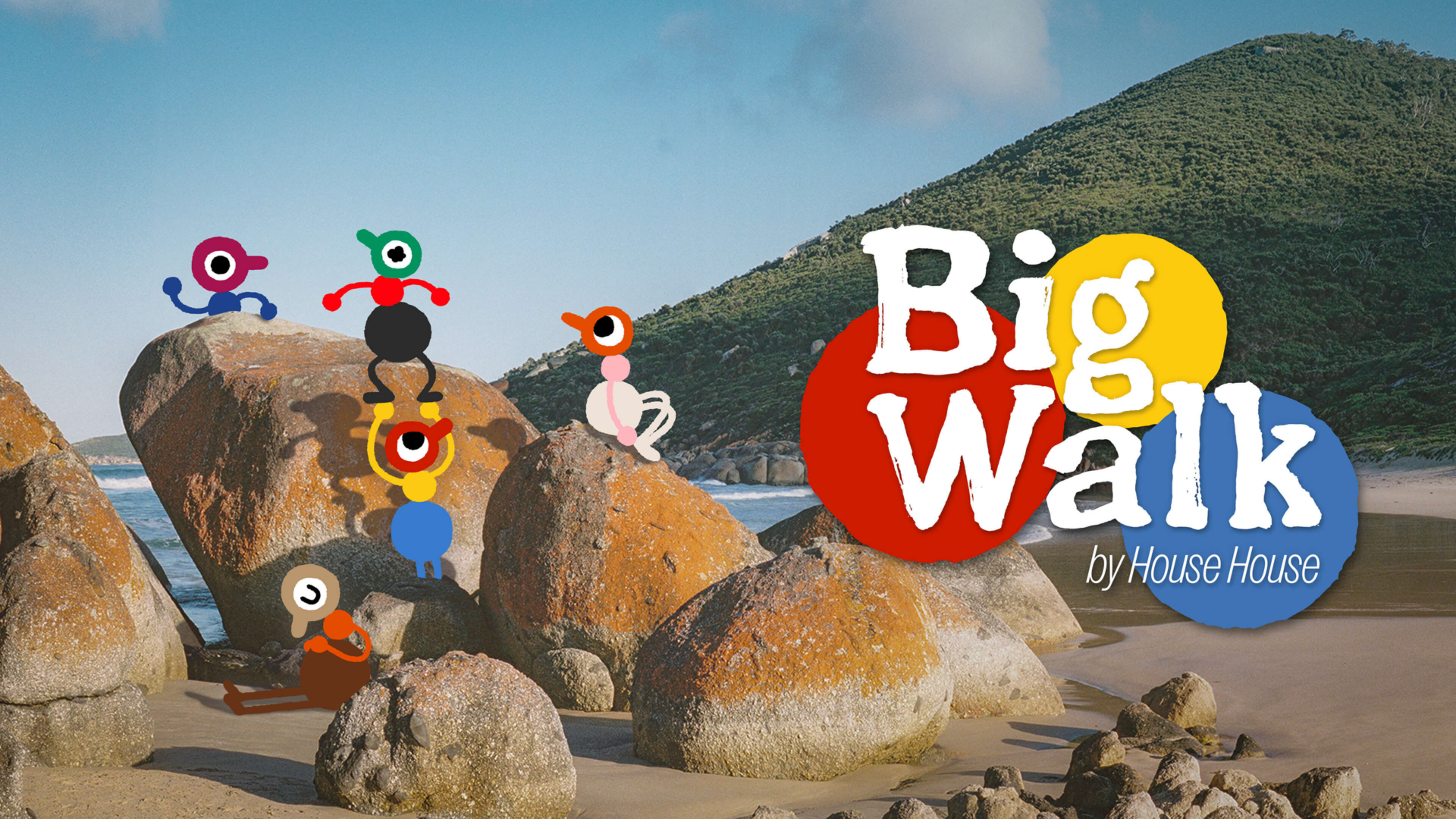
What happens when you take the pretension out of The Witness, replace it with silly sound effects and Keith Haring-esque art, and add Multiplayer? I mean certainly something LIKE Big Walk, but there’s something more here in actuality. Walk with me West Wing-style and let’s talk about it.
The developer, House House, came to prominence with the indie hit Untitled Goose Game, wherein you play a mischievous goose ruining the town’s day. That one had its own set of cascading problem solving, but it was designed for single player. You can add another goose in multiplayer, but the puzzles remain the same, so while it’s fun, it just feels tacked on. Big Walk needs other people to function. Everything is built around coordination and communication. Not even just in the gameplay – you can’t even join open lobbies in this game. You have to reach out to someone and be given a code to play with them. The intent here is you’ll play with friends, or at least people you have a vested interest in talking to. You’ll need either that buy-in or a level of familiarity if you’re wanting to succeed.
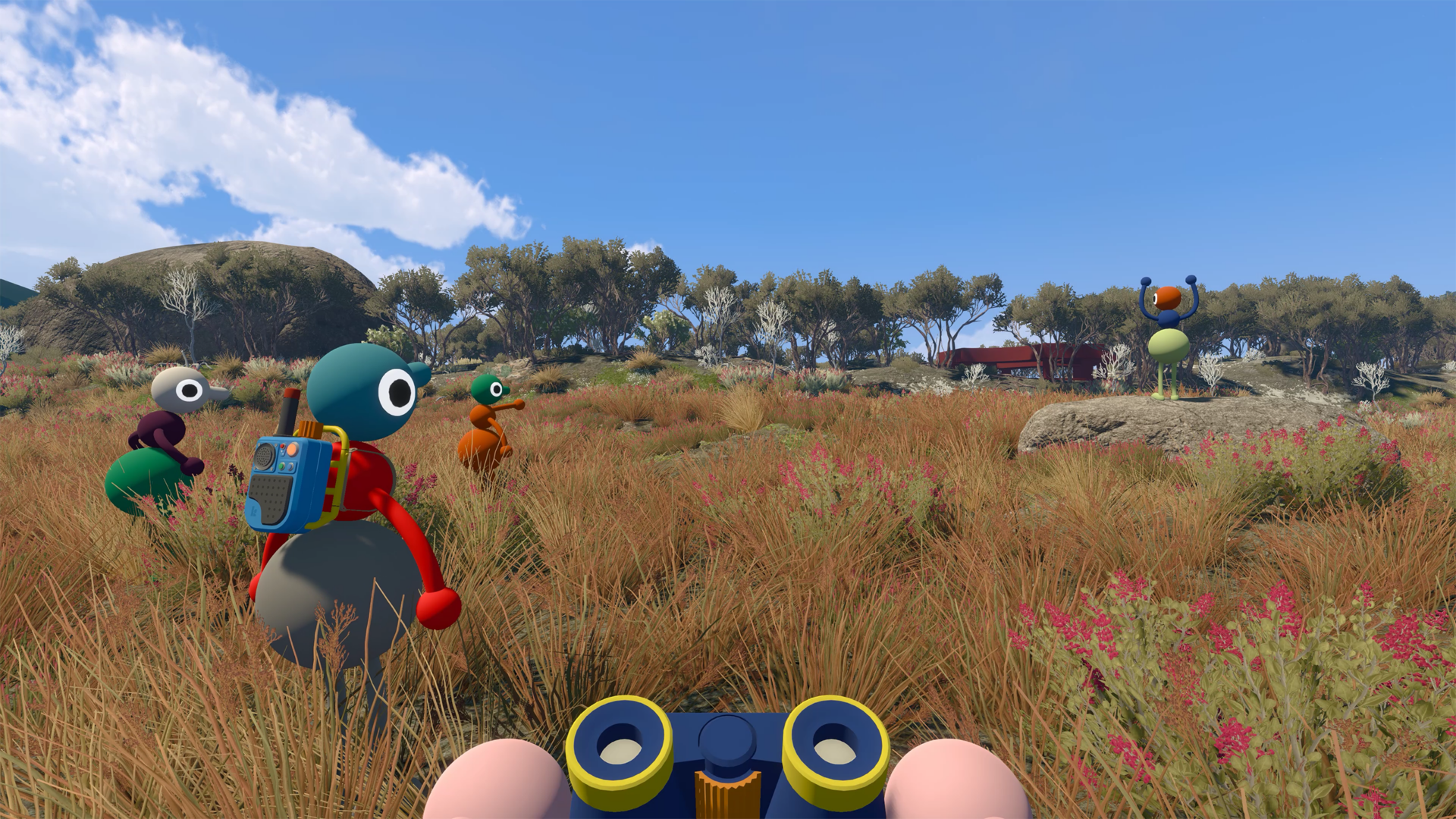
Big Walk is a cooperative puzzle game where environmental puzzles are solved through communication. You’ll use tools as they become available to you such as flashlights, laser pointers, walkie talkies, and much more. Generally all that’s needed to solve a puzzle is your own two hands and everyone’s heads put together, though as the game advances use of these tools is essentially required. Puzzles vary wildly, from picking up other friends so you can reach a button, to elaborate games of telephone relaying code sequences. Your reward is a red macguffin that goes in a slot so as to open up the next area. (What this thing is called, no one knows. That’s another design choice encouraging communication – because everything is unlabeled, you have to come up with your own names for things. We called them gourds or nubbins.)
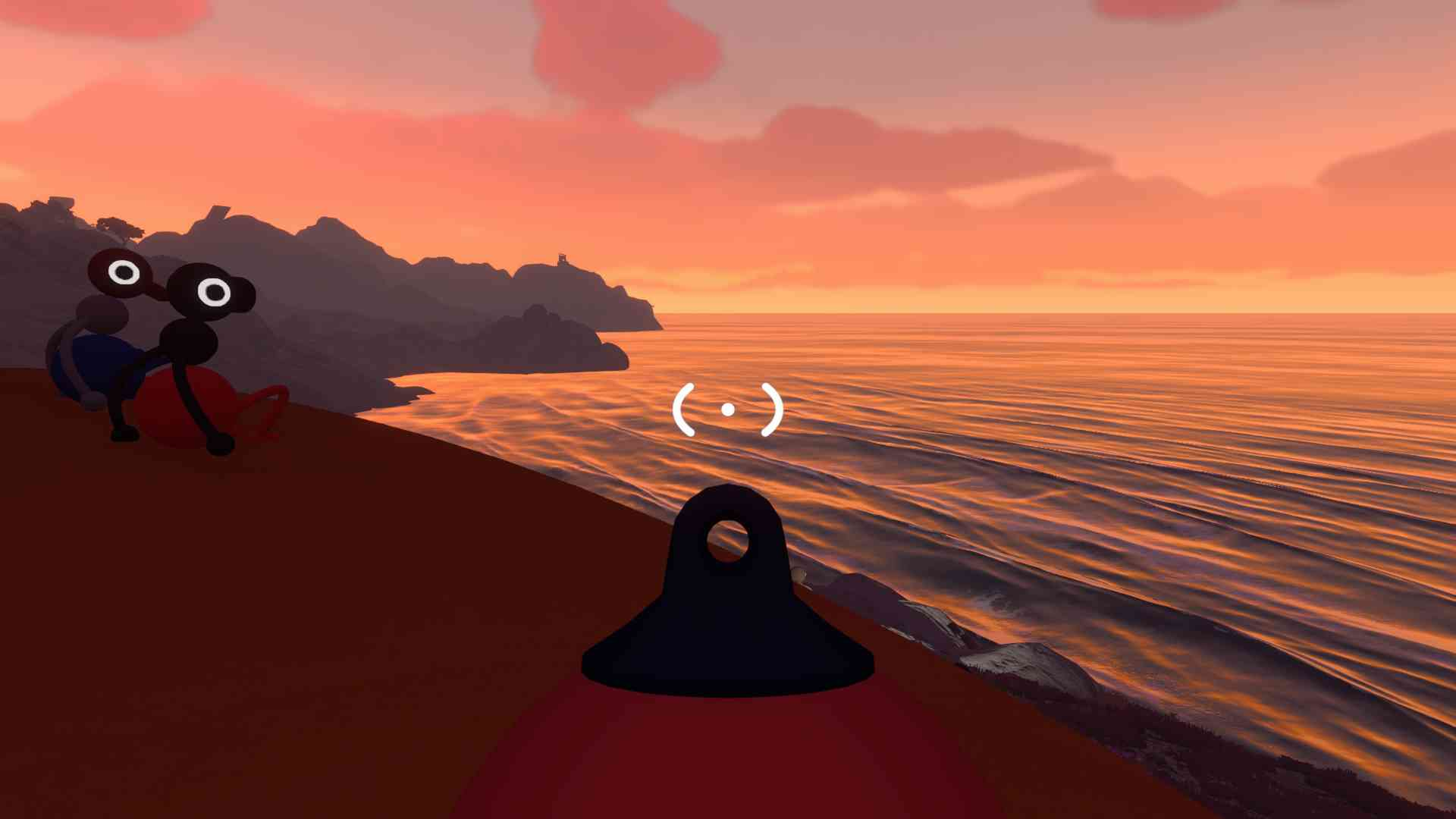
Big Walk is as fun as your friends are, so choose carefully! Working through communication is good and fun, and important for the health of any relationship. But it can be tough too. How you resolve conflicts in communication is also part of the game. Rules and standardization of signals are a good way to improve how the team operates and communicates long distance. Generally this will vary from group to group. For the groups I played with, for example, tower fireworks going off meant “reconvence here”. Further signals and rules will develop as you play more and once more tools become available to you. But you won’t get anywhere without a solid foundation of talking. It can be fun to troll a little, but this is not the type of party game where you’ll have fun for long being the prankster. It’s also important to note that the voice chat for the game is proximity-based, with a relatively sharp drop-off, so make sure you’re heard. If you go wandering off, try to grab a partner – a solo big walk is well and good now and then, but it can certainly lead to frustrations in the group if you’re a wanderer and someone else needs help.
It doesn’t control perfectly, but generally it doesn’t need to. Accuracy isn’t that important here. Usually these types of games aim for imprecision in physics because it adds to the goofiness of the experience. Playing basketball with your limited movement becomes more rewarding when the system doesn’t feel perfectly built for it. And the game really is hilarious – or to be more exact, it’s very conducive to it. There are cute and humorous little touches in-game for sure, but the situations you’re put in and how the group reacts is what makes it so funny. Those building blocks let the players control the “funny”, which will be more hilarious than a scripted game moment 9 times out of 10.
A lot of emphasis is placed on the ambience of the island and enjoying your surroundings. There are no enemies or hazards, and many sub-areas in the game are dedicated simply to luxuriating in the atmosphere. There are multiple radio stations throughout the island playing the soundtrack, and each area where you unlock them has great hangout potential. And that’s part of the journey! The emphasis was always on the journey anyway – why rush through it?
The music itself is quirky – synthesizers and vocals are sequenced in multiple variations. More often than not it sounds programmed rather than composed, but there is still an organic component found in the instrumentation and harmonies. Think Glassworks, not autotune. I prefer the slower music, though the faster music is at a perfect walking tempo. It’s generally pleasant enough to listen to, though too much of it can wear on you. Thankfully, you’ll only hear the music when you’re at a radio station or carrying a boombox around. The rest of the game is entirely quiet – well, except for the animal noises all around you. It’s not disquieting though. It’s actually quite peaceful.
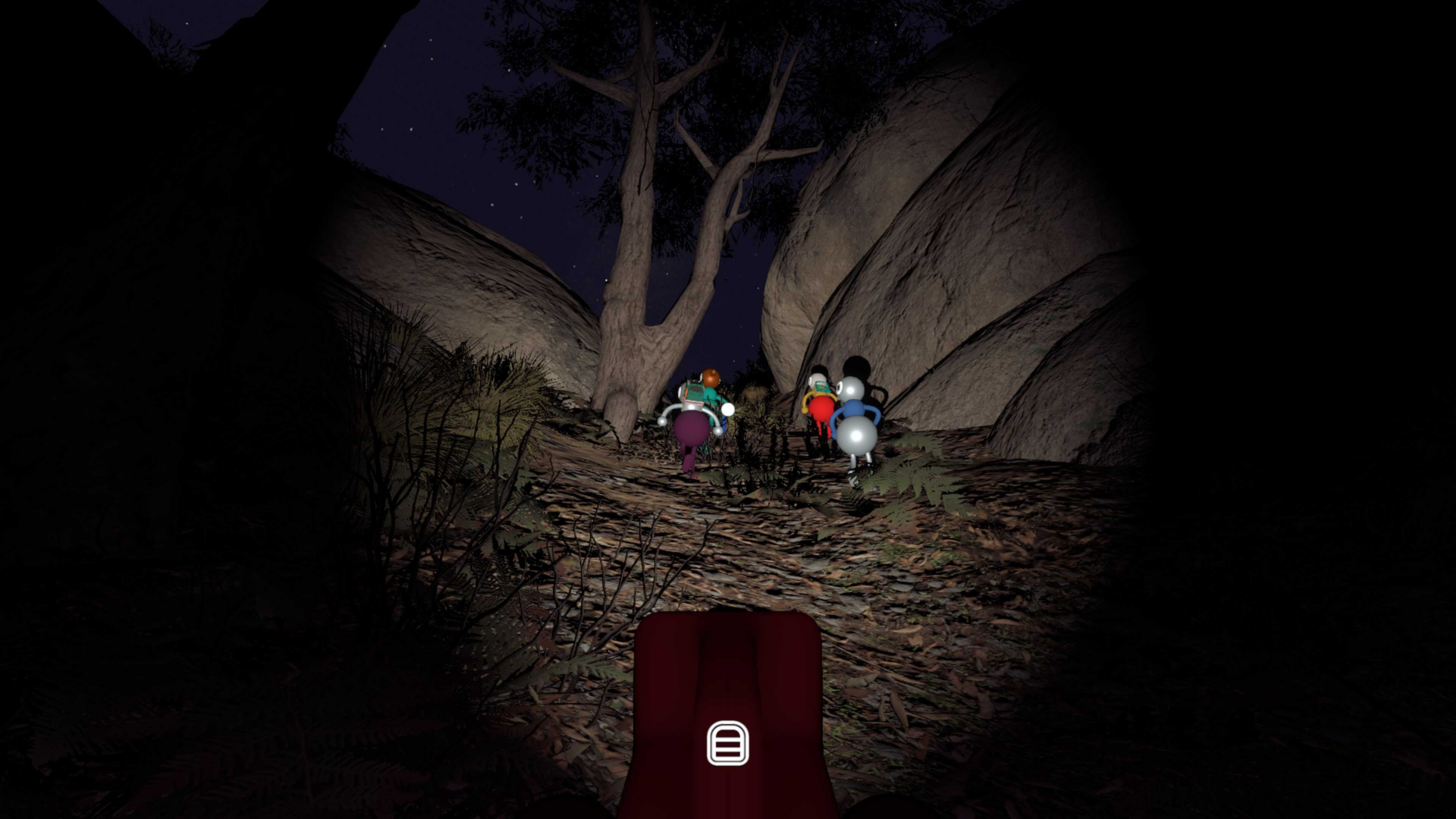
All combined, the environment makes a firm yet subdued impact on you. It subtly reminds you how nice it is to be actually outdoors. Turning on your flashlight while walking with your buds through the woods at night brought me back to my Boy Scout days, and those late summer nights traipsing back to the campsite. Getting lost in the dark is dreadful, not because there’s anything harmful, but because of being separated from the group with no way of knowing how to return. Like I said, you can wander off, but a walk is always better with a friend.
Earlier I made the comparison to The Witness, but really they are on different planes from each other. The Witness requires you to learn the language of each puzzle and build on that knowledge to solve future puzzles. While there is a similar progression in Big Walk, because more depends on relaying information, it’s not as intellectually demanding as The Witness. Big Walk exercises a different muscle. It doesn’t matter a lick if you can understand a puzzle’s subtleties at a glance if you can’t explain it to the person next to you.
This is the big strength of Big Walk – it emphasizes a core theme of multiplayer that is not stressed as much anymore. Other games like to remove friction by having each player capable of completing a task, so while communication helps and is still emphasized, carrying the team is still possible. And because of that being optional, you can get plenty of people who won’t cooperate. (I’m flashing back to my Overwatch days….*shudder*.) But because communication and cooperation is required, friction enters in. No one person can do this alone. Committing to that level of cooperation is a bold design move, but it paid off. Yes, there is the potential for frustration when things aren’t working or communication breaks down. But on the whole, Big Walk subtly gives you tools to improve your communication, so when you overcome these obstacles, it’s not just a win in-game – it’s a win in real life.
Spiritually there’s not much to analyze in the game proper. Obviously there is the metatextual part of the game discussing the importance of communication, but that’s been hammered home quite clearly. However, it does highlight something else as well – shared life, a pivotal foundation of evangelization. In the modern age we have to filter out a lot of noise and a lot of opinions. We’re inundated with stuff all the time. To stay sane, we have to keep a lot out, or cast off some of the dross we accumulate. But the thing is our taste is indiscriminate when it comes to casting most things out. Logically, the first thing to go is information from anyone we don’t know or anyone we don’t trust. It’s a good way to eliminate a lot of noise, but that doesn’t mean everything cast out was actually false. This is why street evangelization is rarely successful in the modern day. Usually you’ll just reach people who already have an inclination to agree with you. But that’s missing a critical amount of people who Christians are called to serve.
When Jesus sent out his disciples, he told them to make disciples of ALL nations, not just the people that agree with you. So how do you reach the person next to you? This is where shared life comes in. To communicate at all with someone, we need to be in the same space with each other. This isn’t necessarily a physical presence. What matters more is a mental and spiritual presence – I am giving you my attention because I have a desire to be around you, to know you. Relationships are built on this foundation.
When a relationship is built up, it can handle heavier truths. I give you a little of myself, see how it’s handled, and if the relationship can bear the weight we know more can be added on. The same is true for, well, truth. If I don’t have a relationship with the person I’m talking to, if they don’t truly know how deep my love is for them, then the truth can fall on deaf ears. Or it will fall on rocky ground. Pick whichever biblical metaphor suits you here. The point is I can’t bring anyone to God if I don’t love them first. And if they love me back, we have a basis for trust and mutual respect that lets truths be exchanged without worry of harm to the relationship. Shared life, just being with others in the present, is how we get there.
Big Walk isn’t alone in doing this; technically any multiplayer game can be an opportunity for shared life with another. But the design principles of the game make it incredibly effective at building relationships, and their focus shows me they were intentional about fostering shared life in the world.
They devoted themselves to the teaching of the apostles and to the communal life, to the breaking of the bread and to the prayers. Awe came upon everyone, and many wonders and signs were done through the apostles. All who believed were together and had all things in common; they would sell their property and possessions and divide them among all according to each one’s need. Every day they devoted themselves to meeting together in the temple area and to breaking bread in their homes. They ate their meals with exultation and sincerity of heart, praising God and enjoying favor with all the people. And every day the Lord added to their number those who were being saved.
-Acts 2:42-47
Scoring: 83%
Art: 7/10
Music: 8/10
Gameplay: 8/10
Design: 10/10
Morality/Parental Warnings
Online Interactions: This might be a first for me, but I don’t really have anything to warn about in this game. While parents should note online interaction is required, you can only play with people you get a code from or from friends on your system. You have to go out of your way to play with strangers.