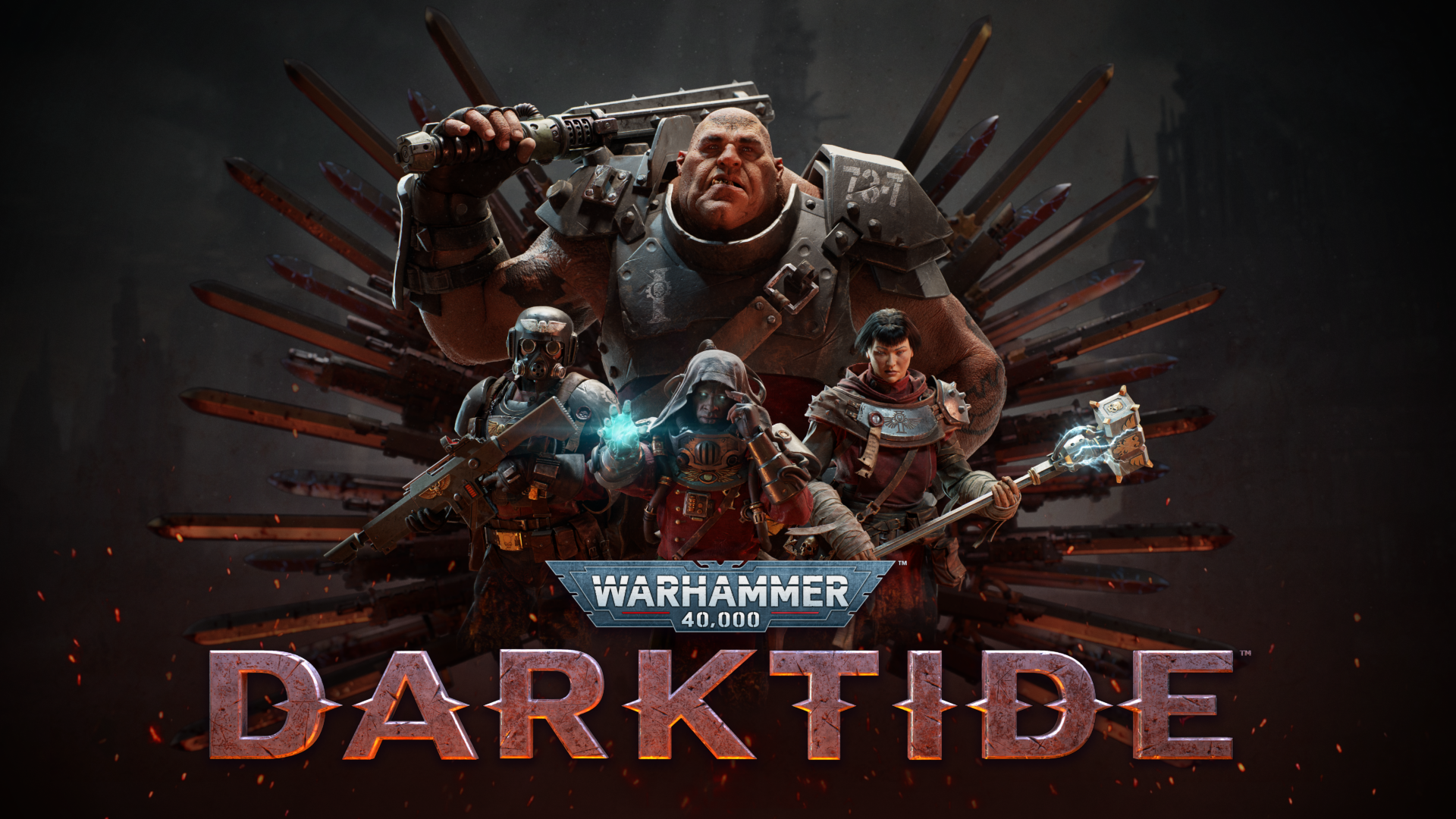
From the studio that brought you Warhammer: Vermintide 2, Fatshark’s latest horde shooter explores the grimdark future of the 41st Millennium in Warhammer 40k: Darktide. You are a reject, a prisoner of the Imperium, who embarks on harrowing missions through the hive city of Tertium. As the Chaos god Nurgle, lord of plague and decay, plunges the hive city into darkness, the Imperium is counting on you to get your hands dirty… and possibly make it back alive. Explore a gothic dark-fantasy setting filled with waves of dynamic enemies, a hybrid combat system, and four-player co-op. Although your crimes are serious, even the most wretched sinner may discover renewed purpose in service to the Throne.
Overview
Warhammer 40k: Darktide is a co-op horde shooter where you and three other players descend into the depths of Tertium, completing various missions as you fight off the horrors that lurk beneath. Missions are selected from a central hub, where you will meet other players on the server, while preparing equipment and cosmetics for your next run. Since its release in 2022, Darktide has added various game modes that offer new ways to play, but all retain the squad-based horde-slaying DNA.
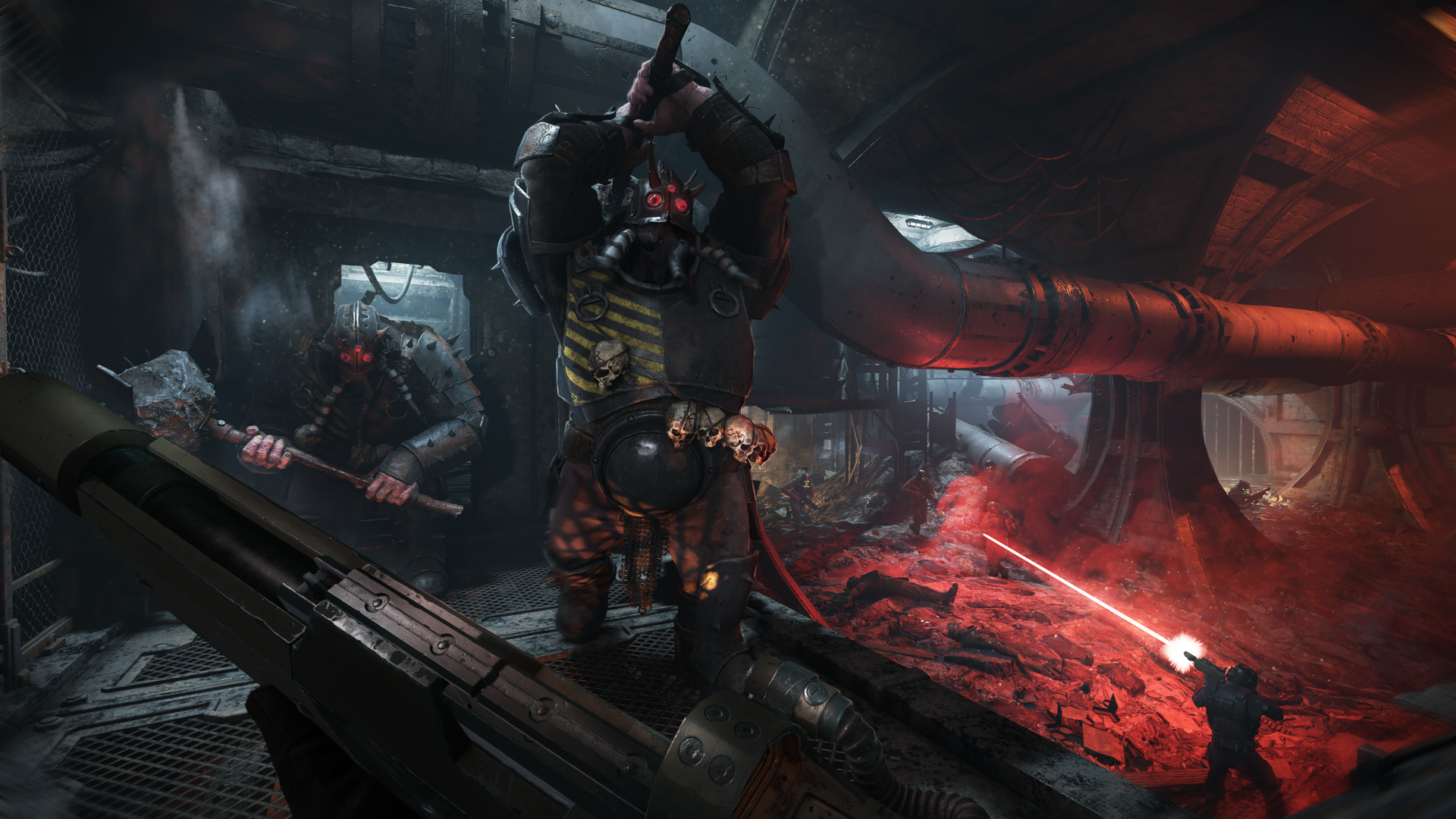
The Mission Terminal delivers the standard ‘Tide menu: Select an objective, and adjust the difficulty modifier to your comfort level. Scaling the difficulty pits you against corresponding enemy spawn rates, as well as introducing negative modifiers at higher levels. Certain modifiers/events will be present regardless of difficulty, such as an excess of a specific enemy type, a sidequest for your squad to complete, or a world mechanic such as dense fog or a city blackout. Combined with the random loot pickups and in-world event triggers, the game delivers a somewhat roguelite feel. While Darktide lacks a true roguelike mode, the variation in its selection of modes keeps things interesting enough. Mission Terminal aside, additional game modes offer small tweaks to the standard experience, keeping players engaged beyond the core of Darktide. Expeditions, for example, are non-linear missions designed for high-risk high-reward gameplay. It offers exploration and extraction mechanics similar to Helldivers 2, and retains the thrill of standard missions. The Mortis Trials offer round-based arena gameplay that includes roguelite mechanics through its use of periodic character buffs. Havoc, on the other hand, is available for those with a competitive edge itching for greater challenges. Although these game modes don’t quite reach the heights of Vermintide 2, Darktide offers ample replayability across its weapons, skill trees, classes, and cooperative gameplay. The combat alone is enough to keep butts in seats, and the itch to try out a new character build will keep players going back for more.
As a diehard fan of Vermintide 2, Darktide both improves and regresses elements of its predecessor. In most cases, there is a clear tradeoff between both games: Vermintide’s melee combat is second to none, but there’s a slight hint of that delicious “blood soup” missing in Darktide. I know the recipe by heart, and yet I find myself tapping the spoon against my chin, trying to find the missing ingredient. On the other hand, Darktide excels in ranged mechanics. Vermintide’s firearms are simple delights, of course, but Darktide delivers a certain chunkiness that surpasses its predecessor. From the zrack zrack of the lasguns to the chunn, shlack of the kinetic rifles (indulge me), melee becomes an afterthought as I mow down waves of heretic scum, only to discover that there isn’t enough ammo to go around. Nevertheless, pitting Fatshark’s game mechanics against one another is like deciding my sushi order: regardless of my options, it’s still a quality meal. However, the key feature completely neglected in Darktide is a fully offline version of the game. Vermintide 2 allowed players to enjoy a truly offline experience, completely divorced from the servers. To make things worse, there is no singleplayer option when queuing for missions, forcing you to join with real players who may or may not proceed at your preferred pace. In my opinion, the absence of these features in Darktide is the most lamentable part of the game.
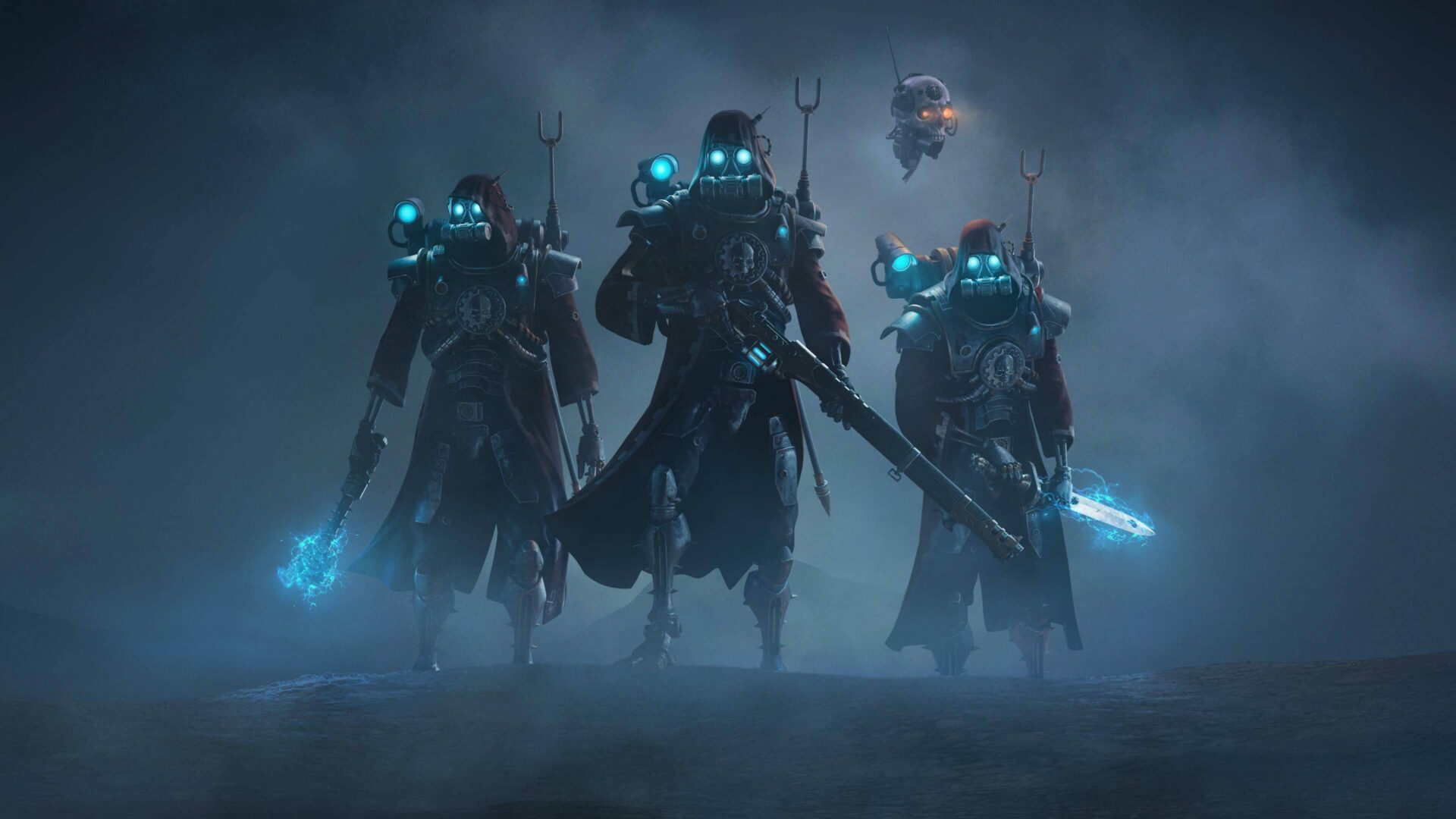
There are four main classes included in Darktide, along with three paid DLC classes: Veteran, Psyker, Zealot, and Ogryn are the classes included with the base game. The Arbites, Hive Scum, and Skitarii (pictured above) are DLC classes. Each brings a valuable dynamic to your squad, along with unique weapon and cosmetic options, with some overlap present. The crucial distinction lies in each class’s unique skill tree. When creating a new character, you will select his or her backstory and cosmetic features. Depending on your character’s background, you will have access to certain customization options that other characters do not: The Skitarii, for example, has access to a special vox shifter within the character customizer, distinguishing your own voice from everyone else’s. Most outfit cosmetics are also class-locked. These traits will not affect stats (those are determined by the class itself), but will instead affect how your character interacts with his squad. It’s a neat arrangement of details creating a small sense of individuality. My favorite is the Veteran class due to his ranged proficiency and Astra Militarium background, but DLC classes such as the Arbites and Skitarii have introduced welcome variety to the way I play. With several character slots available, however, players are not limited to just one type. Sticking to one class alone provides hours of fun, but exploring options breathes new life into familiar territory. Furthermore, squads are not restricted to one player per class, allowing the freedom to mix and match. If you and your friends wish to embark on a mission as four fanatical Zealots, then by all means.
Gameplay
The bread and butter of Darktide lies in its addictive combat. Fatshark certainly cracked the code on this one, and in most respects, it remains faithful to Vermintide 2’s legacy. While the delicious, horde-slaying action and fluid character motions are still intact, the gothic backdrop of Tertium adds an extra layer of grungy tension. Of course, the real magic lies in Jesper Kyd’s cyber-dystopian score, where a metaphorical IV line pumps octane directly into your bloodstream whenever the music kicks in. With both melee and ranged weapons at your disposal, enemy encounters mean using the right tool for the right job. While mowing down a wave of zombie-like heretics is never a dull prospect, limited ammo means knowing when to save your bullets for an inevitable pinch later on. Mag-dumping into a miniboss may keep you out of reach, but the following horde of gunners and snipers might cause trouble if you’re running dry. Likewise, revving your chainsword is often more efficient than spending an entire magazine on armored close-range foes. There are no strict rules, but measured choices are often the difference between life and death. Sticking with your squad and listening for audio cues are equally as important; without spatial awareness, you put the entire mission at risk. You might be fully stocked on ammo, health, and grenades, but a rogue Pox Hound or Trapper can instantly knock you out of the fight. Similarly, a Poxburster or Grenadier can quickly shift the dynamic of an otherwise ordinary encounter. Even if a situation seems under control, special enemies are always out to put a dent in your plans. However, this tension can often have the opposite effect: the roar of Mutants or howling of Pox Hounds, combined with a beat drop and a fresh magazine, is a high to be sought out rather than avoided. All that to say, Darktide’s gameplay is great because it stands on its own two feet. Stripped of its graphical fidelity or Warhammer 40k theme, the game would retain most of its value. Other games feel like I’m checking off a laundry list of tasks, grinding away objectives instead of enjoying the moment. To be fair, Darktide has a grind of its own, but it’s far less egregious compared to the hamster wheel of other live-service games.
Aside from upgrade materials, loot found on each mission is limited, and must be shared among squad members. A single ammo pickup will supply the one who scoops it up. Likewise, a Medicae station often lacks enough healing slots for an entire squad. Keeping tabs on your allies’ status meters ensures that equipment is available to those most in need. Aside from invoking the Catholic economic theory of Distributism, this system tends to separate the wheat from the chaff: Some players will hoard whatever they find without a second thought, and others will be overly generous when they are actually the ones in need.
Combat and survival aside, each mission contains a main objective, with minor objectives along the way. While the main objective might involve eliminating a final boss, you may have to defend ordinance or remove obstacles before moving on to the next section of the level. These objectives pull one or more squad members away from combat, splitting your attention between enemies and the task at hand. It’s crucial to defend your squadmates during these sequences, as enemy attacks will interrupt the process. This can be incredibly frustrating if you’re suffering under the weight of incessant hordes, but a competent team will find the patience to properly coordinate. Completing these smaller objectives can be as satisfying as they are frustrating, however, since they require proper timing or a quick eye. Of course, if one member of the party is running the Skitarii class, most of these menial tasks can be passed on to the Servo Skull (as usual).
Spirituality
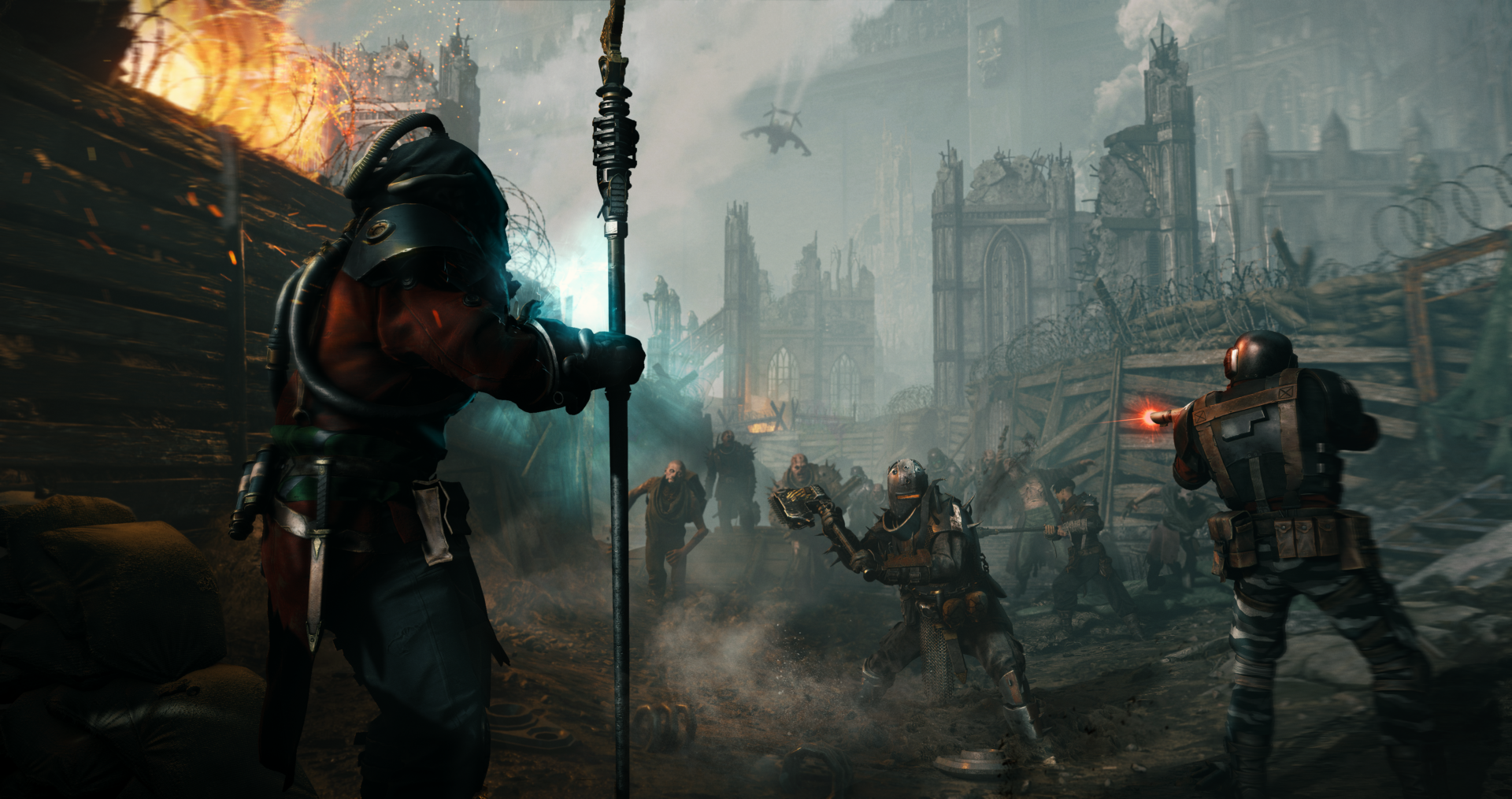
For the uninitiated, the spiritual side of Darktide (and by extension, Warhammer 40k as a whole) may be confusing, yet thrilling. Before diving headlong into the lore, I recall being drawn by the mere sight of cathedral-style spaceships, tech priests swinging thuribles, and the lingering air of religious fervor surrounding the hobby. In its choice of imagery, 40k’s vague appeal to Catholicism presents a particular enticement for those of us within the Church. However, the characters of Darktide belong to a highly zealous– yet entirely misled –era of humanity. In the far future, mankind has regressed in its knowledge of the past, and the people dedicate their lives in service to “The God-Emperor of Mankind.” While this Emperor is a false god in-universe (this is debated, but we’re not getting into that), the people themselves do not know it. In other words, the Imperium is made up of men and women acting under invincible ignorance. While an outside observer may apply theological nuance through his top-down view of the narrative, the characters themselves truly believe they are doing what is right. They have a strong sense of faith and stick to their guns (literally), even if their faith is misguided. However, much of the 40k universe has no need for theological nuance: The Chaos gods and their servants, such as Darktide’s corrupt hordes, are physical manifestations of vice and its consequences. From this perspective, the Imperium’s mission involves the eradication of pure evil. While the religious fervor of Warhammer 40k is often carried to the point of absurdity, there are valuable lessons to be drawn from it. Just as the Imperium’s answer is to destroy every threat to mankind (real or perceived), we also must root out any semblance of corruption within ourselves. We are temples of the Holy Spirit, and must never flirt with temptation. The life of virtue requires a firm hand in order to extinguish the smoldering embers of concupiscence within our hearts.
You will find differing viewpoints on this topic, but that merely illustrates the complexity of the 40k universe. In my experience, this religious fanaticism has been a source of inspiration in my own spiritual battles. Unless one is seriously misguided in his faith, Warhammer 40k: Darktide will not pose a threat to one’s spiritual life, but may in fact reinforce it. Warhammer 40k may be far from the truth, but like any solid work of fiction, there is always a scrap of meaning to be salvaged from its depths. Even in the dark, nihilistic future of the forty-first millennium, there may yet be hope amongst the stars.
Scoring: 90%
Graphics: 5/5
Controls: 5/5
Gameplay: 5/5
Replayability: 3/5
(Docking points for a lack of proper roguelite and singleplayer options)
Morality/Parental Warnings
Language: Light language is present, but most swearing is reserved for in-universe slang terms. These are treated as crude within the fictional setting, but mean little in reality.
Sex/Nudity: In the character creator, men and women are displayed in their undergarments. Both males and females have visible torsos. Obviously, this is not meant to titillate in any sort of way. Sefoni, the overseer of the Psykhanium, wears such undergarments while she floats around in a strange vat, but this is hardly noticeable. Her voice is somewhat provocative; it’s not intended to be.
Violence: Players will kill hundreds of enemies by slashing and shooting at their opponents. Blood and gore are constants within combat and the surrounding environment. Killing is glorified by the setting, but again, this passion is oriented towards the eradication of pure evil.
Consumerism: Premium cosmetics are available from the Commodore’s Vestures, which require paid currency to unlock. Additionally, three of the seven character classes require paid DLC to access.
Magic/Occult: All magic and supernatural phenomena in the 40k universe is the product of the Warp. Psykers (who we might call witches or wizards) draw their power from it, as do the Chaos gods. Furthermore, because human knowledge has regressed so far in the 41st Millennium, both the Imperium and the Adeptus Mechanicus are very superstitious. For example, machines are believed to have spirits: Booting up a computer system is not an ordinary process, but a ritual to “awaken the spirit inside of the machine”. By their nature, these sheer displays of ignorance are somewhat comedic. However, they turn the mundane into the awesome: mankind does not know how machines work, only that they do work, so the explanation must be beyond our comprehension. I think this detail is very important, and shouldn’t be scoffed at. The modern world tends to lack imagination due to the demystification of nature and the material world, which is both a blessing and a curse for creative interpretation.