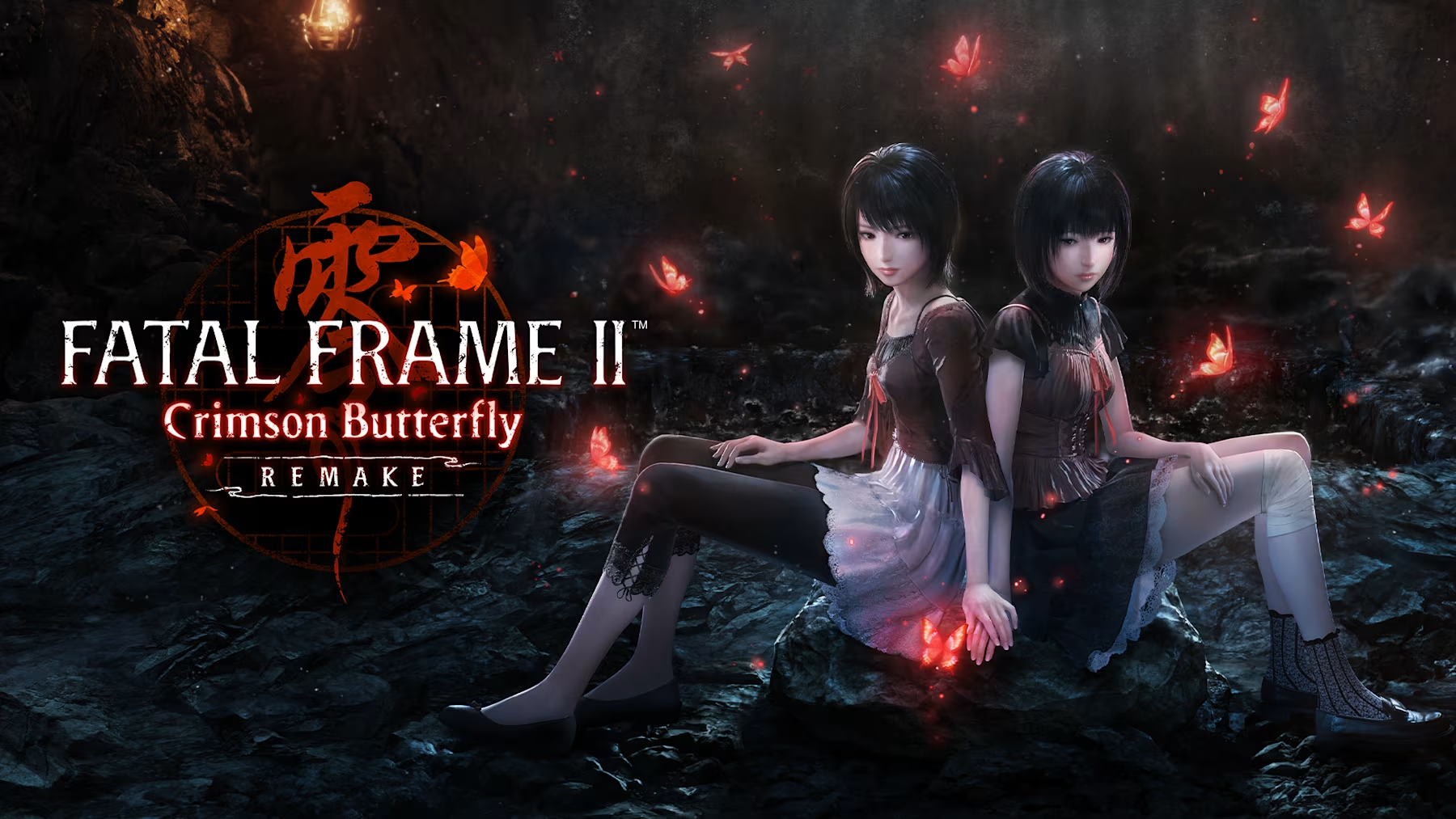
Title art from the Nintendo Store website. All other screenshots are my own.
Being born a twin is simultaneously a strange and wonderful thing. Sometimes I think nothing of it, my twin brother being no greater or lesser than our older brother, but other times I am struck by the impossibly deep bond no other human relationship could possibly replicate. Sure you might be seen as a circus curiosity at times, surrounded by superstitious assumptions that you possess the same thoughts and personalities, but I wouldn’t trade it for anything in this world. Twins are not an uncommon sight in media or literature, usually reserved for side characters in a large ensemble cast or a plot twist that dramatically changes the relationship between key figures, but twins as the main protagonists and central theme is surprisingly hard to come by. Fortunately for me, today’s review covers a video game that aims to explore this very subject.
Fatal Frame, also known as Project Zero, is a survival horror series created in 2001 by the latter half of Koei Tecmo and went on to become a cult classic, boasting critical acclaim despite historically modest sales numbers. Among the five main entries in the series, Fatal Frame II: Crimson Butterfly is easily the most popular and has not one but two remakes to its name. The subject of today’s article is the game’s second remake, which was released earlier this year, as previous versions are not readily available on modern platforms. Grab a camera and say a prayer because things are about to get spooky.
Fatal Frame II: Crimson Butterfly follows the story of Mio Amakura and her twin sister Mayu, who become trapped in the lost village of Minakami while exploring the surrounding forest. To make matters worse the village is cursed by an eternal night and haunted by the ghosts of its former inhabitants, one of whom appears to possess Mayu and frequently leads her to be separated from Mio. Fortunately for our heroine, Mio finds the Camera Obscura, a device capable of exorcising ghosts by taking pictures of them. With the camera in hand, Mio must explore Minakami village to find Mayu, discover the secrets behind the villagers’ demise, and find a way back to the outside world. The story of Fatal Frame 2 is very cryptic with very few scenes of proper dialogue between characters. The bulk of the narrative is found in the pages of journals left behind by the deceased villagers, detailing Minakami’s history and the calamity that befelled it. This approach to storytelling works really well in a horror game and kept me invested from beginning to end, but the end is question is… well… we’ll come back to that later.

Every step through a dilapidated house or a ransacked shrine is a risk you must dare to take.
Presentation wise, Fatal Frame 2 is terrifyingly effective. The eternal night of Minakami Village combines with a misty fog to create an unsettling atmosphere that ensures the player never feels safe, even in places they logically know to be safe. The ghosts that constitute the game’s enemies are appropriately creepy as well, but only 2 of them genuinely put butterflies in my stomach(the Kusabi and the drowned woman). Beyond the excellent atmosphere however, the game’s graphics are about what you’d expect from a horror game made by a triple-A studio in 2026, not bad per se, but nothing I haven’t seen before. The game’s music is not very melodic in its composition, but it is effective at heightening the tension while wandering through desolate streets and derelict hallways. Voice acting is sparse due to the lack of spoken dialogue for most of the game so it doesn’t hurt the game that much, but what was there felt a little hammy compared to the otherwise deathly serious tone.
The original Fatal Frame 2 from 2003 followed the late 90s/early 2000s horror game formula rather closely in terms of gameplay with fixed camera angles and deliberately clunky tank controls. What set the game apart from its contemporaries was its photography based combat, which switched the perspective to 1st person and encouraged the player to get as close to enemies as they could to take clearer pictures that deal more damage in an intuitive risk versus reward system. The first remake from 2012, which was released exclusively for the Wii in Japan, featured an over-the-shoulder 3rd person perspective and motion controls, making it more in-line with Fatal Frame 4. I mention this because the 2026 remake does not appear to make any similarly dramatic changes to the core gameplay aside from the controls being reworked for more orthodox controllers(veteran players would know more than me).
Using the Camera Obscura to exorcise ghosts and occasionally solve puzzles is the central mechanic which all others are built around. New lenses and functions for the Camera Obscura make up the majority of the game’s upgrades and progression. Auxiliary mechanics include charms, which can be equipped to buff Mio’s combat effectiveness and contain cryptic audio logs from associated characters, and the flashlight which makes it easier to find items scattered around the village, but attracts more ghosts to Mio’s location. Exorcising ghosts can be a fun challenge at first due to their slippery movements and the thrill of learning to photograph enemies during their attacks to deal more damage, but as the game went on and the common enemies were trivialized it definitely became a little stale outside of boss fights.

Maybe she just wants a hug?
Outside of combat Fatal Frame 2 unfortunately doesn’t have much else going for it. There are puzzles in the game, but they mostly boil down to bringing the right item to the right place, taking a picture using a special lens to reveal something hidden, or rotating an object until a pattern is formed. All things put together the game also isn’t particularly challenging on the normal difficulty, as despite being a survival horror game it wasn’t hard to find extra camera film and healing items, so I never felt in danger of running out. I should also mention that in lieu of mechanical additions the 2026 remake’s main contribution to the formula are side quests that offer greater insight into the backstories of various ghosts, which I did find fairly interesting to follow, but it doesn’t exactly solve the game’s shortcomings.
Finally, let’s return to our discussion of the main story. Usually if my critical or spiritual analysis requires me to spoil the majority of the game’s plot I’d set aside a dedicated spoiler section under the body of the main review, but for Fatal Frame 2 I feel very strongly about conveying this information to readers as a Catholic, a critic, and a twin. If you’re interested in playing the game for yourself and you don’t like spoilers, this is your last warning to stop reading and come back at a later date.
Throughout the course of the story, revealed largely by journal entries, the player learns that Minakami Village is built above an underground pit described as “the gateway to hell” or “the abyss”. In order to protect the village from its precarious position the villagers keep themselves isolated from the outside world and regularly perform the Crimson Sacrifice Ritual. The ritual requires a pair of twin shrine maidens with the elder twin(who by village’s tradition is the twin born second) strangling the younger twin to death. The twin who is killed becomes a crimson butterfly, a spirit that assists the living twin who is deified by the villagers as a bringer of good fortune. Minakami’s downfall was preceded by a series of failed rituals, but the appearance of a new set of twins in Mio and Mayu presents an opportunity for the villagers to complete their macabre work and end Minakami’s curse. It’s all very harrowing stuff to read through, especially as a twin because on some level it’s hard not put myself in the shoes of Mio and the other second-born twins described in the village’s past.

Even the most experienced horror gamers think twice when the invincible stalker shows up.
This all brings me to how the game ends, or rather one ending in particular. Fatal Frame 2 has multiple endings based on the player’s chosen difficulty and ability to complete certain side quests. For your first play through however, you are required to see the Crimson Butterfly ending, which is in my opinion the worst ending imaginable. In this ending Mayu encourages Mio to complete the ritual and Mio capitulates, killing Mayu, turning her into a butterfly, and lifting the curse from Minakami Village. To make matters worse my post-playthrough research into this ending revealed that this is the version of the story acknowledged as canonical in Fatal Frame 3, so the franchise doesn’t actually reward players who replay the game to get a happier ending. Needless to say my emotions are running hot in light of all this, but I’ll try my best to provide a rational analysis.
It’s important to note that the Crimson Butterfly ending is framed in such a way to communicate that a purely surface level reading of its events is not intended. Throughout the game it is clear that Mayu is being possessed by the ghost of Sae, the last shrine maiden who failed to perform the Crimson Sacrifice Ritual, so it’s safe to assume that Sae is the one in control of Mayu during this ending. Furthermore, Mio herself is also possessed by the ghost of Sae’s twin sister Yae, whose presence is far more subtle throughout the game and all but confirmed in the alternative endings, who takes control of Mio during the sacrifice as evidenced by the black and white filter framing the scene like one of the flashbacks between Sae and Yae. All of this is to say that during this ending both Mayu and Mio have their free-wills violated by Sae and Yae, so despite how upsetting this ending is I can still acknowledge it as a valid resolution to the plot.
Nevertheless, I am still deeply frustrated by the fact that this ending is considered canonical by a future entry in the series. I’m not against stories having tragic endings, Sophocles and Shakespeare absolutely deserve their place among the literary giants, but such stories need a moral or thematic reason to end tragically. In the case of a horror story, if the monster wins in the end it should probably be because the main character was unable or unwilling to overcome some moral failing on their part which the monster represents. In the case of Fatal Frame 2, I can’t identify any moral failing or thematic purpose that justifies Mio and Mayu suffering the fate they meet within the Crimson Butterfly ending. As far as I can tell the developers just said: “wouldn’t it be shocking if we made a horror story about twins murdering each other?” without any further reflection upon the subject matter. If the good endings aren’t canon, then I can’t help but feel Fatal Frame 2 is a story that depicts cruelty for its own sake. Maybe a person who isn’t a twin would come to a different conclusion, but it’s not a bias I can’t easily shake.

For all my personal grievances with Fatal Frame II: Crimson Butterfly, the critic in me can still acknowledge it as a good horror game. The Camera Obscura is a great gameplay concept once you get used to its quirks and it’s easy to see how it was able to carry a franchise for 5 games. The atmosphere created by the setting is sensational and the story is engaging to follow, even if I strongly disagree with the franchise’s choice of which ending is considered canon. I probably wouldn’t recommend this be anyone’s first horror game, but it’s definitely earned its place as a cult classic that any self-proclaimed horror game fan should be able to find something to enjoy in.
Scoring: 80%
Gameplay: 4/5
Visuals: 4/5
Sound: 5/5
Story: 3/5
Replayability: 4/5
Morality/Parental Warnings
Violence: Enemies in Fatal Frame 2 are vengeful spirits that will attack the player character on sight, sometimes with improvised weapons or by conjuring supernatural projectiles and other occult powers. The player exorcises these ghosts by taking pictures of them with a special camera, which is more or less a form of combat as far as the gameplay is concerned. Certain areas in the game are covered in bloodstains. Cutscenes depicting snippets of the game’s backstory involve bloody scenes of torture, suicide, and human sacrifice. Similar instances of violence are described in journal entries found throughout the game.
Mythology/Occult: The game is full of references to Shinto, including shrines, temples, gates, talismans, and ceremonial outfits. The rituals of human sacrifice depicted and described throughout the game are not representative of actual Shinto practices, but rather the workings of a fictional cult that merely adopts Shinto aesthetics. Spirits of the dead are a constant presence throughout the game with many of them intentionally designed to be scary. The pit hidden beneath the village from which the supernatural phenomena originates is often described as a “gateway to hell” or “the abyss”.