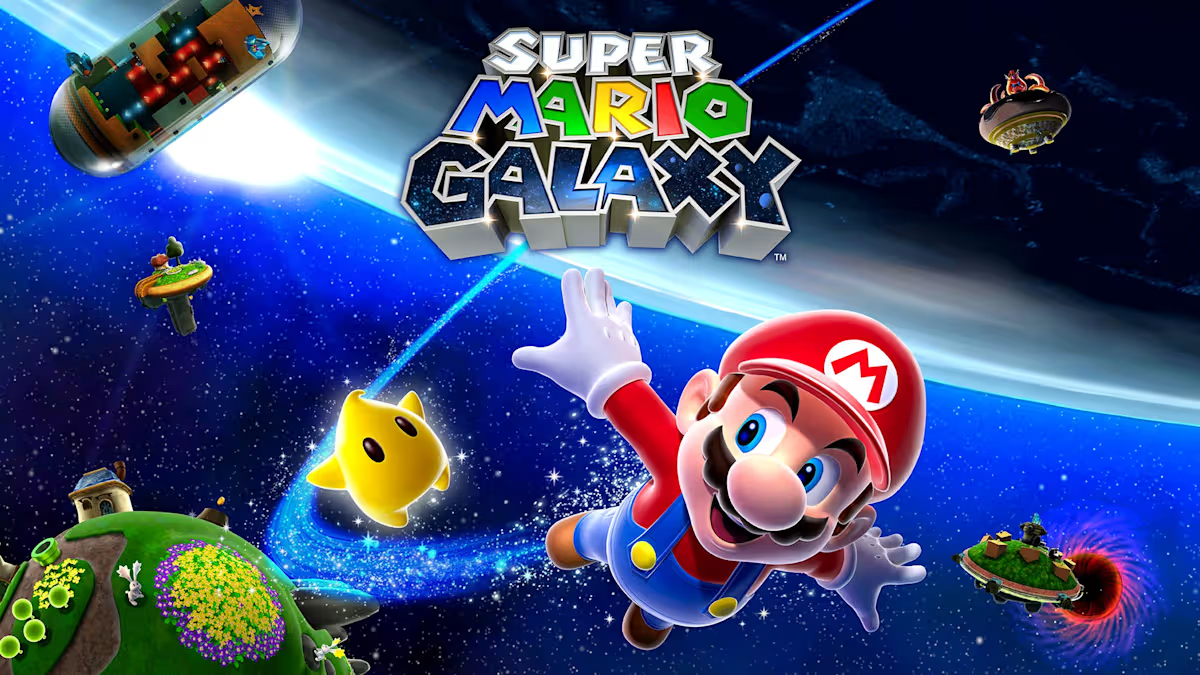
So how about that Super Mario Galaxy Movie, eh? Well I haven’t seen it and probably won’t go out of my way to do so anytime soon. That’s partially because I’ve been too busy revisiting the source material. I originally played Super Mario Galaxy on the Wii growing up, but my old Wii collection was scattered to the four winds when my Wii remotes stopped working. I always considered the game one of my all time favorites, top 10 games of all time even, but since I haven’t been able to actually play it in years I could understand any skepticism that statement might create. With Super Mario Galaxy and its sequel rereleasing on the Switch however, I finally have an avenue to replay this childhood favorite and determine whether or not it actually stands the test of time regardless of nostalgia.
The premise of Super Mario Galaxy is about as straightforward as any Super Mario game. A comet passes by the Mushroom Kingdom every 100 years which prompts the celebration of the Star Festival. Princess Peach invites Mario to her castle during the festival, but just as Mario arrives his nemesis Bowser shows up and abducts Peach’s Castle using a giant UFO. Mario is flung into space during the attack, but is fortunately found by Rosalina, a cosmic guardian who lives on the passing comet and the adoptive mother of star-like creatures called Lumas. Determined to save Peach, Mario teams up with Rosalina to find Power Stars they can use to repair the comet and fly to the center of the universe where Bowser is plotting to build a new galaxy in his own image.
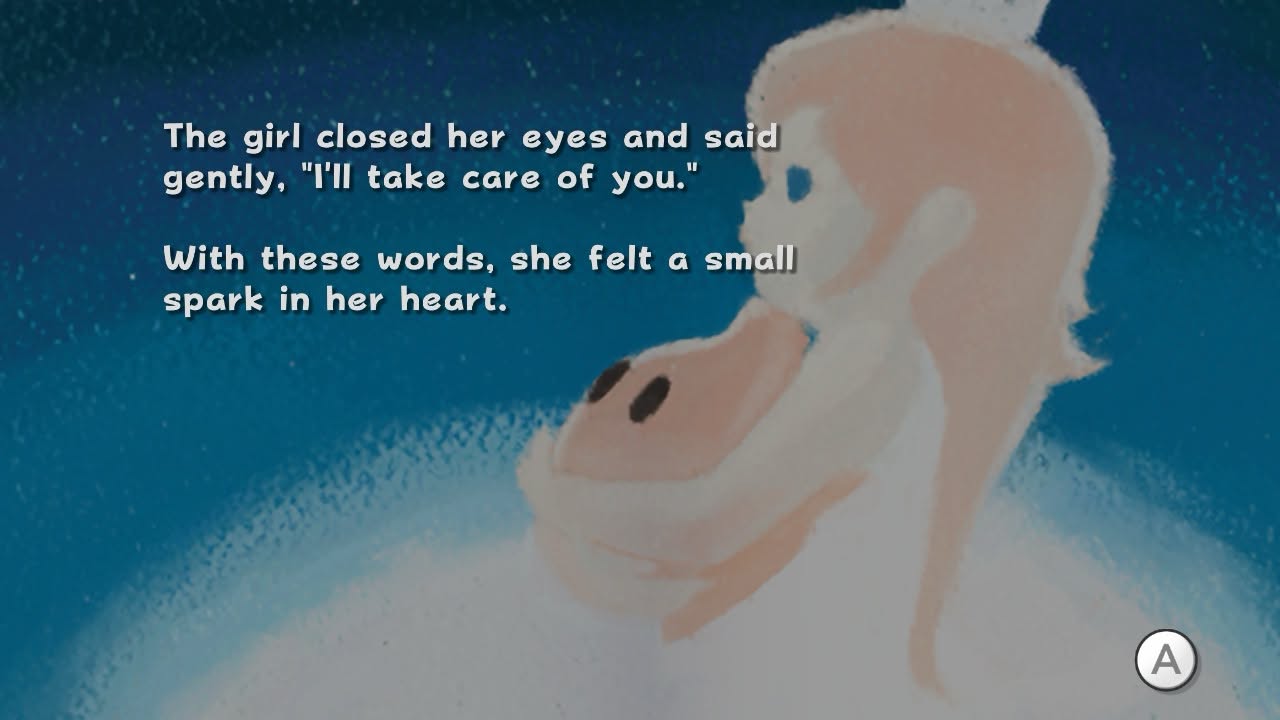
Despite how straightforward the game’s premise is, Super Mario Galaxy is often regarded as having one of the best stories in the entire series. To be fair the main plot is almost non-existent once Mario has his commission to find the Power Stars, but the game includes a library in which Rosalina will read the Lumas a storybook that details how she became their comet surfing mama. It’s very rare for any character in the Super Mario series to get any sort of elaboration on their origins, so for Rosalina to get a proper backstory(and a tragic one at that) gives the game a sense of depth that Super Mario has never seen before or since. Don’t get me wrong, the game is still very light on story, but Rosalina’s storybook absolutely elevates the experience and I am shocked this didn’t become a regular feature in Super Mario moving forward.
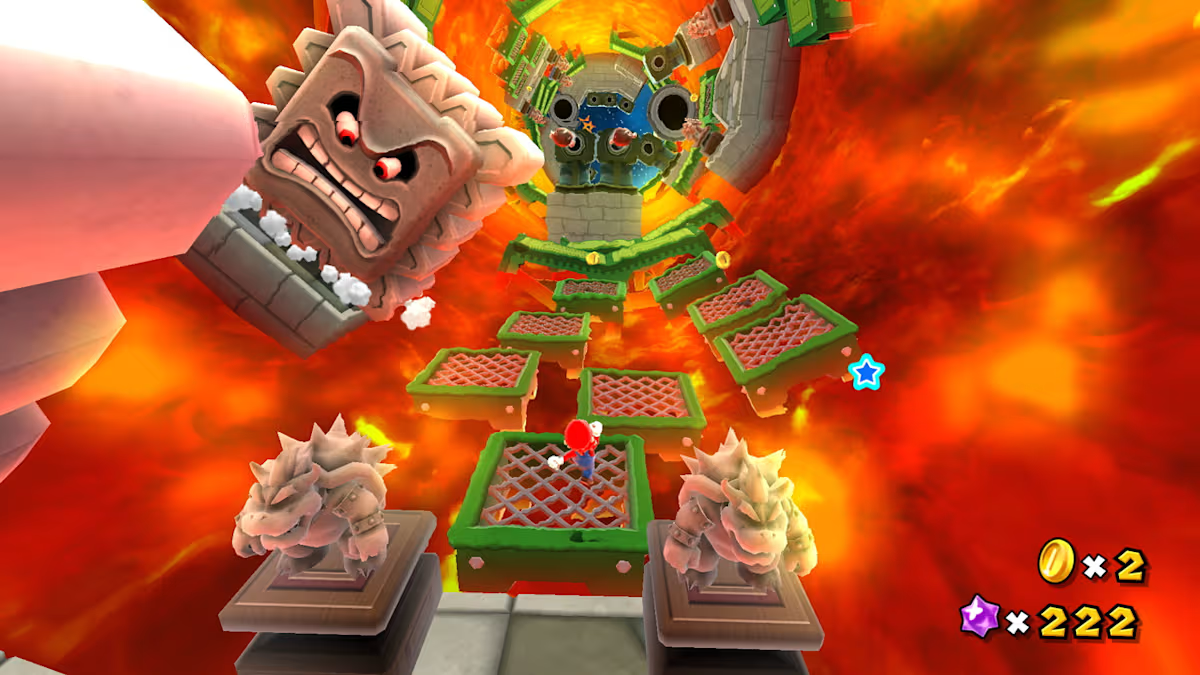
The floor is lava! The walls are lava! THE CEILING IS LAVA!!!
Presentation wise Super Mario Galaxy has aged very well. Super Mario’s cartoon sensibilities have always been visually evergreen no matter the hardware and two decades later Super Mario Galaxy still looks great with its vibrant colors, lively animations, and creative environments. The soundtrack is even better due to the utilization of a full orchestra to capture the grandeur of space while still retaining the catchy melodies characteristic of the series music. Voice acting is sparse but effective and the sound effects have a lot of impact across the board. Whatever technical limitations the Wii might have had, Super Mario Galaxy transcends pretty much all of them.
Super Mario has always been a gameplay first experience and Super Mario Galaxy is no exception. Mario’s movement abilities in 3D environments have always been very robust with moves like the long jump, triple jump, wall jump, somersault, and backflip all returning from previous games and they all still feel great to use. Mario’s new technique is the Spin Attack, which can stun enemies or give extra airtime in the middle of a jump. The Spin Attack compliments Mario’s abilities nicely, especially in the unique level design offered by the space setting.
Levels in Super Mario Galaxy take place on small planetoids that offer different challenges for Mario to overcome as the player hops between them. These challenges are often centered around the game’s dynamic gravity system which allows Mario and his adversaries to traverse walls, ceilings, and bizarrely shaped structures. The movement, level design, and setting all come together to create some of the most creative and interesting levels in the entire Super Mario series, at least for the first two-thirds of the game.
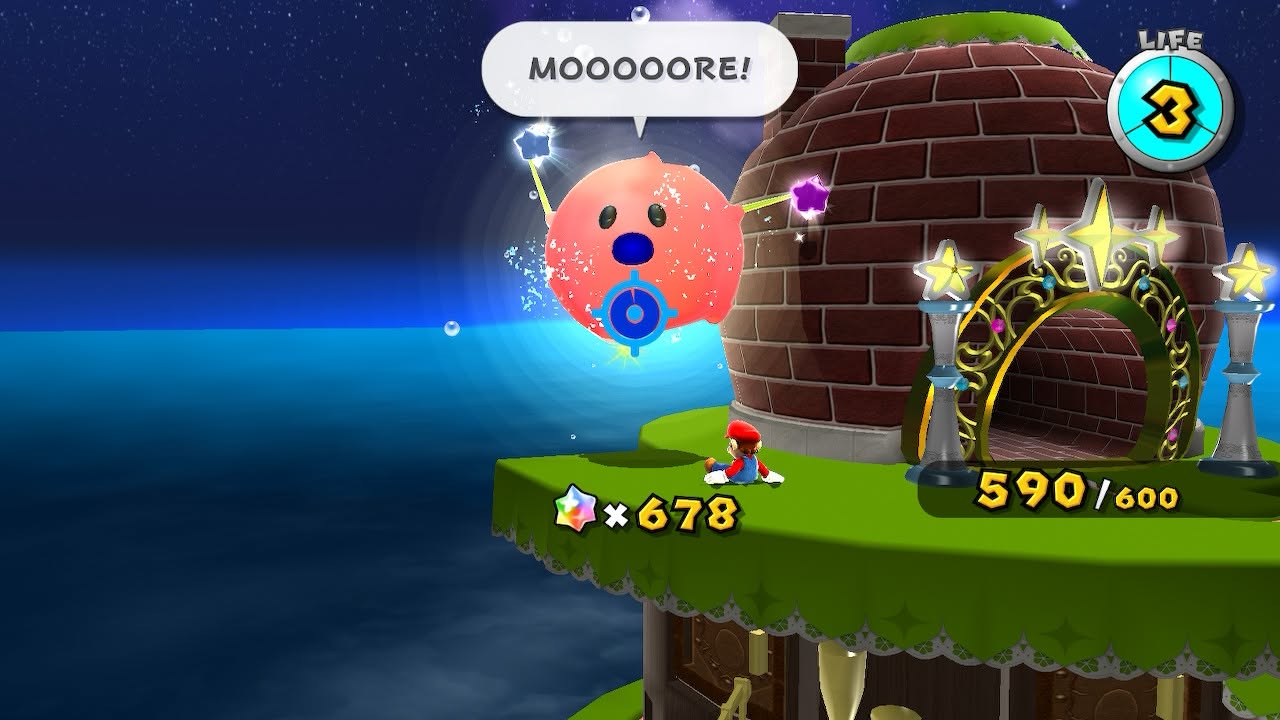
His greed sickens me.
The first 4 worlds in the game, consisting of the terrace, fountain, kitchen, and bedroom, are a near continuous stream of imaginative levels. Unfortunately, the last 2 worlds, the engine room and garden, run out of steam and consist mostly of reused assets without meaningfully expanding on the associated mechanics. These later levels can still be fun to play, but if you’re trying to marathon your way through all the levels in the game it starts to feel very repetitive. There are also Prankster Comet challenges that shake up the typical rules of the game, such as asking players to finish a level within a time limit or defeat a boss without taking damage. Prankster Comets provide a boost in difficulty to a game that is admittedly not particularly challenging, but they can contribute to the repetitive nature of the game’s latter third.
As for the Catholic perspective on Super Mario Galaxy, Rosalina’s backstory provides a unique opportunity for spiritual insight in a Super Mario game. In Rosalina’s storybook we find a heart wrenching tale about a little girl who attempts to satisfy her longing to see her deceased mother again by helping a lost Luma find its mother, but ultimately finds closure by taking on the responsibility of motherhood herself when it becomes clear their search is in vain. As tragic as Rosalina’s origin is, it’s a beautiful reminder of the dignity of motherhood we need in today’s secular culture which relentlessly scorns it. Being a mother is an act of self-sacrificing love, because raising a child requires a woman to devote her blood, sweat, and tears to her children so they can grow up to be healthy, self-sufficient adults. Many secular people have a hard time accepting a life where they aren’t the primary beneficiaries of their life’s work, but Christ’s willingness to die for our sins shows us that self-sacrifice for the sake of others, especially our children, is the only way of life that can truly satisfy our souls.
Unfortunately, this deeply moving triumph of motherhood through Rosalina has been squandered by Nintendo ever since. Rosalina’s storybook was originally created in secret by Super Mario Galaxy’s director Yoshiaki Koizumi, because the game’s producer, Shigeru Miyamoto, is notoriously anti-story and probably would have shot the idea down if Koizumi didn’t approach him with a finished product as proof of concept. While I respect Miyamoto’s dedication to making games that are above all else fun to play, I vehemently disagree with his assertions that story is so unimportant that it’s practically non-existent. No where is Miyamoto’s hubris more pronounced than the previously mentioned Super Mario Galaxy movie, which he was heavily involved in creating and by all accounts is receiving major backlash from audiences for its lack of narrative depth. Miyamoto can put Mario, Rosalina, and Fox McCloud in as many movies as he wants, but if he can’t use those characters to teach children something meaningful about the human condition I will never watch them of my own accord.
Super Mario Galaxy is a game I’m happy to say still holds up beyond my childhood memories. The level design is incredibly fun and imaginative, it looks and sounds wonderful even compared to more technologically advanced successors, and a memorable story about motherhood is the cherry on top. The repetitive final third of the game holds it back from being a true masterpiece, but a near perfect game is still an achievement worth celebrating. So if you’ve never played Super Mario Galaxy or are on the fence about replaying it, I promise you it’s a game worth your time. God bless and see you in the cosmos!
Scoring: 96%
Gameplay: 5/5
Visuals: 5/5
Sound: 5/5
Story: 5/5
Replayability: 4/5
Morality/Parental Warnings
Violence: The game features slapstick violence on cartoon creatures and machines.
Occult: Some characters and enemies have magic powers, but no rituals or incantation are present. Some enemies are undead creatures like ghosts or reanimated skeletons. Mario can also turn into a ghost using the boo mushroom power-up.