
The run-and-gun game is a genre with historic roots in the arcade era of video games, but one that hasn’t retained a steady presence as the medium evolved. Famous series such as Contra and Metal Slug live on more as brands through spinoff games instead of retaining regular core series, but looking at their overall design it’s not hard to see why this is the case. Run-and-gun games are quarter munchers through and through, designed with high difficulty to coax cash out of players who just wanted to see a little more of the game’s content, rather than being the most tightly designed gameplay experiences. Where the disappearance of a genre leaves a gap however, you can be sure an indie developer will come along and try their hand at reimagining the genre in a new way. Today’s title is one such challenger to the task, and I’m going to examine if its aim was true!

Developed by Zenovia Interactive, published by Retroware, and released in November of 2025, Neon Inferno is a side-scrolling action shooting game available on Nintendo Switch 1 and 2, PS4, PS5, XBox One, XBox Series X|S, and Steam. Its premise involves two mafia hitmen picking off targets in a dystopian metropolis amidst great underworld struggle. Players interact with the game by traversing and shooting their way through linear action stages, perusing power-up shops, and watching a few cutscenes. Please note that the Steam version was used in the making of this review.
The story of Neon Inferno takes place in the year 2055 in a dystopian, cyberpunk-esque New York City and follows the exploits of Angelo Morano and Mariana Vitti. In this setting New York has been a veritable battleground for thirty years between various underworld groups like the yakuza, a corrupt police department, and megacorp cyborg bounty hunters. Angelo is the adoptive son of the leader of The Family, a conglomerate of the old mafias of European lineage, and Mariana was a bored urbanite who joined The Family after a chance encounter led to her and Angelo dating. Together the two are the most lethal of the mafia’s hitmen, but each hero numbs the pain of their dark work in their own way, and secretly longs to leave the city behind. The storytelling on offer is carried mostly by the context paragraphs outside the game, as well as a few cutscenes scattered about the campaign. From an objective standpoint it’s pretty clear that in order to make the independent budget work that Neon Inferno went light on narrative, and while I think what story it has is mostly good, there just isn’t that much to chew on for the average player. I certainly found stuff to uniquely appreciate about it, but for most the story will be just a vessel for the rest of the game.
Stepping onto the streets of New York, the game should feel familiar to enjoyers of classic run-and-guns. You run along a 2D plane, can fire steady streams of bullets in one of eight directions, do some platforming, and mow down enemies in your quest to take out the boss of the stage. Where Neon Inferno immediately sets itself apart is in its rear ground mechanic, where you can fire into the background of a stage at any time with the press of a button. Gallery shooter segments in this genre aren’t unheard of, but here it’s woven into the gameplay loop seamlessly and creates great moments where you have to balance fighting enemies in both the foreground and rear ground at the same time. The rear ground firing reticle is also initialized at your current location, so there is strategy in choosing to begin shooting immediately and guiding your spray over to the enemy, or positioning in front of your target to land shots right away. It can be understood as more of a contextual mechanic in some ways as you’re never going to use the button without a rear ground target to shoot at, but when it’s implemented so regularly and naturally I can hardly call that much of a problem.
The other major mechanic is the plasma knife, a melee attack option. On harder difficulties this adds space for enemies you’re intended to melee in order to defeat, but the real addition it brings is a bullet deflection. Green-colored bullets and grenades can be swiped with the plasma knife to send back to their attacker, which serves as a nice alternative to just holding down the shoot button the entire time. It’s not a hard technique to use, but satisfying all the same. However, if you hold the melee button after doing a deflect you’ll enter into a slow-down which allows you to redirect these bullets for more damage, even more so if sending them to the background, and that’s where the mechanic really starts to shine. Due to the damage bonus players can take the risk of leaving weaker enemies alive in order to redirect their shots into tougher foes, meaning the skill expression you can achieve with this is truly next-level. There is a limit to the number of times you can use the slow-down thanks to an energy meter, but a player who understands how to manage it properly will still wipe the floor in style. I’m not even that good with it, but I can totally see how much more to learn there is when taking the technique into account.

If all these flashy mechanics make the game sound too easy, rest assured that Neon Inferno does not pull punches. The game features three core difficulty settings so you don’t have to make clearing the story challenging if you don’t want to, but the ranking system caps at 3 out of 5 stars on Easy and Medium difficulties so Hard is definitely the intended experience after you get the game practiced. You can use the easier difficulties to get familiar with New York’s many perils for sure, but the true Hard mode playthrough will send more enemies, with more difficult counterplay, and sometimes even slightly randomized patterns to prevent pure memorization. Zenovia certainly wasn’t stubborn enough to gate off their game’s content through forced difficulty, but if you want the inferno to live up to the name then it will gladly oblige. Don’t even let me tell you about the Arcade difficulty mode with the player having only one hit point and no checkpoints! In between stages of the campaign you’re also able to buy powerups using the money that serves as a soft points system. These are manually activated mid-stage, and usually switch your weapon’s firing pattern for a limited number of shots. You can temporarily enjoy flaming shots, homing shots, a faster fire rate, and so on. This can help flavor your run of the campaign a bit, though the limited ammo count makes these powerups a bit tough to use with fun abandon. Plus it can be hard to want to experiment with some of the more inherently damaging gear when Chaser Shot is so cheap and can ease your mental load in a firefight.
Beyond the main campaign, there isn’t too much to do in Neon Inferno. Aside from the Arcade difficulty, there’s a recently released score attack mode which allows you to replay the campaign with a hard points system that incentivizes risky and stylish maneuvers, and a replay mode that allows you to run through any stage of the campaign on any difficulty you wish. No real side modes with unique content to sink your teeth into here, though I’m inclined to give the game a pass. The core stages are already quite fun and varied in terms of the mechanics they play around with which I won’t spoil here, so being able to revisit my favorites without playing the whole game again is far from a bad thing.
Visually speaking, Neon Inferno looks excellent. It’s no secret to anyone who has played classics like Metal Slug X that quality sprite-work is a must to do this genre of game justice, and this game does not skimp on meeting that standard. It really is the little things that bring the game’s visuals together, like how an overturned table leaves believable debris when shot enough times or how an enemy killed on a staircase will physically roll all the way down to the floor below. The broad strokes are of course no less impressive, with expressive character animations for your foes and some great environment design to traverse as you make your way through the stages. I don’t want to oversell the environment variety in a purely urban setting like New York, but there’s still plenty to appreciate like shopping streets abuzz with neon signs, desolate warzones wreathed in endless flame, and luxury establishments decked out with expensive furniture among others. The cutscene artwork is great at giving us a more intimate look at key moments in the story, though I do have a minor complaint with their consistency. As the dual protagonists might imply the cutscenes typically feature variations to account for whoever is player one during the campaign, and for the most part it’s nice to see the slight changes based on your selected hitman, but they clearly forgot about this detail in some areas. For instance in the first cutscene you might notice that Mariana has a colorful smartphone to better sell her more upbeat personality and materialistic mask, but in the opening to the mission Fatal Overture her phone is the factory model that Angelo has if you pay close attention. Noting game-ruining of course, but I’d be lying if the game’s otherwise sharp eye for detail made this oversight pretty noticeable.
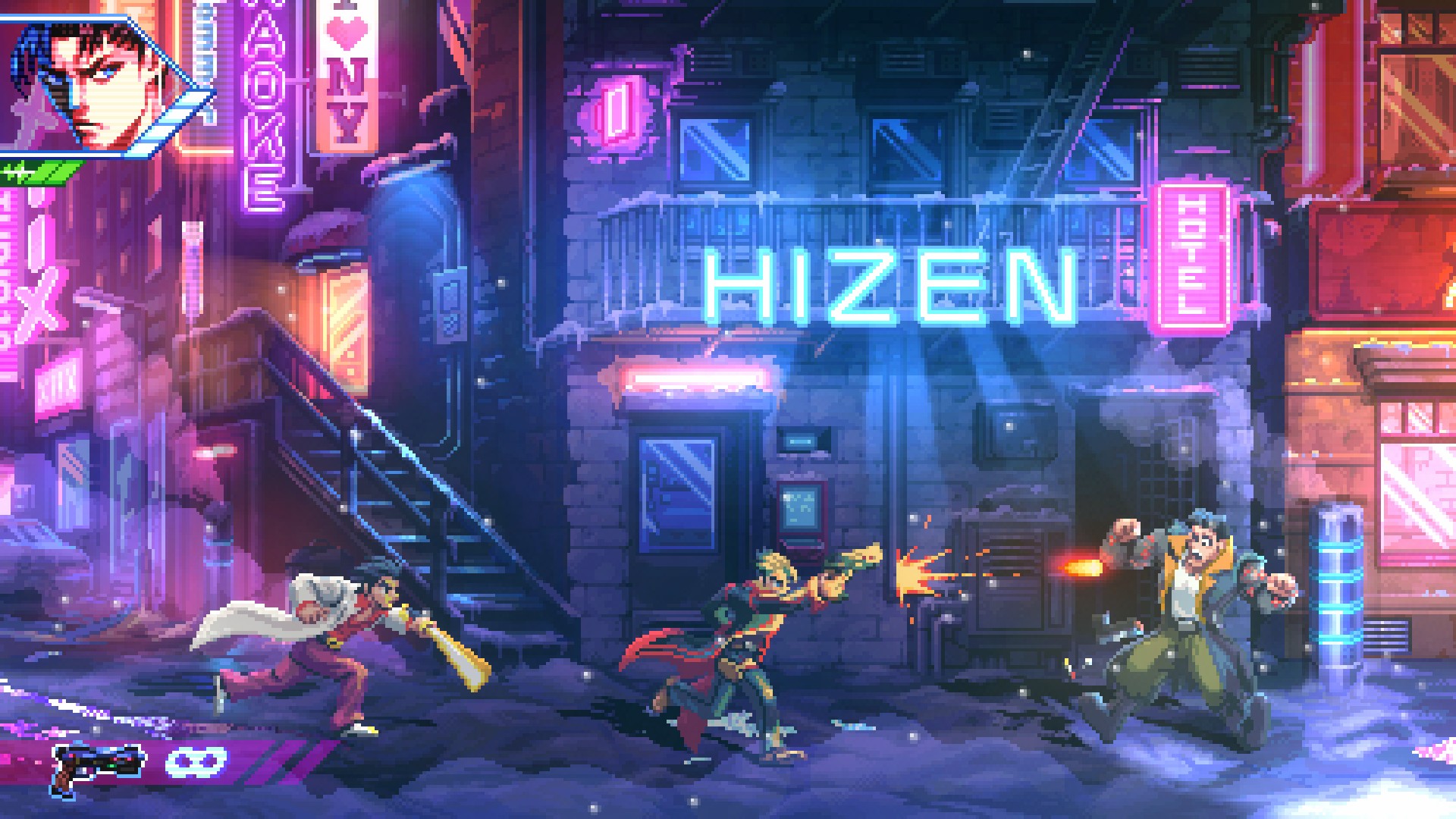
The music of Neon Inferno is also notable for the sheer confidence of its variety. Cyberpunk EDM might seem like the name of the game and there’s definitely a strong presence of synth in the soundscape, but it just as comfortably busts out into pulse-pounding rock to great results. It’s a soundtrack that has been carefully tailored to fit the mood of whatever stage it plays over, to the point where if you’re passing above a live opera house performance you’ll fight to the tune of classical music! Compared to the visuals I won’t say that I noticed the music as much in the moment-to-moment gameplay, probably thanks to the din of gunfire, but taking a bit to revisit the OST on its own revealed quite a well made soundtrack indeed.
Lastly for the game’s Catholic takeaways, it does have to be admitted that on the surface the Neon Inferno does considerably less with its religious references than one would expect considering one of its protagonists wears a cross and the opening crawl directly quotes Dante’s most recognizable work. In many ways the reference to Inferno serves more as an allusion to help characterize 2055 NYC as a truly miserable place than anything, but add in any whiff of Christian symbolism and I’m going to take it as far as it can go! While New York may not literally be Hell, it is certainly well characterized as a place that will destroy your soul due to how deep the roots of evil and corruption are. Angelo makes for a great protagonist precisely because he lives on the bleeding edge of rejecting this debased city; grappling with the tension between faith that spurs him to leave everything behind, and a ‘Family’ he owes a life debt to that asks him to kill in their name. Mariana might on the surface seem like Angelo’s polar opposite in as much as she copes with her situation by indulging in the city’s vices, but her pink accents and big heart-shaped earrings reflect how important her love for Angelo is to her. If we’re to read her love as an authentic one, then it stands to reason that she would be willing to help Angelo leave NYC behind given the opportunity, for the sake of that love. How very transformative Love can be, yeah?
After many missions undertaken together, they finally get their chance to seek liberation when the betrayal of the Don looses the pair from any obligations they might have felt towards the mafia. Following their cutting of ties, the end of the game seems to reinforce the bleakness of the cyberpunk genre by focusing on the heroes’ uncertainty in now facing a life of watching their backs, but eyes of faith suggest something a bit more hopeful. In finding their way out of the Inferno, Angelo and Mariana may not have escaped a life of hardship yet, but freed from the temptations and abused filial piety that drowned them in sin, they can at least strive towards a more virtuous life from there on out. The stains of their sins may have only won them a Purgatorio, but the silver-lining is then when thrust into the flames of purification, they can only go up from there. For our part the best inspiration to take from this game is one of hope, as every breath we take in is proof we are still alive and capable of finding the path God wants us to walk to fulfill His plan for our lives. We may have baggage and past sins that affect this path sure, but ultimately even these can be conquered through humble acknowledgement that Christ’s mercy and sacrifice is bigger than our mistakes. There is no living hell mankind can create which we have no hope of escaping from, not now or ever.
In conclusion, Neon Inferno is a small but well-made game featuring well-paced and challenging gameplay and strong art direction from start to finish. It may not be the most fleshed out package and its heavier subject matter limits its reach somewhat, but older gamers looking for something arcadey might find more to like here than expected. It goes to show that old genres can still impress with just a little creativity from those who seek to evolve them, and sometimes learning from your roots is for the best. Now if only we could learn how to make light-gun games work at home without it being so expensive…
Scoring: 80%
Gameplay: 4/5
Story: 3/5
Art and Graphics: 5/5
Music: 4/5
Replayability: 4/5
Morality/Parental Warnings
Neon Inferno’s core mature element is the core gameplay’s violence. Blood is spilled whenever a non-mechanical enemy is killed, and bosses tend to get a more dramatic bleed-out to cap off their encounters. Most battles involve pistols, knives, bombs, etc. Most characters involved in the game are criminals of some stripe, be they mobsters, yakuza, corrupt police officers, or corporate cyborgs. The main characters themselves are hitmen, and are deployed for missions such as assassination and backing up other mobsters on drug runs. Characters are often depicted smoking. Female characters typically show some degree of skin, with Mariana being present throughout the campaign if you choose to play as her and other female characters making minor appearances in stage backgrounds or short cutscenes. The game’s world explores themes of corruption, debauchery, cyberpunk dystopia, and loyalty. Angelo wears a cross around his neck at all times even while ‘working’, though it’s meant to represent the conscience he still has and his desire for atonement. One of the two shopkeepers refers to the cops as “pigs” in one of her item descriptions, and while the police are genuinely corrupt in this setting, I did want to mention it here due to how loaded that term is.